The M.Tech Environment Engineering syllabus focuses on advanced engineering approaches for managing water and wastewater, air pollution, solid and hazardous waste, Environment assessment, climate change and sustainable development. The two-year postgraduate programme combines core theory with laboratory-oriented subjects, electives, research work, projects and industry exposure.
The curriculum also introduces students to Environment monitoring, modelling, risk assessment, remote sensing, GIS, Environment management and green technologies. At Delhi Technological University (DTU), the current scheme includes three semesters of taught/project-oriented work followed by a major project, while University’s programme also includes professional electives, an internship, minor project and dissertation. The syllabus therefore supports careers in Environment engineering, pollution control, consulting, sustainability, research and Environment management.
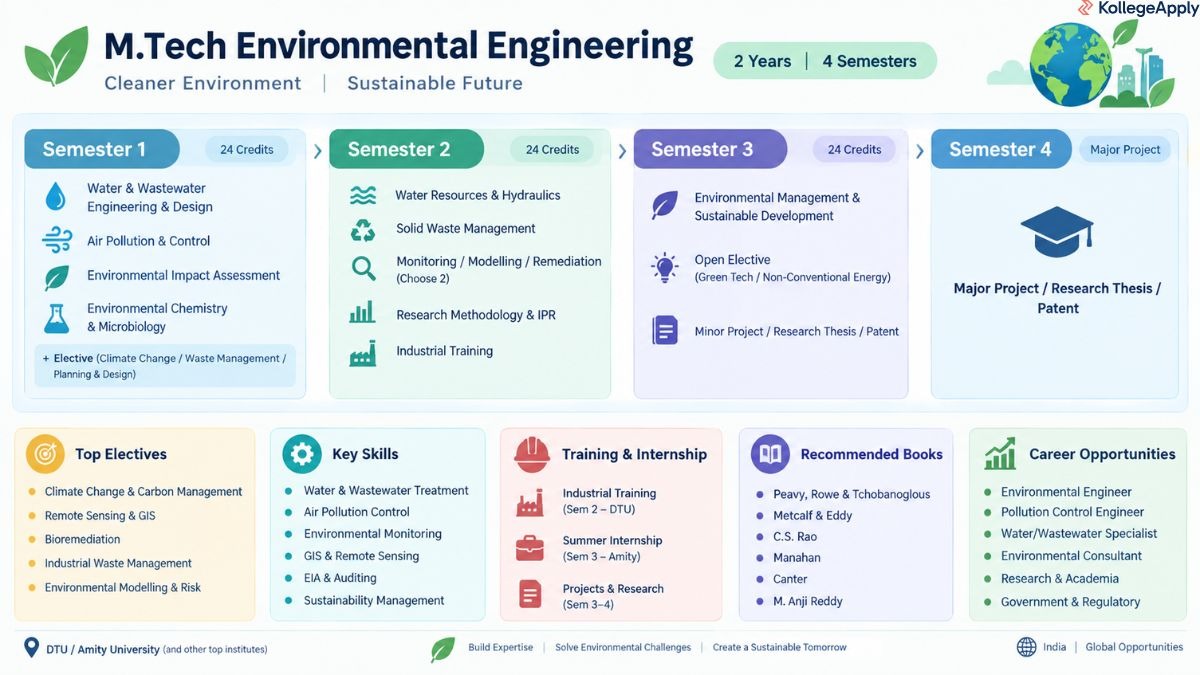
Table of Contents
- M.Tech Environmental Engineering Syllabus Semester-Wise
- M.Tech Environmental Engineering Syllabus in Private University
- Electives in M.Tech Environmental Engineering Syllabus
- Practical Training / Internship in M.Tech Environmental Engineering
- Skills Developed Through M.Tech Environmental Engineering Syllabus
- Higher Studies After M.Tech Environmental Engineering
- Books for M.Tech Environmental Engineering Syllabus
- FAQs on M.Tech Environment Engineering Syllabus
M.Tech Environmental Engineering Syllabus Semester-Wise
The DTU M.Tech Environmental Engineering syllabus is structured around core environmental engineering subjects and specialised electives. The first two semesters build expertise in water, air, waste, environmental assessment and monitoring, while the third semester moves towards sustainability, green technology and research. The fourth semester is dedicated to major projects or research work.
M.Tech Environmental Engineering Syllabus at DTU
DTU assigns 24 credits each to Semesters I and II, followed by Environmental Management & Sustainable Development and an open elective in Semester III, along with a minor project/research thesis/patent. Semester IV carries the major project/research thesis/patent.
Semester 1: M.Tech Environmental Engineering Subjects
The first semester establishes the engineering foundation of the programme. Students study water and wastewater treatment, air pollution control, environmental impact assessment and environmental chemistry and microbiology. The semester also introduces climate change, industrial waste, environmental planning and occupational safety through electives and skill-oriented coursework.
The DTU syllabus specifically includes treatment-plant design, sewer design, CETPs, zero-liquid-discharge concepts and reactor design in the water and wastewater course. Air pollution coursework covers Gaussian plume dispersion, pollution-control equipment, air-quality legislation and noise mapping.
Semester 2: M.Tech Environmental Engineering Subjects
The second semester expands the syllabus into water resources, solid waste, environmental monitoring and advanced analytical methods. Students can also study hydraulic structures, contaminated-site remediation, environmental modelling, bioremediation or GIS and remote sensing, making this semester particularly relevant for technical and research-oriented careers.
DTU’s environmental monitoring syllabus includes environmental sampling, QA/QC, laboratory instrumentation, spectrophotometry, chromatography, SEM/TEM, remote sensing and environmental statistics. Its modelling elective introduces air-quality, surface-water and groundwater models together with risk assessment.
Semester 3: M.Tech Environmental Engineering Subjects
The third semester shifts from individual pollution-control technologies towards broader environmental management and sustainability. Students examine environmental management systems, environmental law, sustainable development and energy-environment relationships while undertaking an open elective and substantial project or research work.
Semester 4: M.Tech Environmental Engineering Subjects
The fourth semester is research and project intensive. DTU’s scheme assigns the final semester to a Major Project/Research Thesis/Patent, allowing students to apply the technical concepts developed during earlier semesters to a substantial environmental engineering problem or research topic.
M.Tech Environmental Engineering Syllabus in Private University
Private-university curricula generally retain the core environmental engineering areas while adding multidisciplinary and industry-oriented subjects. Amity University’s official Noida course structure includes environmental chemistry and microbiology, water-treatment design, wastewater engineering, environmental facilities, industrial waste management, computational methods, geomatics, AI tools, climate change, environmental legislation and air-pollution modelling.
M.Tech Environmental Engineering Syllabus at Amity University
Amity lists the programme as a two-year M.Tech Environmental Engineering degree at its Noida campus. Its official course page also specifies eligible engineering and environmental-science backgrounds and includes a personal-interview selection process.
The private-university syllabus demonstrates a broader multidisciplinary approach, with subjects such as AI Tools and Applications, computational methods, geomatics, carbon management and professional development alongside conventional environmental engineering subjects.
Electives in M.Tech Environmental Engineering Syllabus
Electives allow students to develop expertise in a particular environmental engineering area instead of studying only a common set of subjects. DTU offers options spanning climate change, environmental services, industrial waste, monitoring, remediation, modelling, biotechnology, GIS and renewable energy, while Amity includes electives covering modelling, EIA, geomatics, biotechnology, climate change and air pollution.
Important Elective Areas
Climate Change and Carbon Management: Covers greenhouse gases, climate mitigation, adaptation, carbon accounting and carbon-management approaches.
Environmental Modelling: Introduces mathematical and numerical approaches for air, surface-water and groundwater pollution modelling.
Remote Sensing and GIS: Develops spatial-analysis capabilities for environmental monitoring, land-use mapping, water resources and resource management.
Bioremediation: Covers microorganisms, biodegradation, phytoremediation, biosorption and biotechnology-based treatment approaches.
Industrial Waste Management: Focuses on waste characterisation, pollution prevention, industrial wastewater, solid waste and industrial air emissions.
Practical Training / Internship in M.Tech Environmental Engineering
Practical exposure is an important part of the M.Tech Environmental Engineering curriculum because students must connect environmental engineering theory with monitoring, treatment, modelling and project applications. DTU includes industrial training in Semester II, while Amity places a summer internship and minor project in Semester III.
Practical work may involve water and wastewater analysis, environmental monitoring, pollution-control studies, GIS mapping, laboratory analysis, waste-management assessment, environmental audits, modelling or field-based research, depending on the institute and project selected.
Skills Developed Through M.Tech Environmental Engineering Syllabus
The syllabus develops a combination of environmental engineering, analytical, computational, research and management skills. The DTU curriculum particularly connects treatment-system design with environmental monitoring, modelling, remote sensing, risk assessment and sustainability, while Amity adds computational methods, AI tools and professional-development components.
Higher Studies After M.Tech Environmental Engineering
Students interested in research can pursue doctoral studies after M.Tech Environmental Engineering. The DTU syllabus itself includes research-oriented components such as research methodology, minor research thesis, major research thesis and patent work, providing a pathway towards specialised research.
Books for M.Tech Environmental Engineering Syllabus
The most useful books for M.Tech Environmental Engineering should match the subjects being studied rather than being selected only for general environmental science. DTU itself provides recommended references covering water treatment, air pollution, EIA, environmental chemistry, waste management, monitoring, modelling, GIS and sustainability.
Books for Environment Engineering Preparation
For water and wastewater subjects, students can prioritise Peavy, Rowe and Tchobanoglous along with Metcalf & Eddy. For air pollution, C.S. Rao and related air-pollution-control texts are useful. EIA preparation can be supported by Canter, while GIS students can refer to M. Anji Reddy. These books correspond closely with the subject areas listed in the DTU syllabus.
FAQs on M.Tech Environment Engineering Syllabus
What is the M.Tech Environment Engineering syllabus?
It covers water and wastewater, air pollution, EIA, waste management, Environment monitoring, modelling, GIS, sustainability and research.
How many years is M.Tech Environment Engineering?
M.Tech Environment Engineering is generally a two-year postgraduate programme divided into four semesters.
What are the main M.Tech Environment Engineering subjects?
Core subjects include water and wastewater engineering, air pollution control, EIA, Environment chemistry, waste management and sustainability.
Does the syllabus include Environment modelling?
Yes. DTU includes Environment Modelling and Risk Assessment, covering air, surface-water and groundwater modelling.
Is GIS included in M.Tech Environment Engineering?
Yes. Remote Sensing and GIS is offered as a specialised elective in the DTU syllabus.
Does M.Tech Environment Engineering have practical training?
Yes. DTU includes industrial training, while Amity includes a summer internship and project-based practical exposure.
What electives are available in Environment engineering?
Options include climate change, industrial waste, bioremediation, Environment monitoring, GIS, modelling, remediation and green technology.
What skills does the M.Tech Environment Engineering syllabus develop?
It develops treatment-design, pollution-control, monitoring, modelling, GIS, research, risk-assessment and sustainability-management skills.
What can I do after M.Tech Environment Engineering?
Graduates can work in Environment engineering, consulting, pollution control, water, waste management, sustainability and research roles.
Which books are useful for M.Tech Environment Engineering?
DTU recommends books on water, air pollution, EIA, waste, Environment chemistry, monitoring, modelling, GIS and sustainable development.