M.Tech in Food Technology is a two-year postgraduate programme that combines food science with engineering, processing, preservation, quality, safety and product development. The syllabus generally progresses from advanced food technology concepts and laboratory work to research, seminars, projects and dissertation work. The exact subjects and electives can vary by university.
The M.Tech in Food Technology syllabus also gives importance to practical learning and research. Sharda University’s 2026–27 curriculum includes food storage and plant layout, new product development, food chemistry, dairy technology, food packaging, food biotechnology and processing subjects, along with laboratory courses and a two-stage dissertation. Amity University’s structure similarly combines core subjects, electives, common curriculum courses, seminar, internship and major project work.
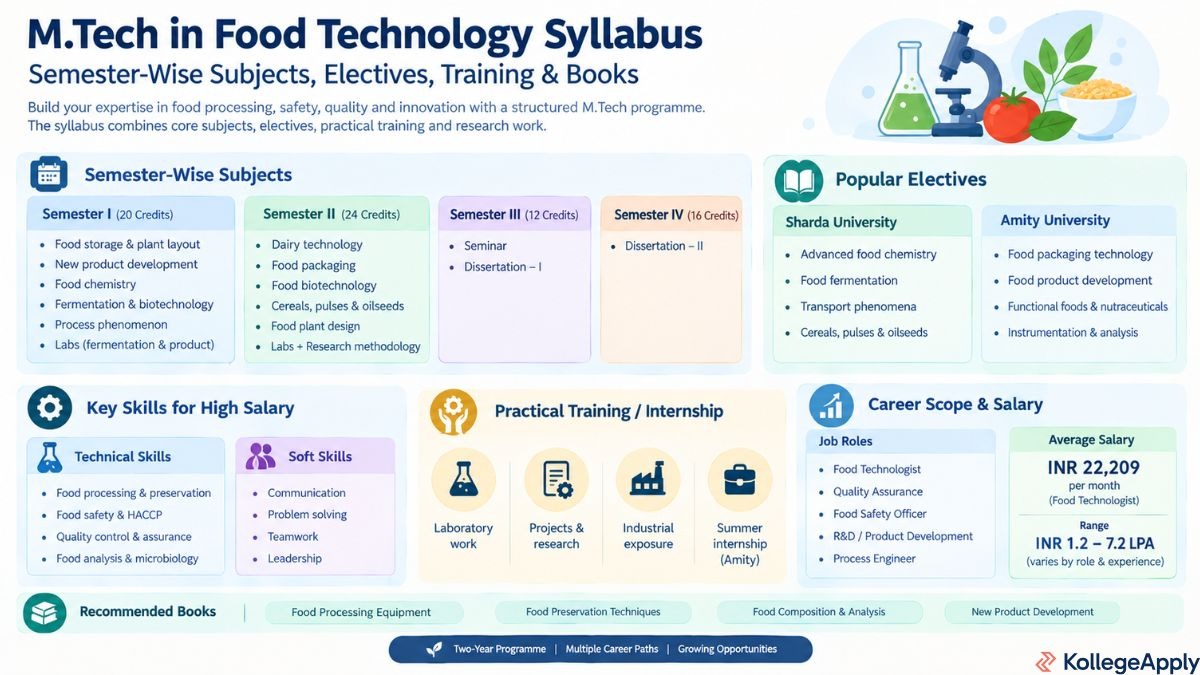
Table of Contents
- M.Tech in Food Technology Syllabus Semester-Wise
- M.Tech in Food Technology Syllabus in Private University
- Electives in M.Tech Food Technology Syllabus
- Practical Training / Internship in M.Tech Food Technology
- Skills Developed Through M.Tech Food Technology Syllabus
- Career Scope After M.Tech Food Technology
- Books for M.Tech Food Technology Syllabus
- M.Tech Food Technology Syllabus FAQs
M.Tech in Food Technology Syllabus Semester-Wise
The semester-wise M.Tech Food Technology syllabus covers core food processing concepts, specialised electives, laboratory work and research activities. Sharda University’s 2026–28 batch curriculum has a total of 72 credits, distributed across four semesters, with the final two semesters focused substantially on seminar and dissertation work.
Note: Sharda University M.Tech Food Technology curriculum for the 2026–28 batch.
Semester I
The first semester builds the foundation for advanced study in food processing and product development. Students study food storage, plant layout, new product development and food chemistry while also undertaking electives and practical laboratory work related to fermentation and product formulation.
The Sharda curriculum assigns 20 credits to Semester I. It combines classroom-based courses with laboratory components, allowing students to connect food science concepts with product development and processing applications.
Semester II
The second semester expands the syllabus into specialised food processing areas such as dairy, packaging, biotechnology and cereals, pulses and oilseeds. It also introduces research methodology and several laboratory courses, increasing the practical and research orientation of the programme.
Semester II carries 24 credits in the Sharda curriculum. The combination of specialised subjects, four laboratory courses and research methodology gives this stage a strong technical and practical component.
Semester III
The third semester marks the transition from structured coursework towards independent academic and research work. At Sharda University, students complete a seminar and begin Dissertation-I, giving them an opportunity to apply food technology concepts to a defined research or technical problem.
The dissertation component can involve investigation, experimentation, data analysis and interpretation depending on the selected research area. Sharda’s curriculum states that the programme uses research projects and dissertation work to provide exposure to advanced food techniques and methods.
Semester IV
The fourth semester is primarily dedicated to completing the major research component. Sharda University lists Dissertation-II with 16 credits, making the final semester substantially research-oriented rather than based on conventional classroom subjects.
Note: The Sharda curriculum identifies Dissertation-II under Semester IV, although the following credit-total line contains a “Semester V” label. The semester-wise structure itself lists the programme across four semesters and totals 72 credits.
M.Tech in Food Technology Syllabus in Private University
Private universities may structure the M.Tech Food Technology syllabus differently while retaining common areas such as food processing, packaging, food engineering, product development and research. Amity University’s Noida course structure provides a useful example of how core subjects, electives, professional courses, internship and projects can be combined.
Amity University M.Tech Food Technology Syllabus
Amity University’s M.Tech (Food Technology) is a two-year programme offered through the Amity Institute of Food Technology. Its course structure includes core and elective subjects in the first two semesters, followed by seminar, internship and project-based components.
Amity’s structure shows that private-university M.Tech Food Technology courses can include both technical specialisations and professional-development components. Its curriculum places practical exposure, internship and project work alongside advanced food technology subjects.
Electives in M.Tech Food Technology Syllabus
Electives allow students to develop deeper knowledge in specific areas of food technology instead of following only a fixed set of subjects. The available choices differ between universities, so students should check the latest curriculum before selecting an elective or specialisation.
Sharda University (Electives / Elective Areas)
Amity University
Sharda’s curriculum identifies programme electives across the first and second semesters, while Amity distributes elective choices across the first three semesters. These subjects cover chemistry, biotechnology, packaging, processing, instrumentation, product development, nutraceuticals and waste management.
Practical Training / Internship in M.Tech Food Technology
Practical learning is an important part of the M.Tech Food Technology syllabus because food processing requires laboratory, analytical and process-oriented skills. Universities may provide this through dedicated laboratories, project work, industrial exposure or internships rather than through one identical training format.
For example, Sharda’s curriculum includes multiple laboratory courses and Dissertation-I and II, while Amity specifically lists a Summer Internship and minor project in Semester III followed by a major project in Semester IV.
Skills Developed Through M.Tech Food Technology Syllabus
The M.Tech Food Technology syllabus is designed to develop technical, analytical, research and professional abilities. Students gain exposure to food processing and safety while also learning to analyse problems, conduct investigations, work with modern tools and communicate technical findings.
The Sharda programme outcomes specifically emphasise engineering knowledge, problem analysis, design, investigation, modern tool usage, sustainability, communication, project management and lifelong learning. Its food-technology outcomes also cover food preservation, processing, food safety and quality assurance.
Career Scope After M.Tech Food Technology
The career scope after M.Tech Food Technology extends across food processing, quality assurance, food safety, research, agriculture, nutraceuticals and academic environments. The subjects selected during the programme can influence the type of technical work graduates are prepared to pursue after completing the degree.
Sharda University lists employment areas including agricultural sectors, academic institutions, food processing industries, nutraceutical and functional food, and R&D departments. Its listed job types include Food Safety Officer, Food Scientist, Food Analyst, Quality Assurance Engineer and R&D Coordinator/Executive.
Books for M.Tech Food Technology Syllabus
Recommended books can help students understand concepts beyond classroom notes and prepare for assignments, laboratory work and research projects. The exact reading list varies by subject, but the Sharda curriculum provides textbooks and references for areas such as food processing, preservation, product development and food chemistry.
The Sharda curriculum specifically lists works as textbooks or references for relevant courses. Students should prioritise the books recommended by their university or faculty because prescribed readings may vary by semester and course.
M.Tech Food Technology Syllabus FAQs
What is the duration of the M.Tech in Food Technology syllabus?
The M.Tech Food Technology programme is generally structured as a two-year postgraduate course divided into four semesters.
What are the main M.Tech Food Technology subjects?
Major subjects include food processing, food chemistry, dairy technology, food packaging, biotechnology, product development and food plant design.
Does M.Tech Food Technology include practical subjects?
Yes, practical work can include food packaging, dairy, fermentation, biotechnology and cereal processing laboratories, depending on the university.
Are electives included in M.Tech Food Technology?
Yes, universities may offer electives in food chemistry, biotechnology, packaging, product development, processing and other specialised areas.
Is internship included in M.Tech Food Technology?
Internship requirements vary by university. For example, Amity University includes a Summer Internship in its Semester III structure.
Does the M.Tech Food Technology syllabus include a dissertation?
Yes, research-oriented universities may include dissertation work. Sharda University has Dissertation-I in Semester III and Dissertation-II in Semester IV.
What skills does the M.Tech Food Technology syllabus develop?
It develops food processing, quality, safety, research, analytical, laboratory, project management and technical communication skills.
What can I do after studying M.Tech Food Technology?
Graduates can pursue roles in food processing, quality assurance, food safety, R&D, food analysis, nutraceuticals, academia and related sectors.
Which books are useful for M.Tech Food Technology subjects?
Useful books include titles on food processing equipment, preservation, food chemistry, food science, food composition and new product development.
Is the M.Tech Food Technology syllabus the same at every university?
No, Core areas may overlap, but subjects, electives, internships, projects and credit structures differ across universities.