
• Updated on 15 Oct, 2026 by Diksha Kumari
What's new?
NMAT Latest news and articles
NMAT score vs percentile refers to the analysis of the percentile students can get based on their exam score. A score above 250 in NMAT translates to a percentile of 98 and above. Meanwhile, NMAT scores between 233 and 249 give candidates a percentile between 90 and 98. NMAT score shows the marks obtained by candidates on a scale of 36 to 360. The NMAT percentile shows the percentage of test takers a candidate has performed better than.
NMAT score vs percentile helps candidates understand if they meet the cutoff criteria of B-Schools they are targeting. GMAC also publishes the percentile ranking on its official website. The NMAT marks vs percentile analysis is drawn from the same percentile ranking.
Key Summary:
- NMAT percentile refers to the percentage of students a candidate performed better than. For example, if a candidate has obtained 90 percentile, it means that the candidate has performed better than 90% of students.
- The total score in NMAT ranges from 36 to 360. This is derived by adding the scaled score of all three sections, including Language Skills, Quantitative Skills, and Logical Reasoning. Each of these is scaled from 12 to 120.
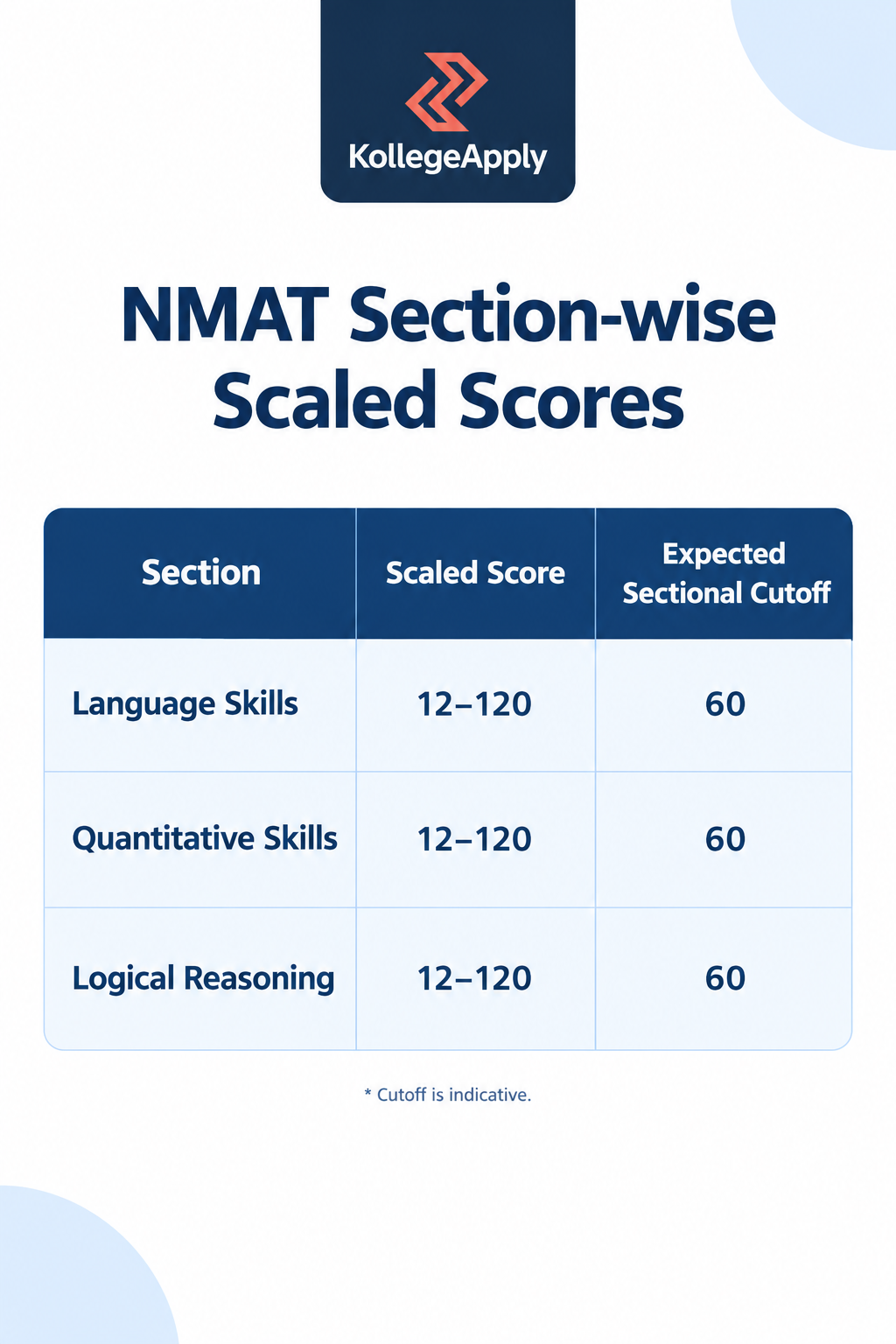
- Each NMAT section carries a scaled score ranging from 12 to 120, with an indicative sectional cutoff of 60 marks for each section.
- There is no negative marking in NMAT, so 0 score is given for incorrect or unattempted questions.
- The scaled cutoff score is used by participating B-Schools to shortlist students. For example, for NMIMS Mumbai, the NMAT cutoff ranges from around 208-210.
- For top management colleges, candidates should aim to score between 225 and 235 in the NMAT exam.
What Is NMAT Score vs Percentile?
NMAT score vs percentile is the analysis of the percentile obtained by candidates with respect to the score obtained in the exam. The NMAT score refers to the total score obtained by candidates in the NMAT by GMAC exam, on a scaled score of 36 to 360. Meanwhile, NMAT percentile refers to the percentage of test takers that a candidate performed better than.
- An NMAT percentile of 80 means that the candidate performed better than 80% of other test takers. This also means that 20% of test takers performed better than that candidate.
- A score above 250 in NMAT 2026 translates to a percentile of 98 and above.
- Meanwhile, NMAT scores between 233 and 249 give candidates a percentile between 90 and 98.
- NMAT score shows the marks obtained by candidates on a scale of 36 to 360.
Candidates should also check NMAT Exam Dates 2026 to avoid missing any important deadlines.
NMAT Score vs Percentile 2026 (Expected)
In NMAT, the higher the score, the higher the percentile. This is because a higher percentile means that candidates have scored better than that percentage of test takers. The lowest percentile in NMAT is below than 1, which is given to candidates who have scored between 36-100 in the exam. The table below provides an overview of the NMAT score vs percentile as per the percentile ranking published by GMAC.
*Note: The above analysis of NMAT marks vs percentile is based on 53271 sample size for the data period between November 5, 2025, and January 17, 2026.
NMAT Section-wise Scaled Scores
Each NMAT section carries a scaled score ranging from 12 to 120, with an indicative sectional cutoff of 60 marks for each section. There are three sections in the NMAT exam:
- Language Skills
- Quantitative Skills
- Logical Reasoning
Each of these sections has a scaled score of 12-120. However, this does not refer to the number of questions answered correctly or the percentage of marks obtained. For example, if a candidate has obtained the following NMAT score:
- This example shows that the candidate has scored above 60 in Language Skills and Logical Reasoning but below 60 in Quantitative Skills.
- This means the candidate meets the indicative cutoff in Language Skills and Logical Reasoning but falls short in Quantitative Skills.
- If the college requires a minimum score of 60 in all three sections, the candidate would not meet its sectional cutoff criteria.
NMAT’s scoring methodology is used to calculate the scaled score for each section. NMAT uses a computer-adaptive test format, so the NMAT Result 2026 is calculated on the basis of question difficulty as well as performance. Hence, the NMAT section wise scaled scores can be represented as:
NMAT Cutoffs 2026 (Expected)
NMAT cutoff refers to the minimum score candidates require to get shortlisted for admission. The cutoff varies depending on the type of institute, specialisation, category, and other factors. It is mandatory for candidates to score as per the cutoff to be eligible for admission. Candidates can check NMAT Cutoff 2026 to get the complete institute-wise cutoff score. Meanwhile, candidates can also check the expected NMAT cutoff 2026 from the table below:
How To Calculate NMAT Score?
NMAT total score is calculated by adding the scaled scores of all three sections. Each section in the NMAT exam carries equal weightage, with scaled scores of 12 to 120. The overall NMAT scaled score ranges from 36 to 360. NMAT score is calculated on the basis of the following formula:
Candidates can add the scaled score of all three sections to get an overall NMAT score. Note that the scaled score does not just depend on the number of questions answered correctly in the exam. The score is calculated on a model that includes the difficulty level of questions and the overall performance of candidates. For example, if a candidate has scored the following NMAT score:
Then, the overall NMAT score will be calculated as:
Hence, the candidate has obtained an overall score of 209 out of 360. As per NMAT score vs percentile, with a score of 209, the candidate will get around 62 percentile.
Candidates can checkNMAT Rank Predictor to predict their expected rank using exam score.
How Does the NMAT Computer-Adaptive Scoring System Work?
NMAT is a computer-adaptive test, which means the difficulty of subsequent questions can change based on a candidate's responses. The scoring process involves the following components when calculating the overall score:
This means that if two candidates have answered the same number of questions may not necessarily obtain the same score. The final score is analysed to manage the difference in difficulty level of the questions.
When is the NMAT Score Available?
Candidates will be able to view their test scores immediately after completing the NMAT exam. However, the official NMAT result will be available to download within 48 hours of the exam. Candidates will be able to check their NMAT scores by visiting the official website and logging in to their candidate’s dashboard.
Candidates can check NMAT College Predictor to predict which college they can get with their score.
How to Calculate NMAT Percentile?
The NMAT percentile refers to the percentage of candidates a candidate has performed better than. In simple words, it refers to the percentage of test takers who have scored lower than a particular candidate. NMAT score vs percentile can help candidates understand their relative performance compared to other test takers. A higher percentile in NMAT indicates better performance relative to other candidates and vice versa. While NMAT score ranges between 36 to 360, the percentile is allotted on a scale of 0 to 100. NMAT percentile is calculated on the basis of the following formula:
For example, if 100 candidates attempted the NMAT exam and 62 candidates scored lower than candidate A. Then the NMAT score vs percentile of that candidate will be calculated as:
The percentile of candidate A will be 62. This means that the candidate performed better than 62% of the test takers.
Factors Affecting NMAT Score Vs Percentile
The relationship between NMAT score vs percentile depends on how candidates perform in the exam and how their scores compare with those of other test takers. The following factors affect NMAT marks vs percentile:
What Do NMAT Score vs Percentile Indicate?
NMAT scores range from 36 to 360. A higher score generally corresponds to a higher percentile, although the exact relationship depends on the relevant percentile data. Based on the GMAC rankings referenced above, a score of 209 corresponds to the 62nd percentile, scores of 255–265 correspond to the 99th percentile, and scores of 266 or above fall within the above-99th-percentile range.
For NMAT 2026 admissions, the expected overall cutoff is around 209 for most of the programs listed above and around 190 for MBA Pharmaceutical Management. The expected sectional cutoff is approximately 60 in each section. These figures are estimates rather than confirmed admission requirements, so candidates should also check the specific cutoff criteria of their target institutes.
NMAT Score vs Percentile FAQs
What is the total score range in NMAT?
The NMAT total score ranges from 36 to 360. It is calculated by adding the scaled scores of the three sections: Language Skills, Quantitative Skills, and Logical Reasoning.
What is the scaled score range for each NMAT section?
Each NMAT section has a scaled score range of 12 to 120. The three sections are Language Skills, Quantitative Skills, and Logical Reasoning.
What percentile is an NMAT score of 209?
An NMAT total score of 209 corresponds to the 62nd percentile, according to the GMAC percentile rankings for November 5, 2025, to January 17, 2026.
What NMAT score is needed for the 99th percentile?
An NMAT total score between 255 and 265 corresponds to the 99th percentile, according to the GMAC percentile rankings referenced above. Scores ranging from 266 to 360 fall above the 99th percentile.
What is the expected sectional cutoff in NMAT?
The expected sectional cutoff for NMAT 2026 is approximately 60 in each of the three sections: Language Skills, Quantitative Skills, and Logical Reasoning. Actual cutoffs may vary by institute and programme.
What does an NMAT percentile mean?
An NMAT percentile indicates the percentage of test takers a candidate has scored higher than. For example, the 75th percentile means the candidate performed better than 75% of test takers, while the remaining 25% scored higher.
Exam Calendar
Explore exam calendars tailored to your interest