
• Updated on 16 Nov, 2026 by Diksha Kumari
What's new?
NMAT Latest news and articles
NMAT exam pattern 2026 is decided and released by GMAC. It is a computer adaptive test through which students are shortlisted for admission to management programmes. As per NMAT 2026 exam pattern, questions are delivered one at a time and selected from a question pool based on the candidate’s performance on previously answered questions. Before starting their preparation for NMAT 2026 exam, candidates must go through the detailed NMAT 2026 Exam Pattern to understand about paper pattern, marking scheme, and other important details.
NMAT 2026 exam is being conducted from November 2 to December 20, 2026. The exam is being conducted for a total of 120 minutes duration with sectional limit for each section.
Key Highlights:
- NMAT by GMAC is a computer adaptive test where the difficulty level of each question depends on candidate's performance on the previous question.
- The NMAT paper contains 3 sections: Quantitative Skills, Language Skills, and Logical Reasoning.
- There is sectional time limit for the exam. Language Skills is for 28 minutes, Quantitative Skills is for 52 minutes, and Logical Reasoning is for 40 minutes.
- The NMAT exam time duration is 2 hours. There is no break in between.
- Each section is equally weighted, consisting of 36 questions each. NMAT total marks is 360.
Table of Contents
- NMAT Exam Pattern 2026
- NMAT Scaled Scoring
- NMAT Adaptive Exam Format
- NMAT Section Sequencing and Timing
- Which NMAT Section Gets the Most Time?
- NMAT Marking Scheme 2026
- NMAT Difficulty Level 2026 (Expected)
- NMAT Mock Test Series 2026
- NMAT Exam Pattern Rules 2026
- How to Choose NMAT Section Order?
- NMAT Exam Pattern 2026 FAQs
NMAT Exam Pattern 2026
It is very essential for the students to go through the detailed NMAT 2026 paper pattern to understand the type of questions asked in the exam and prepare accordingly. This can help them in NMAT 2026 exam preparation and will also help them score well in the exam.
- Sections in the NMAT exam: NMAT 2026 consists of mainly 3 sections: Quantitative Skills, Language Skills, and Logical Reasoning.
- Number of Questions: Each section of the NMAT paper consists of 36 questions, resulting in a total of 108 questions in the whole paper.
- Overall Time Duration: NMAT exam will be a CBT (computer based test) exam. The NMAT exam time duration is a total of 120 minutes (2 hours).
- Sectional Time Limit: There are a total of 3 sections as per NMAT exam pattern. Each of these sections have their own time limits. These include 28 minutes for Language Skills, 52 minutes for Quantitative Skills, and 40 minutes for Logical Reasoning.
Candidates who wish to appear for the exam must complete NMAT Registration 2026 before deadline.
NMAT Scaled Scoring
NMAT by GMAC uses scaled scoring rather than simply reporting the number of correct answers. Questions are selected from a question pool based on a candidate’s performance on previously answered questions. As the exam adapts to the candidate’s estimated ability, a higher-performing candidate will generally receive more difficult questions. After the test, the candidate’s final ability estimate is calculated using a probabilistic model based on modern test theory and then converted into a scaled score. Each section is scored on a 12–120 scale, while the NMAT total marks ranges from 36–360.
| Components | NMAT Scaled Score |
| Language Skills Score Range | 12–120 |
| Quantitative Skills Score Range | 12–120 |
| Logical Reasoning Score Range | 12–120 |
| NMAT Total Marks Range | 36–360 |
Important: Because NMAT is adaptive, the raw number of correct answers should not be treated as a direct equivalent of the final scaled score.
More details related to exam day instructions will be mentioned on NMAT 2026 Admit Card.
NMAT Adaptive Exam Format
NMAT is a computer-adaptive exam. Questions are delivered one at a time and selected from a question pool based on the candidate’s performance on previously answered questions. In other words, the difficulty level of subsequent questions is targeted to the candidate’s estimated ability. The number of questions, section timings and overall structure remain predetermined. Candidates cannot go back to previous questions to review or change their answers.
Candidates must also check NMAT Exam Dates 2026 to stay updated with the latest events.
NMAT Section Sequencing and Timing
NMAT has three individually timed sections:
Candidates can choose the order in which they attempt the three sections at the beginning of the exam. However, once a section is completed either because the candidate moves to the next section or because its allotted time expires, it cannot be reopened. The section timings are independent. Unused time from one section cannot be carried forward to another section. For example, if a candidate finishes Language Skills before the 28-minute limit, the remaining time cannot be added to Quantitative Skills or Logical Reasoning. Candidates should therefore choose their section order strategically and manage the allotted time within each section rather than trying to save time for another section.
Candidates must also check NMAT 2026 Syllabus to understand which topics will be asked in the exam.
Which NMAT Section Gets the Most Time?
Although all three sections in NMAT consist of 36 questions each, the time limit assigned to each section is different. Quantitative Skills gets 43.3% of the total exam time, followed by Logical Reasoning at 33.3% and Language Skills at 23.3%. Let us understand how:
Candidates can check NMAT Exam Centres 2026 to understand the exam will be conducted in which cities.
NMAT Marking Scheme 2026
As per NMAT 2026 exam pattern and marking scheme, the candidates’ overall marks are scaled to calculate final score. This scaling is done for the score ranking from 12 to 120. NMAT by GMAC evaluates the candidates on the basis of an adaptive marking scheme. This means the difficulty level and weightage of questions are decided on the basis of candidate’s performance in previous questions on the test. This marking scheme ensures that no two test takers have identical questions or same weightage. For each correct answer, marking is done as per scaled score. There is no negative marking for incorrect or unattempted answers. Candidates can check in detail NMAT marking scheme 2026 from the table below:
Candidates can check NMAT Sample Papers 2026 to understand the pattern of the exam and how to manage time while attempting questions.
Will Leaving a Question Unattempted in NMAT affect my score?
Yes. Running out of time and leaving unanswered questions will lower candidates’ final scaled score in the NMAT. While NMAT by GMAC does not have a traditional fixed negative marking system for wrong answers, leaving questions entirely blank significantly hurts candidates’ performance due to how the exam's scoring and computer-adaptive algorithm work.
NMAT Difficulty Level 2026 (Expected)
The NMAT 2026 exam analysis will be released after the exam is over. As per the previous exam analysis, the expected difficulty level for NMAT 2026 is easy to moderate. The expected exam analysis is given in the table below:
Also Check NMAT Question Papers to understand which questions will be asked in the exam.
NMAT Mock Test Series 2026
Once the candidates are well aware of the NMAT exam pattern 2026, they should attempt the mock test as their next step. Attempting mock tests gives them an overview of the exam pattern beforehand, understanding the type of questions asked in the exam, understanding time management, and preparing accordingly. Attempt KAPP Mock Test 2026 now.
NMAT Exam Pattern Rules 2026
Candidates must keep in mind the following NMAT exam pattern rules 2026:
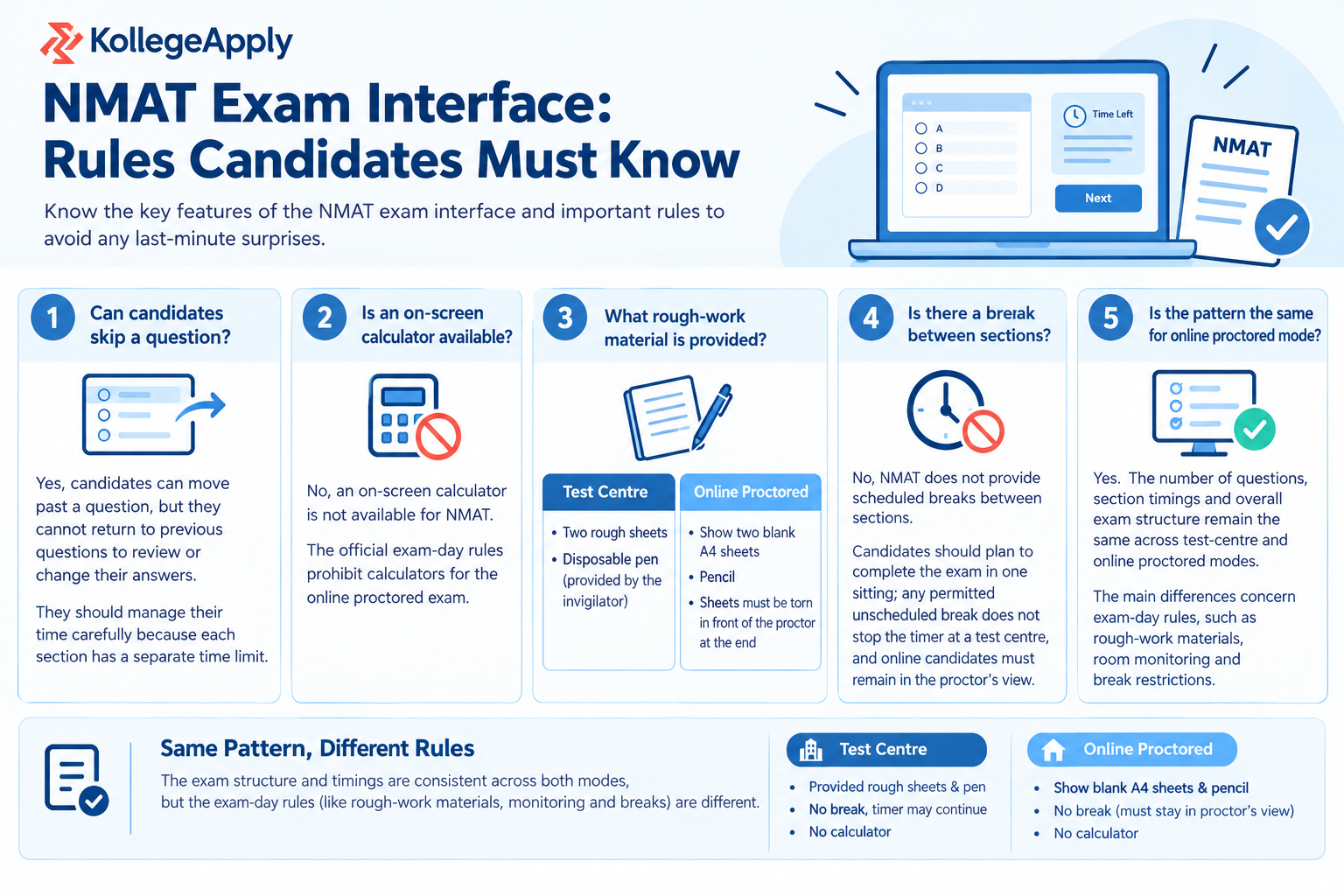
- Can candidates skip a question? Candidates can move past a question, but they cannot return to previous questions to review or change their answers. They should manage their time carefully because each section has a separate time limit.
- Is an on-screen calculator available? No, an on-screen calculator is not available for NMAT. The official exam-day rules prohibit calculators for the online proctored exam.
- What rough-work material is provided? At test centres, candidates receive two rough sheets and a disposable pen from the invigilator. For the online proctored exam, candidates must show two blank A4 sheets and a pencil; the sheets must be torn in front of the proctor at the end.
- Is there a break between sections? No, NMAT does not provide scheduled breaks between sections. Candidates should plan to complete the exam in one sitting; any permitted unscheduled break does not stop the timer at a test centre, and online candidates must remain in the proctor’s view.
- Is the pattern the same for online proctored mode? Yes. The number of questions, section timings and overall exam structure remain the same across test-centre and online proctored modes. The main differences concern exam-day rules, such as rough-work materials, room monitoring and break restrictions.
How to Choose NMAT Section Order?
NMAT allows candidates to choose the order in which they attempt the three sections: Language Skills, Quantitative Skills, and Logical Reasoning. Candidates should choose an order that helps them manage time effectively and perform confidently.
- Start with the strongest section: Candidates who are more confident in Quantitative Skills or Logical Reasoning can attempt that section first to build momentum.
- Start with Language Skills: This section has 36 questions to be completed in 28 minutes, giving candidates approximately 47 seconds per question. Starting with it may help candidates tackle the section with the tightest time limit while they are fresh.
- Attempt the most time-sensitive section first: Candidates who tend to spend too long on reading or verbal questions may benefit from starting with Language Skills rather than leaving it until the end.
- Practise the chosen order in mock tests: Candidates should compare their accuracy and time management across different section orders before deciding which approach works best.
Important: Each section has its own fixed time limit, and candidates cannot return to a section once its time expires. The best section order depends on individual strengths, accuracy, and time-management habits.
NMAT Exam Pattern 2026 FAQs
How is NMAT score calculated?
NMAT uses a scaled scoring system based on a candidate’s performance. Each section is scored from 12 to 120, giving a total score range of 36-360.
Is there a negative marking in NMAT?
No, NMAT has no negative marking. Candidates do not lose marks for incorrect answers, so all questions can be attempted.
What are the total marks for NMAT?
The NMAT total score ranges from 36 to 360 marks. Each of the three sections has a 12–120 score range.
What is the sectional weightage for NMAT?
NMAT has equal sectional weightage. Language Skills, Quantitative Skills, and Logical Reasoning each have 36 questions and a score range of 12–120.
Is NMAT adaptive?
Yes, NMAT is a computer-adaptive test in which the difficulty of questions is adjusted based on candidates’ responses to previous questions.
Can I skip questions or go back to an earlier one?
Candidates cannot return to previous questions to review or change their answers. They should manage their time carefully to complete each section within its allotted time.
Is a calculator allowed in NMAT?
Candidates cannot use a personal calculator during NMAT. They should check the latest official exam instructions for details about any calculation tools available in the test interface.
Which section should I attempt first in NMAT?
Candidates can choose the order of Language Skills, Quantitative Skills and Logical Reasoning. Starting with the strongest section can build confidence, while starting with Language Skills may help candidates manage its tighter time limit of 28 minutes for 36 questions.
Do unanswered questions lower my NMAT score?
NMAT does not have a fixed negative-marking penalty for incorrect answers. However, leaving questions unanswered because time runs out may affect the final score, so candidates should aim to complete each section within its time limit.
Is the NMAT exam pattern the same for the home-based exam?
Yes, the number of questions, section timings and overall exam structure remain the same for test-centre and online-proctored modes. However, exam-day rules differ, including rough-work materials and monitoring requirements.
Exam Calendar
Explore exam calendars tailored to your interest