
• Updated on 16 Oct, 2026 by Simran
What's new?
UPSC ESE Latest news and articles
The UPSC Engineering Services Examination (ESE/IES) 2027 comprises three stages: Prelims, Mains and the Personality Test. The examination carries 1,300 marks in total, including 500 marks for Prelims, 600 marks for Mains and 200 marks for the Personality Test. Marks obtained in all three stages contribute to the final merit ranking.
The Prelims consists of two objective-type papers and carries a penalty of one-third of the marks assigned to a question for each incorrect answer. The Mains comprises two conventional (descriptive) papers in the candidate's engineering discipline.
The UPSC ESE 2027 Prelims is scheduled for 31 January 2027, followed by the Mains on 18 June 2027. The exam pattern below is based on the official UPSC notification, Examination Notice No. 02/2027-ENGG.
Latest Update: The ESE 2027 exam structure remains the same as that of ESE 2026. Registration has closed. The notice says e-admit cards are issued on the last working day of the week before the exam, so the Prelims e-admit card is expected to be available from 22 January 2027, subject to UPSC's schedule. For the topics in each paper, see the UPSC ESE syllabus page.
- UPSC ESE Exam Pattern 2027 Highlights
- UPSC ESE Prelims Exam Pattern 2027
- UPSC ESE Mains Exam Pattern 2027
- UPSC ESE 2027 Personality Test and Final Merit Ranking
- UPSC ESE Marking Scheme 2027
- UPSC ESE Prelims vs Mains
- How Candidates Are Shortlisted at Each Stage
- UPSC ESE Tie-Breaking Rule
- UPSC ESE Exam Rules for 2027
- UPSC IES Preparation Tips Based on the Exam Pattern
- FAQs on UPSC ESE Exam Pattern 2027
UPSC ESE Exam Pattern 2027 Highlights
| Particulars | Details |
| Exam | Engineering Services Examination (ESE) 2027, also called IES 2027 |
| Conducting body | Union Public Service Commission (UPSC) |
| Stages | Prelims (Stage I), Mains (Stage II), Personality Test (Stage III) |
| Exam mode | Offline (pen and paper); OMR answer sheet in the Prelims |
| Prelims | 2 objective papers, 500 marks |
| Mains | 2 conventional papers, 600 marks |
| Personality Test | 200 marks, no minimum qualifying marks |
| Total marks for final rank | 1,300 |
| Negative marking | One-third of the question's marks, Prelims only |
| Language | Mains in English only |
| Disciplines | Civil, Mechanical, Electrical, Electronics & Telecommunication |
UPSC ESE Prelims Exam Pattern 2027
Stage I (Prelims) consists of two objective-type papers. Paper I is common to all four branches, while Paper II is on the candidate's engineering discipline.
| Paper | Subject | Type | Duration | Marks |
| Paper I | General Studies and Engineering Aptitude (common to all branches) | Objective | 2 hours | 200 |
| Paper II | Engineering discipline (Civil, Mechanical, Electrical or E&T) | Objective | 3 hours | 300 |
| Total | 5 hours | 500 |
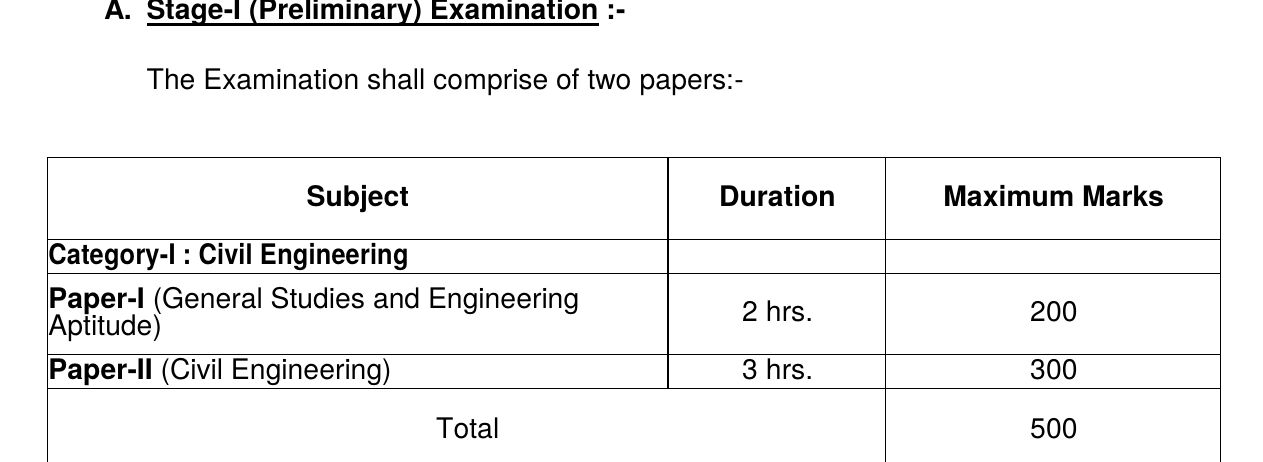
Prelims marks are counted towards the final merit list; the stage is not merely qualifying. To move to the Mains, candidates need the minimum qualifying marks in both Prelims papers, and UPSC generally admits about six to seven times the number of vacancies to the Mains.
UPSC ESE Mains Exam Pattern 2027
The Mains (Stage II) has two conventional (descriptive) papers, both on the candidate's engineering discipline. There is no General Studies paper in the Mains.
| Paper | Subject | Type | Duration | Marks |
| Paper I | Engineering discipline, Paper I part of the syllabus | Conventional | 3 hours | 300 |
| Paper II | Engineering discipline, Paper II part of the syllabus | Conventional | 3 hours | 300 |
| Total | 6 hours | 600 |
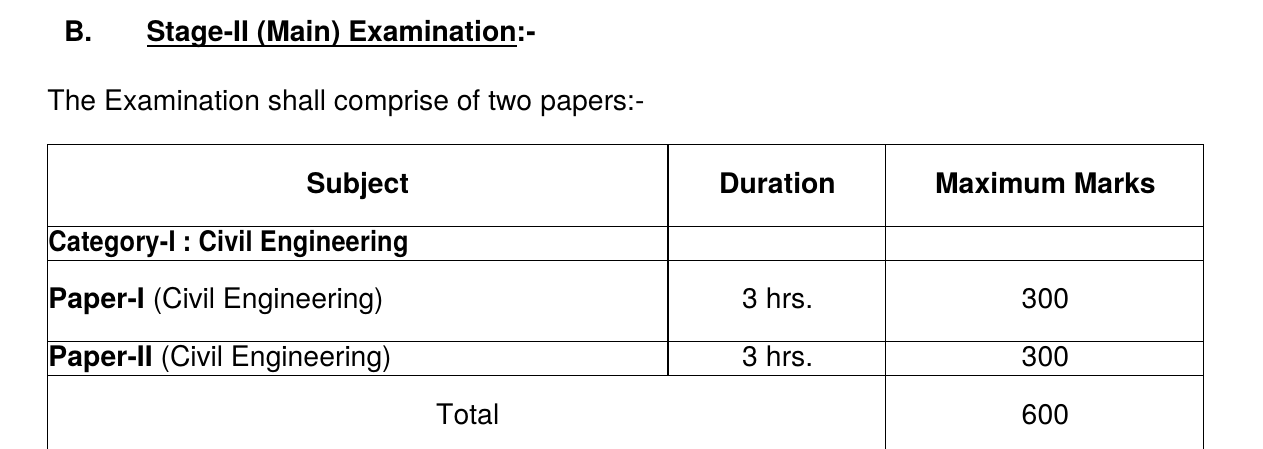
The Mains papers are set in English only and must be answered in English.
UPSC ESE 2027 Personality Test and Final Merit Ranking
Candidates who reach the minimum qualifying marks fixed by UPSC in the Prelims and Mains are called for the Personality Test (Stage III). UPSC generally calls candidates for the Personality Test in a number approximately twice the number of vacancies.
| Particulars | Details |
| Marks | 200 |
| Minimum qualifying marks | None |
| Candidates called | About twice the number of vacancies |
| What it assesses (as per the notice) | Leadership, initiative and intellectual curiosity, tact and other social qualities, mental and physical energy, powers of practical application and integrity of character |
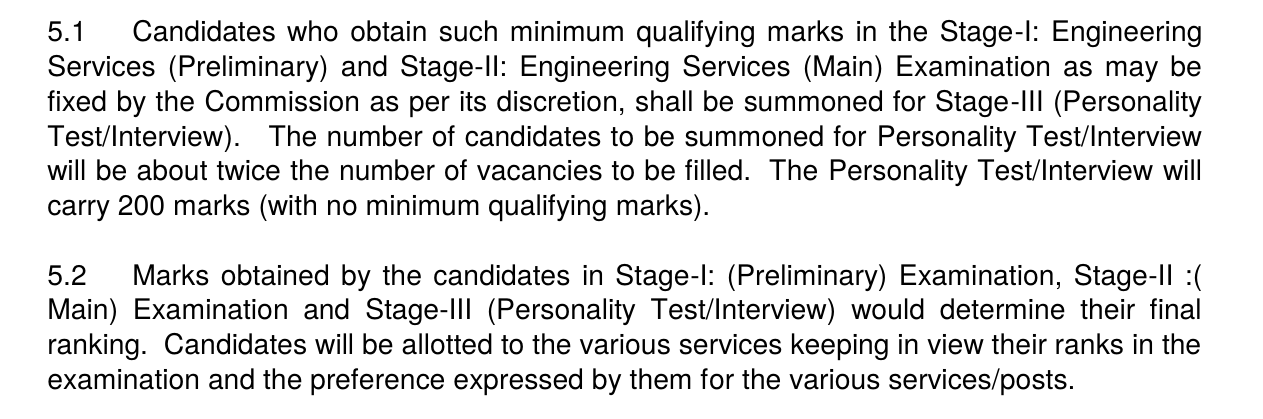
For reference, the ESE 2026 Personality Tests run from 21 September to 30 October 2026 for 1,336 candidates.
UPSC ESE Marking Scheme 2027
| Stage | Maximum marks | Negative marking | Counts in final rank |
| Prelims (Paper I + Paper II) | 500 | Yes, one-third of the question's marks | Yes |
| Mains (Paper I + Paper II) | 600 | No | Yes |
| Personality Test | 200 | No | Yes |
| Total | 1,300 |
UPSC ESE 2027 Negative Marking Rules
As per the notice, every Prelims question has four answer options, and:
- For each wrong answer, one-third of the marks assigned to that question are deducted.
- Marking more than one answer counts as a wrong answer, even if one of them is correct, and gets the same penalty.
- A question left blank gets no penalty.
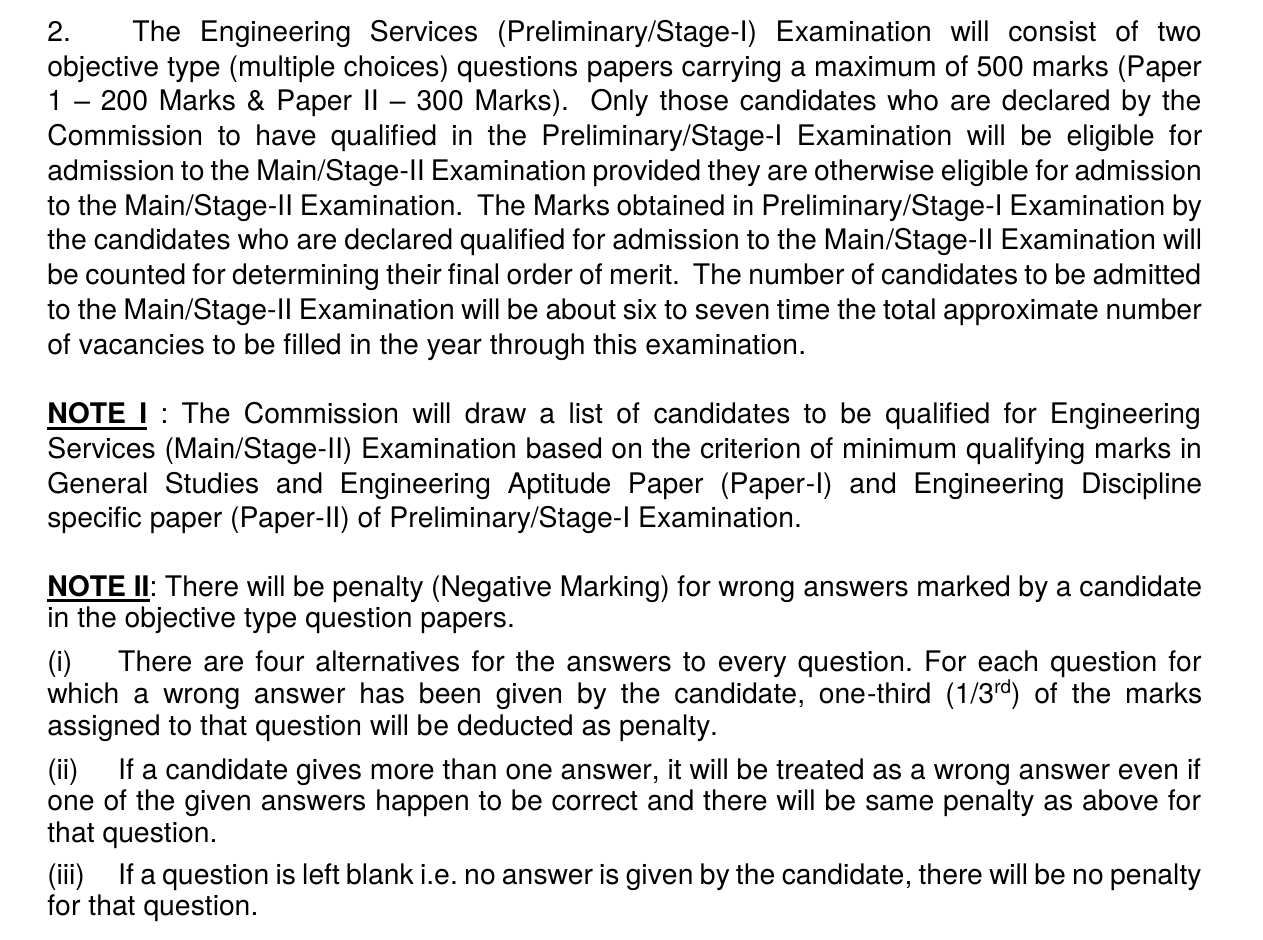
The notice does not fix a number of questions or marks per question for each paper, so any "marks per question" figure should be checked on the question paper itself.
UPSC ESE Prelims vs Mains
| Basis | Prelims (Stage I) | Mains (Stage II) |
| Papers | 2 (General Studies + engineering discipline) | 2 (both engineering discipline) |
| Question type | Objective, four options | Conventional (descriptive, numerical) |
| Total marks | 500 | 600 |
| Total duration | 5 hours | 6 hours |
| Negative marking | Yes, one-third | No |
| Calculator | Not allowed | Battery-operated pocket calculator allowed |
| Language | Not specified in the notice | English only |
| Counts in final rank | Yes | Yes |
| Candidates advancing | About 6 to 7 times the vacancies go to the Mains | About 2 times the vacancies go to the interview |
How Candidates Are Shortlisted at Each Stage
Applying the ratios in the notice to ESE 2027's approximately 480 vacancies gives these estimates (not confirmed candidate counts):
| Stage | Rule in the notice | Approximate number for ESE 2027 |
| Prelims to Mains | About 6 to 7 times the vacancies | About 2,880 to 3,360 candidates |
| Mains to Personality Test | About twice the vacancies | About 960 candidates |
| Final selection | Rank based on all 1,300 marks | About 480 |
The actual number of candidates shortlisted depends on the final vacancy count, qualifying criteria and UPSC's selection process. In ESE 2026, 1,336 candidates were called for interview against 474 notified vacancies.
UPSC ESE Tie-Breaking Rule
Marks are rounded off to two decimal places at every stage. When two or more candidates have the same final marks, UPSC breaks the tie in this order, as per the ESE 2027 notification:
- More marks in the three engineering discipline papers (Prelims Paper II and Mains Papers I and II) plus the Personality Test, taken together.
- If still tied, more marks in the three engineering discipline papers alone.
- If still tied, the candidate senior in age is ranked higher.
- If a tie still remains, it is resolved at the Commission's discretion.
UPSC ESE Exam Rules for 2027
| Rule | Details (as per the notice) |
| Answer sheet (Prelims) | OMR sheet, filled with a black ball pen |
| Calculators | Battery-operated pocket calculators allowed in conventional (Mains) papers only; not allowed in the Prelims; no lending or swapping |
| Language of Mains | Question papers set in English only; answers must be in English |
| Numerals | International form of Indian numerals only (1, 2, 3...) |
| Units and tables | SI units used; standard tables and charts in SI units supplied where needed |
| Handwriting | Up to 5% of the maximum marks for written papers can be deducted for illegible handwriting |
| Answer quality | No marks for superficial knowledge; credit for orderly, effective and exact expression with economy of words |
| Identity marks in answer scripts | Irrelevant matter or marks that could reveal identity lead to a deduction or non-evaluation of the script |
| Minimum qualifying marks | UPSC can fix minimum qualifying marks in any or all papers |
Scribe, Compensatory Time and PwBD Provisions
- Candidates with low vision can have a scribe if they wish, and get compensatory time of 20 minutes per hour.
- Other PwBD candidates get a scribe and compensatory time on producing a medical certificate that they have a physical limitation to write.
- Candidates can bring their own scribe or ask UPSC for one; this choice was made in the application form.
- A scribe must have at least a matriculation qualification, but not more than the minimum qualification for the exam.
UPSC IES Preparation Tips Based on the Exam Pattern
- Answer Prelims questions carefully, keeping the negative-marking rule in mind. With a one-third penalty, three wrong answers cancel one right answer. Leaving a question blank costs nothing.
- Treat the Prelims as part of your final score. The 500 Prelims marks count in the final 1,300, so a strong Prelims score lifts your final rank, not just your Mains entry.
- Check the paper-wise qualifying requirements. In previous ESE cycles, UPSC prescribed minimum qualifying standards in each paper, separate from the branch-wise and category-wise cutoffs. In ESE 2021 to 2025, these were 15% in each Prelims paper and 20% in each paper at the written stage (10% for PwBD candidates). UPSC can fix these afresh for ESE 2027, so check the official cutoff documents for the exam year.
- Practise written answers for the Mains. The Mains comprises six hours of descriptive and numerical questions, answered in English, and illegible handwriting can cost up to 5% of the marks.
- Practise with a calculator for the Mains only. Calculators are allowed in the Mains but not in the Prelims, so build mental calculation speed for the Prelims.
- Use previous years' branch-wise cutoffs as a reference when setting score targets. They are on the UPSC ESE cutoff page.
FAQs on UPSC ESE Exam Pattern 2027
What is the exam pattern of IES?
Three stages: Prelims (500 marks), Mains (600 marks) and Personality Test (200 marks), for 1,300 marks in total.
Is the ESE Prelims only qualifying?
No. As per the notice, the Prelims marks of candidates who qualify for the Mains are counted in the final order of merit.
Is there negative marking in UPSC ESE?
Yes, in the Prelims only. One-third of the marks for a question are deducted for each wrong answer, and marking more than one option counts as wrong. There is no penalty for a blank answer, and no negative marking in the Mains or the Personality Test.
Is the ESE 2027 exam pattern the same as ESE 2026?
Yes. The stages, papers, durations and marks are the same as in ESE 2026.
Is there a General Studies paper in the ESE Mains?
No. General Studies and Engineering Aptitude is only Prelims Paper I. Both Mains papers are on the engineering discipline.
Can I use a calculator in the ESE exam?
Only in the Mains (conventional papers). Calculators are not allowed in the Prelims.
In which language can I write the ESE Mains?
English only. The notice states that conventional papers are set in English and must be answered in English.
How many candidates are called for the ESE interview?
About twice the number of vacancies. For approximately 480 ESE 2027 vacancies, that is about 960 candidates.
Is there a minimum mark in the ESE Personality Test?
No. The notice states that the 200-mark Personality Test has no minimum qualifying marks.
Is IES tougher than IAS?
The two examinations assess different competencies, so there is no official basis for directly comparing their difficulty. IES is limited to engineering graduates and is mostly technical: of the 1,100 written marks, 900 come from the engineering discipline (Prelims Paper II, 300 marks, and both Mains papers, 600 marks), and the remaining 200 from Prelims Paper I, General Studies and Engineering Aptitude. The Civil Services exam covers general studies and an optional subject.
Is IES very difficult?
The examination is highly competitive, with selection based on performance across all three stages. Only about twice the number of vacancies reach the interview, and from 2021 to 2025, the General final cutoff ranged from 546 to 804 out of 1,300, depending on branch and year.
What is the IES exam salary?
Group A officers selected through ESE start at Pay Level 10 of the 7th Pay Commission matrix, with a basic pay of ₹56,100 per month, plus allowances.
Where can I download the UPSC IES exam pattern PDF?
The official exam pattern is in Appendix I of the ESE 2027 notification, published on upsc.gov.in.