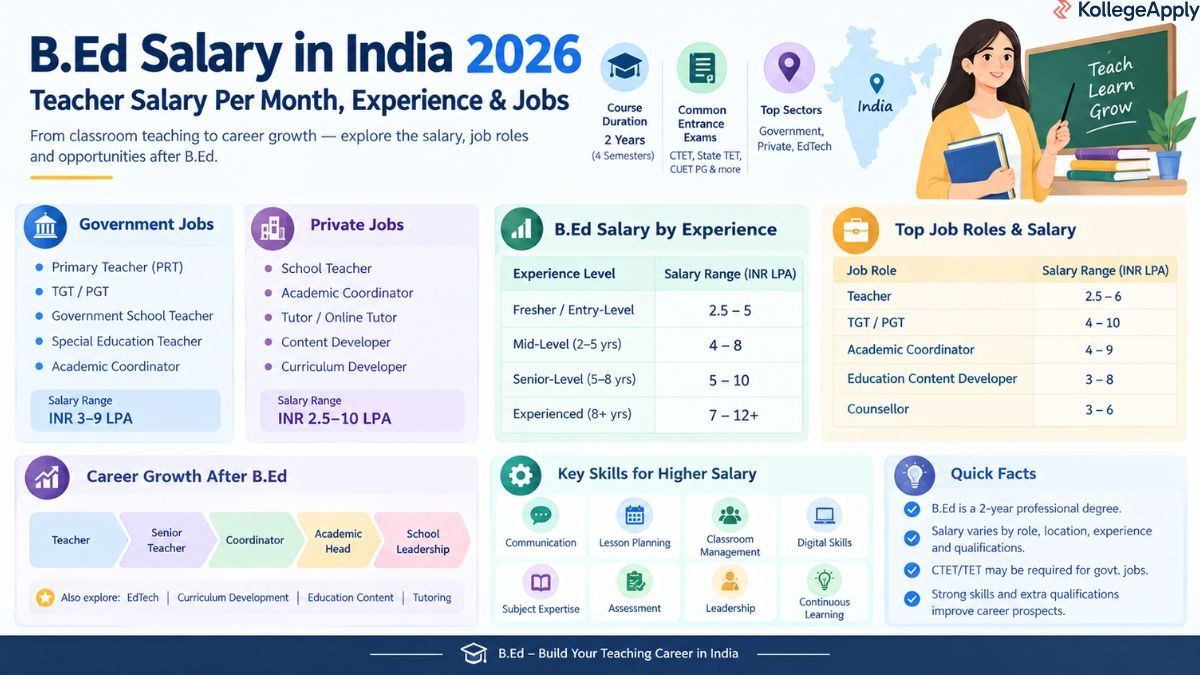
B.Ed salary in India varies according to experience, job role, employer, location, teaching subject and additional qualifications. B.Ed graduates can work as school teachers, tutors, academic coordinators, education content professionals and other education-sector professionals. Government teaching positions generally follow prescribed pay structures, while private-school and education-sector salaries are determined by the employer.
The B.Ed teacher salary can increase with teaching experience, subject expertise, professional qualifications and career progression. Candidates with qualifications such as CTET/TET, relevant postgraduate degrees, specialised certifications and digital-learning skills may have access to more opportunities, depending on the eligibility requirements of the role. Overall, B.Ed salary can range from around INR 2.5–5 LPA at entry level, while experienced professionals may earn INR 7–12+ LPA in suitable roles.
- What is the Salary After B.Ed?
- B.Ed Salary Per Month
- Factors Influencing B.Ed Salary
- Detailed Breakdown of B.Ed Salary
- Government B.Ed Teacher Salary
- B.Ed Salary for Freshers
- Skills Required for High B.Ed Salary
- Qualifications That Can Improve B.Ed Career Prospects
- B.Ed Career Growth and Salary Progression
- Will I Get a Job After B.Ed?
- B.Ed Salary FAQs
What is the Salary After B.Ed?
There is no single fixed salary after B.Ed because graduates enter different types of schools and education-sector roles. Government recruitment, private schools, international schools, EdTech companies and education-content organisations can follow different salary structures. The table below provides a broad salary benchmark for B.Ed graduates based on career stage. These are indicative ranges rather than guaranteed packages.
Candidates appointed to government teaching posts receive salaries according to the applicable government pay level and recruitment rules. Private-sector salaries are more variable and may depend on school reputation, location, teaching subject, qualifications and classroom experience.
B.Ed Salary Per Month
The B.Ed salary per month depends on the annual package, employer and job role. A monthly figure should therefore be treated as an approximate gross salary rather than a guaranteed take-home amount. These calculations divide annual CTC by 12. Actual in-hand salary can be lower because of taxes, provident fund, insurance and other deductions.
Factors Influencing B.Ed Salary
B.Ed salary is influenced by several professional and employment-related factors rather than the degree alone. Candidates working in government schools may have structured pay scales, whereas private employers can set salaries based on institutional budgets, experience and candidate performance. Location and teaching specialisation can also affect earning potential.
Major factors affecting B.Ed salary include:
Detailed Breakdown of B.Ed Salary
The salary structure after B.Ed becomes clearer when analysed according to experience, job role and location. A fresher joining a private school may start at a considerably different salary from an experienced teacher in a government school or an academic professional working in an established education organisation.
The following sections provide indicative salary ranges to help candidates understand how compensation can change across different career stages and employment settings.
B.Ed Salary Based on Experience
Experience is one of the major factors affecting the earning potential of B.Ed graduates. Freshers generally begin with classroom teaching, tutoring or academic support roles, while experienced professionals can move into senior teaching, coordination and academic leadership positions. Government employees may follow applicable pay levels rather than the broad private-sector ranges given below:
B.Ed Salary Based on Job Roles
B.Ed graduates can pursue different career paths depending on their teaching subject, qualifications and professional interests. School teaching remains the most common route, but experienced candidates may also move towards academic coordination, curriculum development, education content and training.
TGT and PGT eligibility depends on the specific recruitment rules, subject qualification and other prescribed requirements. A B.Ed degree alone does not make a candidate eligible for every TGT or PGT post. CTET also states that eligibility is ultimately determined according to the applicable recruitment rules.
B.Ed Salary Based on Location
Location can influence private-sector B.Ed salaries because schools and education organisations in major cities may have different salary budgets and demand for teachers. However, higher salaries in metropolitan areas may also be accompanied by higher living costs.
Note: These are broad private-sector benchmarks. Government teacher salaries are governed by the applicable recruitment and pay rules rather than city-based private salary bands.
Government B.Ed Teacher Salary
Government B.Ed teacher salary generally follows the pay structure specified by the recruiting authority. Therefore, it is not appropriate to assign one universal salary to all government teachers.
Government teaching opportunities can be available through central and state recruitment systems, subject to the required academic qualifications, TET requirements and recruitment rules. For example, KVS states that its teacher recruitment follows prescribed Recruitment Rules and that vacancies are advertised through its recruitment process.
Note: Candidates should always check the official recruitment notification for the exact basic pay, allowances, eligibility and selection process.
B.Ed Salary for Freshers
Freshers with a B.Ed degree generally begin their careers as teachers, tutors or academic support professionals. Private schools may recruit candidates directly, while government teaching positions require candidates to meet the eligibility and recruitment conditions specified in the relevant notification.
The following salary ranges can help freshers understand the broad starting market rather than treating them as fixed B.Ed salary figures.
Skills Required for High B.Ed Salary
A higher B.Ed salary usually comes from a combination of teaching expertise, subject knowledge, professional qualifications and career progression rather than the degree alone. Teachers who can manage classrooms effectively, use technology, assess learners and take on additional academic responsibilities may have stronger opportunities for advancement. The following skills can help B.Ed graduates build a stronger profile for higher-paying teaching and education-sector roles.
Qualifications That Can Improve B.Ed Career Prospects
A B.Ed degree is the foundation for many teaching careers, but additional qualifications can improve eligibility for particular positions. The exact requirement depends on the school level, subject and recruiting organisation. CTET's official eligibility guidance makes clear that candidates must satisfy the qualifications prescribed by NCTE and the relevant government or school recruitment rules. Candidates can consider:
- CTET or State TET, where required for the target teaching post
- Relevant postgraduate degrees for higher-level subject teaching
- Subject-specific qualifications
- Special education qualifications for specialised teaching roles
- Digital teaching and educational technology certifications
- Additional training in curriculum design and assessment
B.Ed Career Growth and Salary Progression
B.Ed career growth generally begins with classroom teaching and can progress towards senior academic and administrative responsibilities. The exact path depends on experience, qualifications, performance and the type of institution. A possible career progression is:
Teacher → Senior Teacher → Academic Coordinator → Academic Head → School Leadership
Some graduates may instead move into EdTech, curriculum development, educational content, tutoring or training. Building subject expertise and gaining relevant experience can help candidates move towards specialised positions.
Will I Get a Job After B.Ed?
A B.Ed degree can open opportunities in schools and other education-sector organisations, but employment is not guaranteed solely by completing the degree. Government teaching posts involve eligibility and recruitment procedures, while private employers have their own selection criteria.
Candidates can improve their prospects by combining B.Ed with strong subject knowledge, teaching experience, relevant TET qualifications where applicable, digital skills and good communication abilities.
B.Ed Salary FAQs
What is the salary of a B.Ed teacher?
B.Ed teacher salary varies by role and employer. Entry-level teachers may earn around INR 2.5–5 LPA, while experienced teachers can earn more.
What is B.Ed salary per month?
B.Ed salary per month can range from about INR 20,800 to INR 1 lakh or more, depending on annual salary and experience.
Is B.Ed 1 year or 2 year?
The regular B.Ed programme is generally a two-year professional course. NCTE's current framework recognises the B.Ed 2-Year programme.
Is B.Ed a good degree?
Yes, B.Ed can be a good degree for candidates interested in teaching, education, student development and academic careers.
Will I get a job after B.Ed?
B.Ed can open teaching and education-sector opportunities, but employment depends on eligibility, recruitment rules, skills and employer requirements.
Does CTET increase B.Ed salary?
CTET may improve eligibility for relevant teaching opportunities, but salary depends on the employer, post, pay structure and recruitment rules.
What is the B.Ed salary for freshers?
Freshers can typically expect around INR 2.5–5 LPA, depending on the school, city, role and qualifications.
Which factors affect B.Ed salary?
Experience, job role, location, employer, teaching subject, qualifications and professional skills can affect B.Ed salary.
Can I get a government job after B.Ed?
Yes, B.Ed graduates can apply for eligible government teaching posts after meeting the required academic, TET and recruitment criteria.
How can I increase my B.Ed salary?
Build subject expertise, gain teaching experience, pursue relevant qualifications and develop ICT, assessment and leadership skills.