The B.Ed syllabus covers educational psychology, teaching methods, curriculum development, assessment, classroom management and subject-specific pedagogy. The exact B.Ed course syllabus varies by university, with institutions offering different combinations of core papers, teaching subjects, electives and practical components.
The B.Ed course is generally two years and four semesters under the current structure followed by institutions such as Manav Rachna University. The programme combines classroom theory with practical teaching, school internships, ICT-based pedagogy, lesson planning and community engagement.
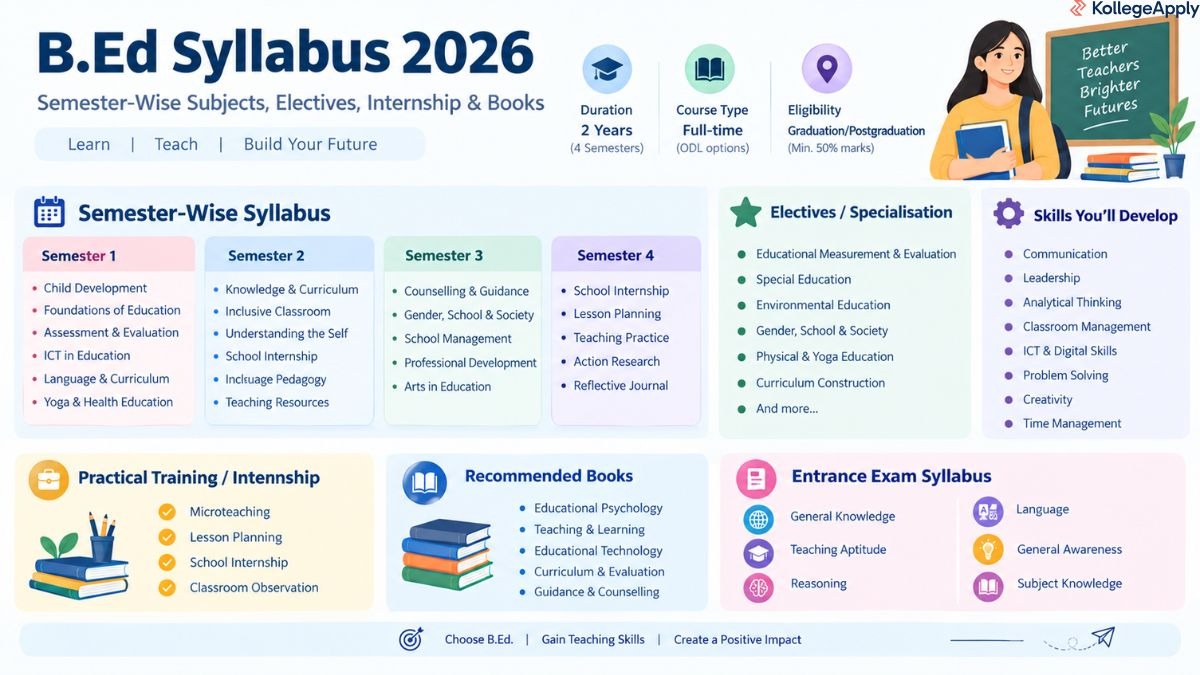
Table of Contents
B.Ed Syllabus Semester-Wise
The B.Ed subjects differ across universities, but the common syllabus areas include learner development, foundations of education, teaching-learning processes, assessment, ICT, curriculum, inclusive education and school-based practice. The syllabus used for reference includes core papers in education, teaching techniques and learner psychology, along with two school teaching subjects and a specialisation.
B.Ed 1st Year Syllabus
The B.Ed 1st year syllabus generally establishes the theoretical and pedagogical foundation required for teaching. For example, Manav Rachna University's current four-semester curriculum includes the following subjects in the first year.
The first year therefore combines theory with early practical exposure. Students learn how children and adolescents develop, how educational philosophies influence teaching, how assessment works and how technology and inclusive strategies can be incorporated into classrooms.
B.Ed 2nd Year Syllabus
The second year generally shifts towards advanced professional preparation, school management, counselling, professional development and extended teaching practice. Manav Rachna University's fourth-semester school internship requires students to apply subject and pedagogical knowledge in actual classrooms, prepare lesson plans, manage classrooms, maintain reflective records and undertake action research.
B.Ed Syllabus in Private University
Private universities generally follow the NCTE-aligned two-year B.Ed structure but may customise the subjects, specialisations and practical components. Manav Rachna University, for instance, offers Mathematics & Science and Language & Social Science specialisation tracks and follows a four-semester, two-year programme.
Electives in B.Ed Syllabus
Electives and specialisation papers allow B.Ed students to develop expertise in an area beyond the compulsory core subjects. The exact choices depend on the university, available faculty and programme structure.
The college's syllabus provides a broad list of specialisation options, while current private-university programmes may instead offer defined subject tracks such as Mathematics & Science or Language & Social Science. It also lists areas such as pre-primary education, school library organisation, population education, teaching of values and history of education among its specialisation choices.
Practical Training / Internship in B.Ed
Practical training is an essential part of the B.Ed course because students must learn to translate educational theory into actual classroom practice. Activities can include microteaching, lesson planning, teaching aids, classroom observation, school records, peer observation and supervised teaching.
For example, in some of the colleges' structures, students undertake a minimum 30-day internship and teaching practice involving orientation, microteaching, demonstration lessons, teaching 40 lessons across two school subjects and 10 peer observations.
The current Manav Rachna structure includes a preliminary school internship in Semester 2 and a longer school internship in Semester 4. Students observe classrooms, teach under supervision, prepare lesson plans, maintain reflective journals and work on action research and case studies.
Skills Developed Through B.Ed Syllabus
The B.Ed syllabus is designed to develop both subject-specific and professional teaching abilities. Along with academic knowledge, students learn to communicate clearly, manage classrooms, assess learners and adapt teaching strategies to different educational needs.
Is B.Ed Easy or Difficult?
B.Ed is generally manageable for students who are comfortable with reading, writing, presentations and practical teaching activities. The course is not limited to theoretical examinations; lesson plans, assignments, practical work, school observations and internships also contribute to the workload.
Students may find educational psychology, assessment and teaching methodology easier with regular revision and practical examples. The teaching internship can initially be challenging because it requires classroom confidence, preparation and effective communication.
Books for B.Ed Syllabus
B.Ed books should be selected according to the university's latest syllabus rather than relying on a generic guide. Students should prioritise books that explain educational psychology, pedagogy, assessment, curriculum, educational technology and the teaching methods of their chosen subjects. The following books are useful for understanding common B.Ed subjects:
B.Ed Entrance Exam Syllabus
B.Ed entrance exam syllabus is different from the B.Ed academic syllabus. The entrance test determines admission, while the course syllabus covers subjects studied after admission.
B.ED Syllabus FAQs
What are the BEd. subjects?
Common B.Ed subjects include educational psychology, teaching methods, assessment, curriculum, ICT, inclusive education and subject-specific pedagogy.
Is BEd. easy or difficult?
B.Ed is manageable with regular study, but practical teaching, lesson planning, assignments and internships require consistent preparation.
Is BEd. 1 year or 2 year course?
B.Ed is generally a two-year course under current structures. Some older university documents describe a one-year format.
How many paper in BEd. 1st year?
The number varies by university. Current four-semester programmes commonly divide several theory and practical courses across the first two semesters.
What is included in the B.Ed 1st year syllabus?
It commonly covers child development, educational foundations, assessment, ICT, curriculum, inclusive education and introductory school internship.
Does B.Ed include practical training?
Yes, Practical work can include microteaching, lesson planning, teaching aids, classroom observation, school teaching and internships.
Does the B.Ed syllabus include ICT?
Many current B.Ed programmes include ICT in education, digital teaching tools, e-learning and technology-supported lesson planning.
Are electives available in B.Ed?
Electives or specialisations vary by university and may include special education, guidance, computer education, evaluation and school management.
Is the B.Ed course syllabus the same in every university?
No, Core areas are similar, but subjects, electives, teaching combinations and practical requirements differ by university.
What can I do after completing B.Ed?
Graduates can pursue school teaching and may explore academic coordination, education content, counselling, administration and other education-sector roles.