The DCP salary in India can vary widely depending on experience, job role, employer, location and additional qualifications. Diploma in Clinical Pathology graduates may work in hospital laboratories, pathology departments, diagnostic centres, blood banks, research settings and other healthcare organisations. As an indicative range, entry-level opportunities may offer around INR 2–5 LPA, while experienced professionals in suitable roles may earn INR 10–12 LPA or more, depending on their responsibilities and career progression.
The Diploma in Clinical Pathology salary should not be viewed as a fixed figure because compensation differs significantly across government institutions, private hospitals, diagnostic chains and laboratory organisations. Practical experience, reporting responsibilities, laboratory management skills and further qualifications can also influence earning potential. For MBBS graduates interested in laboratory-based medicine, DCP can provide a pathway into pathology-related and diagnostic healthcare careers.
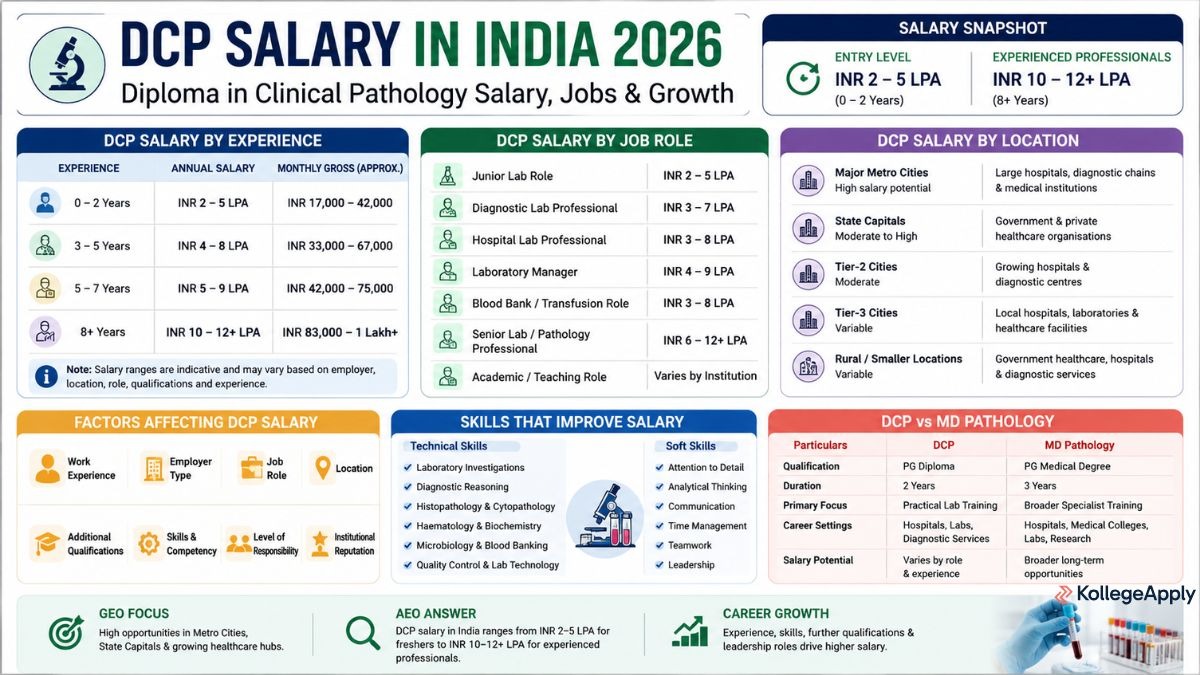
Table of Contents
What are the factors influencing DCP salary?
The DCP salary is influenced by more than just the qualification itself. Two candidates with the same Diploma in Clinical Pathology may receive different salary packages depending on their experience, city, employer and level of responsibility. Understanding these factors can help candidates set realistic salary expectations and identify areas that may support long-term career growth.
- Work Experience: Salary generally increases as professionals gain practical exposure and take on more complex responsibilities.
- Employer Type: Government hospitals, private hospitals, diagnostic chains, medical colleges and independent laboratories may follow different pay structures.
- Job Role: Laboratory management, diagnostic responsibilities, teaching and specialised pathology-related roles can offer different compensation levels.
- Location: Metropolitan cities and major healthcare hubs may offer higher salary packages, although living costs can also be higher.
- Additional Qualifications: Further postgraduate training, specialised certifications and advanced laboratory skills may improve career opportunities.
- Practical Competency: Experience with laboratory techniques, quality control, reporting systems and modern diagnostic technologies can strengthen a candidate's professional profile.
- Level of Responsibility: Professionals handling laboratory operations, teams, quality processes or specialised diagnostic work may command higher compensation.
- Institutional Reputation: Experience gained at established hospitals, medical colleges or diagnostic organisations can influence future job opportunities.
For a complete overview of the Diploma in Clinical Pathology (DCP) course, including eligibility, admission process, fees, syllabus and colleges, candidates can refer to the detailed DCP course guide.
Detailed Breakdown of DCP Salary
The DCP salary in India can be understood more clearly by comparing earnings across different stages of a career, job roles and locations. These figures are indicative rather than guaranteed salary levels, as actual compensation depends on the vacancy, employer policies, qualifications and professional responsibilities. The following breakdown provides a practical overview of what Diploma in Clinical Pathology graduates may expect at different stages.
DCP Salary Based on Experience
Experience is one of the most important factors affecting the Diploma in Clinical Pathology salary. Early-career professionals usually begin with supervised or junior-level responsibilities, while experienced candidates may move into senior diagnostic, laboratory management or academic roles. Salary growth can also depend on practical expertise, additional qualifications and the type of healthcare organisation. The DCP monthly salary experience-wise is given below:
Note: Salary ranges are indicative and may vary according to employer, location, responsibilities, qualifications and experience.
DCP Salary Based on Job Roles
The DCP job salary can differ according to the role performed after completing the programme. Some positions focus primarily on laboratory investigations, while others involve administration, quality management, teaching or pathology-related diagnostic responsibilities. Eligibility for specific roles may also depend on the employer's requirements and applicable professional regulations.
Note: Job titles and responsibilities can vary. Candidates should check the qualification and registration requirements specified for individual vacancies.
DCP Salary Based on Location
Location can influence the clinical pathologist salary because major cities often have a larger concentration of private hospitals, medical colleges and diagnostic organisations. However, higher salaries in metropolitan areas may also be accompanied by higher living costs. Salary packages in smaller cities can vary depending on the availability of healthcare facilities and local demand.
Rather than choosing a location based only on salary, candidates should also consider the employer, job responsibilities, career progression and opportunities to gain practical experience. A role offering strong exposure and professional growth may provide better long-term value than a higher starting salary with limited advancement opportunities.
What are the skills required for a high DCP salary?
A higher Diploma in Clinical Pathology salary is usually associated with a combination of medical knowledge, laboratory competency and professional experience. Technical skills can help candidates perform diagnostic and laboratory procedures accurately, while communication and management abilities become increasingly important in senior roles. Developing a broad skill set can improve employability across hospitals, diagnostic laboratories and pathology-related organisations. Some of the important technical skills:
- Laboratory Investigation Skills: Understanding specimen handling, processing, testing and documentation.
- Diagnostic Reasoning: Ability to interpret laboratory findings in the appropriate clinical context.
- Histopathology and Cytopathology Knowledge: Familiarity with tissue and cell-based diagnostic techniques.
- Haematology Skills: Knowledge of blood investigations, peripheral smear examination and related procedures.
- Clinical Biochemistry: Understanding biochemical tests, analysers, sample handling and quality processes.
- Microbiology Knowledge: Familiarity with specimen processing, culture methods, staining and infection-related investigations.
- Blood Banking and Transfusion Practices: Knowledge of blood grouping, compatibility procedures and laboratory quality requirements.
- Quality Control: Ability to follow standard operating procedures, documentation and laboratory quality practices.
- Laboratory Technology: Familiarity with modern laboratory equipment, automation and digital reporting systems.
Important Soft Skills
- Attention to Detail: Essential for accurate specimen handling and interpretation of findings.
- Analytical Thinking: Helps professionals identify patterns and evaluate laboratory results.
- Communication Skills: Important for working with clinicians, technicians and other healthcare professionals.
- Problem-Solving Ability: Useful for addressing unexpected results and laboratory-related issues.
- Time Management: Supports efficient handling of multiple investigations and responsibilities.
- Teamwork: Pathology and diagnostic services require coordination across multidisciplinary teams.
- Leadership Skills: Particularly valuable for laboratory management and senior operational roles.
- Research Orientation: Supports evidence-based practice and academic or research opportunities.
Career Growth and Scope After DCP
The pathology salary after DCP can increase as candidates gain experience and move into roles with greater responsibility. Career progression may involve working in larger hospitals, established diagnostic organisations, laboratory management or academic and research environments, depending on the candidate's qualifications and eligibility. Some of the major career settings available to DCP graduates include:
- Pathology departments
- Diagnostic laboratories
- Hospital laboratories
- Blood banks and transfusion services
- Private healthcare organisations
- Government healthcare institutions
- Medical colleges and teaching hospitals
- Research laboratories and academic organisations
- Laboratory quality and management roles
The long-term scope of a Diploma in Clinical Pathology salary also depends on how candidates continue to develop their qualifications and practical expertise. Those interested in broader specialist, academic or research opportunities may compare DCP with longer postgraduate pathways such as MD Pathology before making their career decision.
DCP Salary vs MD Pathology Salary
DCP and MD Pathology are both postgraduate pathways related to pathology, but they differ in training duration and scope. These differences can also influence the range of career opportunities available over the long term. Salary should therefore be considered alongside professional goals, academic interests and the type of pathology career a candidate wants to pursue.
A higher qualification does not automatically guarantee a specific salary. The actual DCP salary or pathology salary depends on the job profile, employer, experience, location and prevailing recruitment requirements.
How to Increase DCP Salary in India?
Increasing the DCP salary in India generally requires a combination of practical experience, professional development and career planning. Candidates can improve their earning potential by building specialised laboratory competencies and seeking roles that provide greater responsibility and exposure. Some practical ways to support salary growth include:
- Gain hands-on experience: Strong practical exposure can improve employability and support progression into senior roles.
- Develop specialised laboratory skills: Advanced knowledge in diagnostic techniques and laboratory technologies can strengthen a professional profile.
- Build quality management expertise: Knowledge of quality control, accreditation processes and laboratory documentation can be valuable.
- Consider further education: Additional postgraduate or specialised training may expand career options, subject to applicable eligibility rules.
- Move into senior roles: Experience in laboratory coordination, operations and management can support career advancement.
- Stay updated with technology: Familiarity with automation, digital pathology and evolving laboratory systems can be beneficial.
- Choose employers strategically: Larger hospitals, diagnostic organisations and specialised healthcare institutions may offer different career and salary growth opportunities.
Is DCP a Good Career for Salary and Growth?
DCP can be a suitable career option for MBBS graduates who are interested in pathology, laboratory medicine and diagnostic healthcare. The programme offers a shorter postgraduate training route compared with a three-year MD Pathology programme and can lead to opportunities across hospitals, diagnostic laboratories and related healthcare settings.
However, candidates should not select the course based only on the starting DCP salary. Long-term career growth depends on the type of role a candidate wants to pursue, practical exposure, further qualifications and the professional requirements attached to specific positions. Candidates seeking a broader specialist or academic pathway should compare the Diploma in Clinical Pathology with MD Pathology before making a final decision.
DCP Salary FAQs
What is the average DCP salary in India?
The DCP salary in India may range from around INR 2–12 LPA, depending on experience, role, employer, location and qualifications.
What is the entry-level Diploma in Clinical Pathology salary?
Entry-level DCP salary may be around INR 2–5 LPA, depending on the employer, job role and location.
What is the DCP salary per month?
DCP salary per month can vary widely. An annual package of INR 2–5 LPA roughly translates to about INR 17,000–42,000 per month before deductions.
Can DCP salary increase with experience?
Yes. Experience, specialised skills, senior responsibilities and additional qualifications can improve the Diploma in Clinical Pathology salary.
What is the highest paying pathology job?
Senior specialist, leadership and highly specialised pathology roles may offer higher salaries, depending on qualifications, experience and employer requirements.
Is DCP better than MD Pathology for salary?
DCP is shorter, while MD Pathology offers broader training. Long-term salary depends on the role, qualifications, experience and career pathway.
Where can DCP graduates work?
DCP graduates may work in hospitals, diagnostic laboratories, pathology departments, blood banks and research settings, subject to eligibility requirements.
Is BSc Pathology a good career?
BSc Pathology-related careers can offer laboratory opportunities, but the qualification, job scope and salary differ from MBBS-based DCP training.
Can I become a pathologist without NEET?
To pursue MBBS and recognised postgraduate medical pathways such as DCP, applicable NEET and admission requirements must be met.
What is a Diploma in Pathology?
A Diploma in Clinical Pathology is a postgraduate medical diploma that provides pathology and laboratory medicine training for eligible MBBS graduates.