MBA in Retail Management is a two-year postgraduate program offered to students interested in marketing and modern retail. The program is divided into four equal semesters and focuses on key areas such as e-commerce applications, retailing, data analytics, and networks. Some of the core subjects included in the curriculum are retail buying and merchandising, retail sales management, retail information systems, retail analytics, and many more.
To pursue an MBA in Retail Management, students are required to fulfil certain eligibility criteria for admission. Prospective candidates must meet the basic requirements, such as obtaining a bachelor’s degree with a minimum of 50% marks in any stream. Appearing for national, state, or university-level entrance exams is also considered during the selection process, including CAT, MAT, NMAT, XAT, VMAT, and others. Some universities also require students to participate in group discussion and personal interview rounds to confirm their admission.
Graduates of MBA in Retail Management programs learn several industry-relevant skills, such as omnichannel strategy, inventory and supply chain control, consumer psychology, data analytics, and many more. Freshers also get opportunities to work in job roles such as Retail Store Manager, Sales Manager, Brand Manager, Department Manager, Financial Controller, and several other positions.
- MBA in Retail Management Highlights
- What is MBA in Retail Management?
- Why Pursue MBA in Retail Management?
- Is MBA in Retail Management Worth It in 2026?
- What is the Eligibility Criteria for MBA in Retail Management?
- MBA in Retail Management Entrance Exams
- Top MBA in Retail Management Colleges in India
- How Does the MBA in Retail Management Admission Process Work?
- What is the Syllabus of MBA in Retail Management?
- Career Opportunities After MBA in Retail Management
- MBA in Retail Management vs MBA in Human Resource Management
- MBA in Retail Management FAQs
MBA in Retail Management Highlights
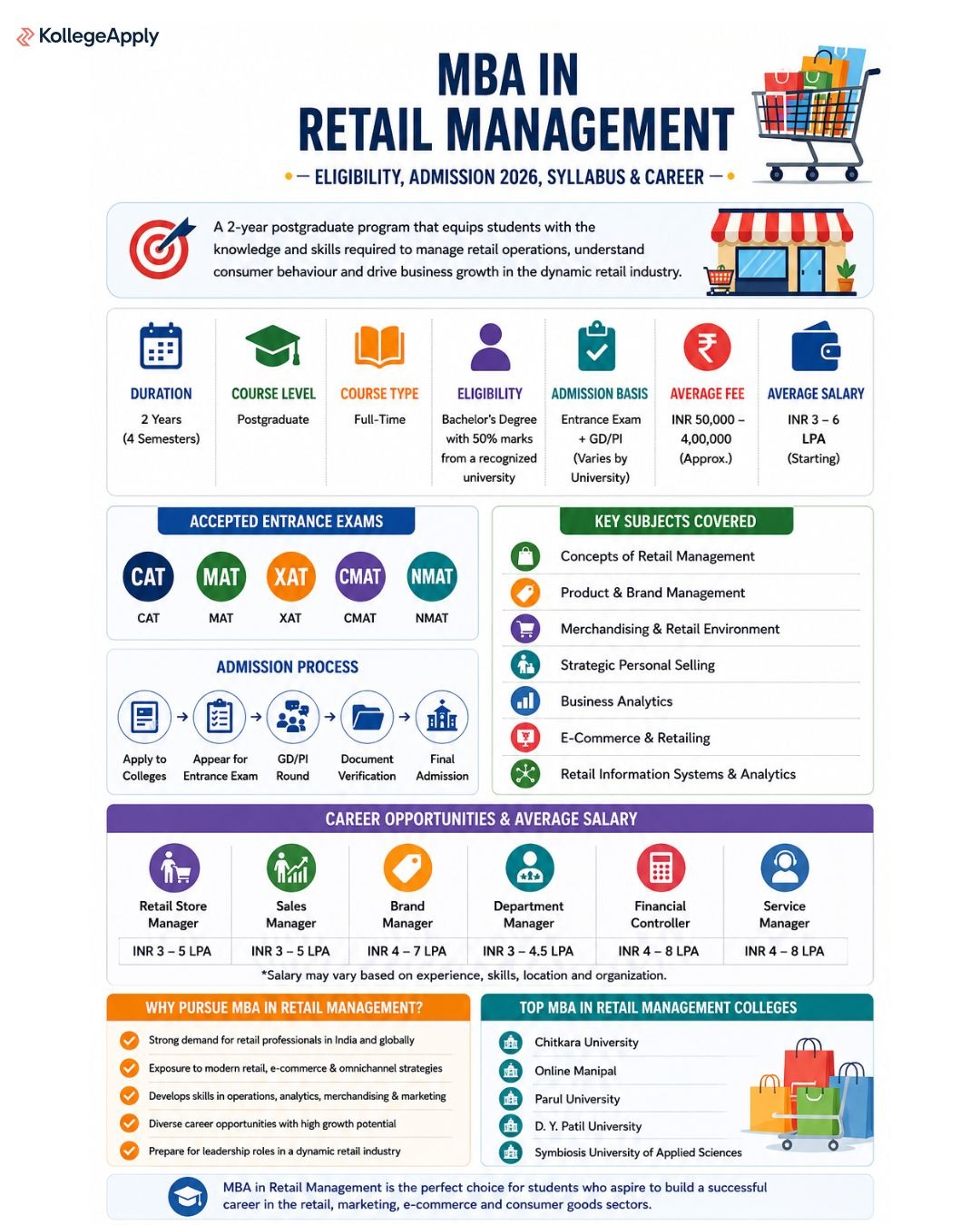
Before taking admission into MBA in Retail Management colleges, students should aim to gather information related to the course. Taking into account all the details associated with the program helps students make informed decisions. Various components such as course duration, fee structure, syllabus, eligibility criteria, admission process, and many more are essential aspects of the program. To gain a better understanding of the key highlights of an MBA in Retail Management, refer to the table provided below:
What is MBA in Retail Management?
MBA in Retail Management is a postgraduate program offered for a duration of two years and structured into four equal semesters. The curriculum consists of core business subjects along with specialised retail-focused topics to help students kickstart their careers in the respective field. The course aims to impart knowledge on how to manage and oversee the distribution and selling of products directly to consumers. Students learn how merchandise is promoted, how to organise employees, handle customer service, and supervise inventories.
Graduates who successfully complete the MBA in Retail Management course learn how to understand customer profiles and acquire the skills required to adjust product supply and predict demand with the objective of increasing profits. Students study various industry-relevant MBA in Retail Management subjects such as Concepts of Retail Management, Product & Brand Management, Merchandising & Retail Environment, Strategic Personal Selling, Business Analytics, and more. Fresh graduates can find opportunities in various job roles such as Retail Store Manager, Department Manager, Brand Manager, and many others.
Why Pursue MBA in Retail Management?
MBA in Retail Management is an appropriate choice for students with a keen interest in the retail, marketing, and consumer goods sectors. The course equips students with industry-relevant knowledge and practical skills required to manage retail operations, understand consumer behaviour, and implement effective business strategies. To understand why Retail Management can be a beneficial course to pursue, refer to the pointers given below:
- Develop a strong understanding of retail operations, merchandising, and store management.
- Gain industry-relevant skills in consumer behaviour, supply chain management, and business analytics.
- Explore career opportunities in organised retail, e-commerce, supermarkets, and retail chains.
- Learn how to create effective marketing and sales strategies to improve customer engagement and business growth.
- Benefit from increasing demand for skilled retail professionals due to the expansion of the retail sector in India and globally.
Is MBA in Retail Management Worth It in 2026?
Yes, pursuing an MBA in Retail Management can be a profitable decision for the students in 2026, especially for individuals interested in the retail, marketing, e-commerce, and consumer goods industries. With the constant increase of organised retail chains, online marketplaces, and omnichannel business models, organizations are actively seeking young professionals who can effectively manage retail operations, customer experiences, inventory systems, and sales strategies.
MBA in Retail Management colleges opens doors to a variety of career opportunities in fields such as retail management, merchandising, brand management, supply chain management, and business development. As consumer preferences continue to evolve and technology becomes more integrated into retail operations, professionals with specialised retail management skills are expected to remain in demand. For students looking to build a career in the dynamic retail sector, an MBA in Retail Management can offer both professional growth and long-term career prospects.
What is the Eligibility Criteria for MBA in Retail Management?
MBA colleges offer the Retail Management course to students only after they meet the specific eligibility requirements set by the respective universities. Candidates are generally required to obtain a minimum qualifying score in their bachelor’s degree and appear for accepted entrance examinations such as CAT, XAT, MAT, NMAT, and others. These criteria play a vital role in evaluating the suitability of applicants for the program and ensuring they possess the necessary academic background and aptitude to pursue advanced management studies. Aspirants can refer to the table given below to gain a better understanding of the eligibility criteria for MBA in Retail Management:
MBA in Retail Management Entrance Exams
Students aspiring for admission to MBA in Retail Management colleges must focus on appearing for the required entrance examinations. There are various types of entrance exams conducted at the national, state, and university levels. CAT, XAT, MAT, GMAT, NMAT, and several other examinations are commonly accepted by institutions offering the program. These entrance tests play an important role in the admission process and help universities assess the aptitude and management potential of candidates. Given below is a table highlighting important information related to MBA in Retail Management entrance exams:
Top MBA in Retail Management Colleges in India
There are several college options available in India in the form of public and private institutions. Students can select a college that aligns with their educational budget, career aspirations, and long-term goals. Choosing the right institution depends on various factors such as location, annual tuition fees, accreditation, placement opportunities, infrastructure, and NIRF rankings. Evaluating these aspects can help candidates make an informed decision regarding their higher education. Students can refer to the table given below to learn more about MBA in Retail Management colleges:
How Does the MBA in Retail Management Admission Process Work?
Students aiming for admission into MBA in Retail Management colleges must thoroughly understand the admission process to ensure a smooth application experience. The process generally begins with fulfilling the prescribed eligibility criteria and visiting the official admission portal of the desired university. Subsequent stages may include filling out the application form, appearing for entrance examinations, participating in interview or group discussion rounds, document verification, and final admission confirmation. For better clarity, a reference to the admission process followed at ITM Business School is provided below:
STEP – 1: Initially, students must visit the official ITM Business School admission portal and fill out the online application form for the MBA program. Candidates are required to pay an application fee of INR 1,500 online to successfully submit their application.
STEP – 2: Complete and submit the application form before the prescribed application deadline. Students are encouraged to apply early as admissions are conducted in multiple selection rounds. Early applicants may have a better chance of securing admission to the program.
STEP – 3: After successful submission of the application form, candidates will receive a unique Application ID. Applicants should keep this ID safe for all future admission-related correspondence.
STEP – 4: Shortlisted candidates will be invited to participate in the selection process. Details regarding the date, time, and mode of the selection process will be communicated through email. Applicants residing outside Mumbai may be given the option to participate online.
STEP – 5: Candidates are evaluated based on multiple parameters, including academic performance, entrance examination scores, performance in the selection process, relevant work experience (if any), and extracurricular achievements. Admission decisions are made after considering the overall profile of the applicant.
Documents Required
What is the Syllabus of MBA in Retail Management?
The MBA in Retail Management is an advanced postgraduate program offered to students for a duration of two years. The curriculum is structured into four equal semesters and comprises core subjects, electives, internships, and project work. The course is designed to equip students with the knowledge and practical skills required to effectively manage various retail functions and business operations.MBA in Retail Management subjects help students become industry-ready professionals capable of handling the retail aspects of a business efficiently. Interested candidates can refer to the syllabus below, based on the curriculum followed by TIEM, to gain a better understanding of the topics covered during the program.
Career Opportunities After MBA in Retail Management
MBA in Retail Management opens the door to a wide range of career opportunities across the retail, e-commerce, consumer goods, and marketing sectors. The program equips students with the managerial, analytical, and customer-focused skills required to handle various retail functions efficiently. Graduates can pursue roles in store operations, brand management, sales, marketing, and departmental supervision. Interested students can check out the table given below to learn more about career scope:
MBA in Retail Management vs MBA in Human Resource Management
It is one of the most important steps before taking admission into any MBA college to identify the specialization that best matches a student’s interests and career aspirations. There are numerous MBA specializations available, including Marketing, Finance, Human Resource Management, Entrepreneurship, Operations, and many others. Each specialization offers a distinct career path and skill set. Human Resource Management (HRM) is one of the popular MBA domains focused on managing an organization's workforce and employee relations. To make an informed choice, students should compare MBA in Retail Management and MBA in Human Resource Management:
MBA in Retail Management FAQs
What is MBA in Retail Management?
MBA in Retail Management is a two-year postgraduate program focused on retail operations, merchandising, sales management, and consumer behaviour.
What is the eligibility criteria for MBA in Retail Management?
The eligibility criteria for MBA in Retail Management generally require a bachelor’s degree with at least 50% marks from a recognised university.
Which entrance exams are accepted for MBA in Retail Management admission?
MBA in Retail Management admission is commonly based on CAT, MAT, XAT, CMAT, NMAT, and other recognised entrance exams.
What is the MBA in Retail Management syllabus?
The MBA in Retail Management syllabus includes Retail Management, Consumer Behaviour, Brand Management, Supply Chain Management, and E-Commerce.
What are the top MBA in Retail Management colleges in India?
Popular MBA in Retail Management colleges include Chitkara University, Parul University, D.Y. Patil University, and Online Manipal.
What is the duration of the Retail MBA course?
The Retail MBA course is usually completed in two years and is divided into four semesters.
What are the career opportunities after MBA in Retail Management?
Career opportunities after MBA in Retail Management include Retail Manager, Store Manager, Brand Manager, Sales Manager, and Department Manager.
What is the salary after MBA in Retail Management?
The salary after MBA in Retail Management typically ranges between INR 3 LPA and INR 6 LPA for fresh graduates.
Is MBA in Retail Management worth pursuing in 2026?
Yes, MBA in Retail Management is worth pursuing in 2026 due to growing opportunities in retail, e-commerce, and consumer goods sectors.
What skills are developed through an MBA in Retail Management?
MBA in Retail Management helps students develop skills in retail operations, inventory management, consumer analytics, and sales strategy.