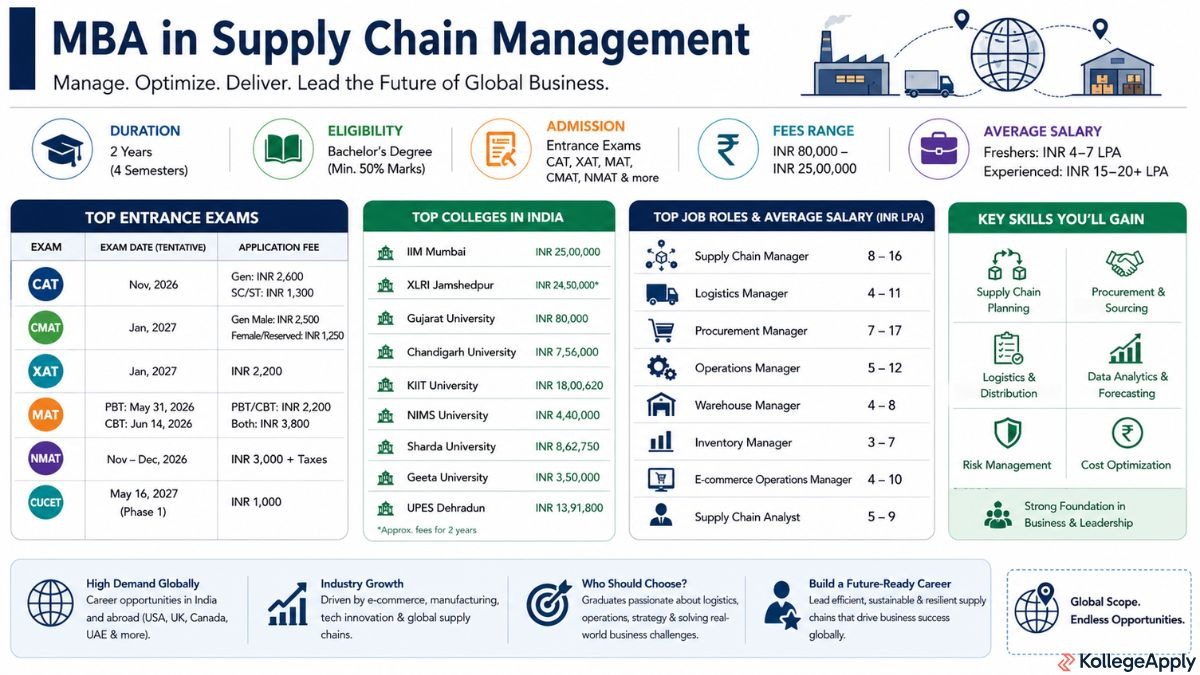
MBA in Supply Chain Management is a 2-year postgraduate program that focuses on logistics, procurement, operations, and end-to-end supply chain planning. It trains students to manage the flow of goods and services efficiently across global businesses. This course is in high demand due to the growth of e-commerce, manufacturing, and data-driven operations. It is ideal for graduates seeking careers in logistics, operations, and global supply chain management.
Candidates must hold a bachelor's degree in any discipline from a recognized university with at least 50% aggregate marks (45% for reserved categories in many institutes). Admission to the program is generally based on performance in national or university-level entrance exams such as CAT, MAT, XAT, CMAT, or NMAT. However, some universities also offer admission based on merit, considering the candidate’s academic performance in their undergraduate studies.
Some of the top colleges offering an MBA in Supply Chain Management in India include IIM Mumbai, Chandigarh University, Geeta University, Gujarat University, Global Institute of Technology and Management (GITM), Sharda University, and NIMS University. The MBA in Supply Chain Management fees generally range from INR 80,000 to INR 25 lakh for the complete program, depending on the institute type, infrastructure, location, and placement support.
After graduation, candidates can pursue careers as Supply Chain Managers, Logistics Managers, Procurement Managers, Operations Managers, Inventory Managers, and Supply Chain Consultants across industries such as manufacturing, retail, e-commerce, FMCG, healthcare, and consulting. Fresh graduates generally earn around INR 4–7 LPA, while experienced professionals can earn INR 15–20 LPA or more by progressing into senior managerial and leadership roles. Global opportunities in countries such as the USA, UK, Canada, and the UAE offer significantly higher salary packages.
- MBA in Supply Chain Management Key Highlights
- What is an MBA in Supply Chain Management?
- Why Study MBA in Supply Chain Management?
- Is MBA in Supply Chain Management Worth It in 2026?
- Eligibility for MBA in Supply Chain Management
- MBA in Supply Chain Management Entrance Exams
- MBA in Supply Chain Management Colleges in India
- MBA in Supply Chain Management Admission Process
- MBA in Supply Chain Management Syllabus
- MBA in Supply Chain Management Skills Required
- MBA in Supply Chain Management Job Opportunities in India
- Top Recruiters for MBA in Supply Chain Management
- MBA in Supply Chain Management VS MBA in Materials Management
- MBA in Supply Chain Management FAQs
MBA in Supply Chain Management Key Highlights
An MBA in Supply Chain Management is a two-year postgraduate program that equips students with expertise in logistics, procurement, inventory management, operations, and global supply chain strategies. The course combines management fundamentals with industry-focused subjects, preparing graduates for careers in manufacturing, retail, e-commerce, consulting, FMCG, and logistics sectors. The table below provides an overview of the MBA in Supply Chain Management course, including eligibility, admission process, fees, syllabus, career opportunities, and salary prospects.
What is an MBA in Supply Chain Management?
MBA in Supply Chain Management is a specialized two-year postgraduate program focused on strategically managing the flow of goods, services, and information throughout a supply chain. It covers key areas like procurement, logistics, inventory management, operations, and distribution. An MBA in Supply Chain Management helps students understand and manage supply chains effectively in a global, fast-paced business environment.
As businesses increasingly rely on efficient supply chains for a competitive edge, an MBA in Supply Chain Management equips graduates to optimize resources, reduce costs, and enhance customer satisfaction. The program combines core business principles like marketing and finance with specialized training in supply chain operations.
The MBA in Supply Chain Management combines theoretical learning with practical experience through internships and industry projects. Graduates can pursue careers in sectors such as manufacturing, retail, e-commerce, and consulting, where supply chain management is essential for business success.
Why Study MBA in Supply Chain Management?
An MBA in Supply Chain Management prepares students to handle procurement, logistics, inventory, transportation, and global operations. With increasing digitization and e-commerce growth, companies require skilled professionals capable of managing complex supply chains efficiently. Some of the reasons to pursue this course are given below:
- An MBA in Supply Chain Management combines business management with logistics expertise, helping students understand modern supply chain systems in depth.
- Growth in e-commerce, global trade, and technology has significantly increased the demand for skilled supply chain professionals.
- Supply chain managers play a crucial role in ensuring timely product delivery, optimizing inventory, reducing costs, and improving overall business efficiency.
- Graduates can pursue leadership roles such as Logistics Manager, Procurement Manager, and Supply Chain Director across industries like manufacturing, retail, healthcare, and technology.
Is MBA in Supply Chain Management Worth It in 2026?
Yes, an MBA in Supply Chain Management remains a valuable management specialization in 2026 due to the increasing need for efficient logistics, procurement, and operations across industries. As businesses adopt automation, AI-driven forecasting, and digital supply chains, organizations are looking for professionals who can optimize costs, improve operational efficiency, and manage global supply networks.
The program is particularly beneficial for graduates who want to build careers in manufacturing, e-commerce, retail, FMCG, healthcare, and consulting. It offers a balanced curriculum that combines core management concepts with specialized knowledge in logistics, procurement, inventory management, and supply chain analytics. Students also gain practical exposure through internships, live projects, and industry interactions, making them job-ready.
Before choosing a college, candidates should compare course fees, placement records, industry collaborations, and ROI before selecting a college. Graduates from reputed institutes often secure better placement opportunities and faster career progression, making the program a worthwhile investment for those seeking long-term growth in operations and supply chain management.
Eligibility for MBA in Supply Chain Management
Candidates seeking admission to an MBA in Supply Chain Management must meet the eligibility criteria prescribed by the respective university or business school. While the basic requirements are similar across most institutions, certain colleges may have additional admission criteria such as entrance exam scores, work experience, or personal interviews. The detailed eligibility requirements are given below:
- Educational Qualification: Candidates must hold a bachelor's degree in any discipline from a recognized university or institution. Graduates from Commerce, Science, Arts, Engineering, Pharmacy, and other streams are eligible to apply.
- Minimum Marks: Most institutes require a minimum of 50% aggregate marks (45% for reserved categories in many institutions) in the qualifying bachelor's degree under the 10+2+3 or 10+2+4 education pattern.
- Entrance Exam Requirement: Admission is primarily based on national, state, or university-level management entrance exams such as CAT, XAT, MAT, CMAT, NMAT, SNAP, ATMA, or institute-specific entrance tests. Some universities also offer merit-based admission.
- Final-Year Students: Candidates appearing in the final year of their bachelor's degree can also apply, provided they submit their final mark sheets and degree certificate within the timeline specified by the institute.
- Academic Background: There is no mandatory requirement to have studied Supply Chain Management at the undergraduate level. However, candidates with knowledge of business, operations, logistics, mathematics, or analytical subjects may find the program easier to grasp.
- Selection Process: In addition to entrance exam scores, many premier institutes shortlist candidates based on academic performance, followed by Group Discussion (GD), Written Ability Test (WAT), Personal Interview (PI), and, in some cases, relevant work experience.
MBA in Supply Chain Management Entrance Exams
Admission to MBA in Supply Chain Management programs in India is primarily based on national, state, or university-level management entrance exams. The scores obtained in these exams are accepted by IIMs, private universities, and other leading B-schools offering Supply Chain Management specialisations. Candidates should regularly check the official websites for the latest application schedules, eligibility criteria, syllabus, and counselling updates, as exam dates and fees may change every year.
MBA in Supply Chain Management Colleges in India
Pursuing MBA in Supply Chain Management from a reputable college will improve your professional prospects. Some of the top colleges offering MBA Supply Chain Management in India include:
Note: Students can also check the MBA in Supply Chain Management Fees article to compare fees across government and private colleges before selecting an institute.
MBA in Supply Chain Management Admission Process
The admission to MBA SCM is based on the entrance exams such as CAT/MAT/XAT/CMAT/NMAT etc. The student needs to appear in one of these exams in order to pursue the course. However, some universities also offer admission based on the merit of the candidate. The admission process may vary across institutions. The following steps illustrate the typical admission process followed by leading business schools such as IIM Mumbai:
Step 1: Candidates must ensure they match the eligibility requirements, including a bachelor's degree with at least 50% marks (45% for SC/ST/PwD candidates) from a recognized institution.
Step 2: Candidates must take the Common Admission Test (CAT), which is usually held in November. The CAT exam measures candidates' quantitative ability, data interpretation, verbal skills, and reading comprehension.
Step 3: After the CAT results are declared, candidates should check and match the requirements for IIM Mumbai's MBA Supply Chain Management program.
Step 4: Based on the candidates' CAT results, academic history, and other variables, IIM Mumbai will shortlist for the Written Ability Test and Personal Interview rounds.
Step 5: Candidates must attend the WAT and PI sessions, during which they will be evaluated on their communication abilities, leadership potential, and overall personality.
Step 6: The final selection is based on the candidate’s academic performance, entrance test score (if applicable), and overall eligibility criteria as defined by the university. If selected, the candidate will be required to submit documents for verification.
Step 7: Upon successful document verification and payment of the required fees, the admission process will be completed and the candidate’s seat will be confirmed.
Documents Required:
Make sure to keep the following documents ready for admission in the MBA in Supply Chain Management:
MBA in Supply Chain Management Syllabus
MBA in Supply Chain Management is one of the most popular MBA specializations. MBA Supply Chain Management subjects focus on the operations, marketing, business communication, planning, management, and optimization of the company's resources. Here is the MBA Supply Chain Management syllabus for Kalinga Institute of Industrial Technology (KIIT), organized semester-wise in the table mentioned below:
MBA in Supply Chain Management Skills Required
An MBA in Supply Chain Management equips students with technical and managerial skills required to manage procurement, logistics, inventory, and global supply chain operations. Besides classroom learning, employers also look for professionals with strong analytical and leadership capabilities.
MBA in Supply Chain Management Job Opportunities in India
An MBA in Supply Chain Management opens up career opportunities across industries such as manufacturing, e-commerce, FMCG, retail, healthcare, automobile, logistics, and consulting. Graduates are recruited for roles involving procurement, inventory management, warehouse operations, logistics planning, demand forecasting, and end-to-end supply chain optimization. Career progression depends on factors such as experience, technical expertise, industry, and the size of the organization. Professionals usually begin with operational and analytical roles before advancing to managerial and strategic leadership positions.
The table below highlights some of the popular MBA in Supply Chain Management job opportunities in India, along with the typical experience required, leading recruiters, and average salary ranges.
Note: Fees are approximate and may vary depending on scholarships, hostel charges, and other institutional components. Students looking for a detailed salary analysis based on experience, designation, top-paying cities, and international opportunities can refer to the dedicated Supply Chain Management Jobs and Supply Chain Manager Salary articles.
Top Recruiters for MBA in Supply Chain Management
MBA in Supply Chain Management graduates are recruited by leading organizations across industries such as e-commerce, logistics, FMCG, manufacturing, and consulting. These companies seek professionals with expertise in procurement, inventory management, logistics, operations, and supply chain optimization. The table below highlights some of the top recruiters for MBA in Supply Chain Management based on industry.
MBA in Supply Chain Management VS MBA in Materials Management
Both MBA in Supply Chain Management and MBA in Materials Management are popular specializations in operations and logistics, but they differ in terms of curriculum, career scope, and industry focus. While Materials Management primarily focuses on procurement, inventory control, warehousing, and the efficient use of raw materials within an organization, Supply Chain Management takes a broader approach by managing the complete flow of goods, services, information, and finances from suppliers to end customers. Candidates should compare the course objectives, skill requirements, career opportunities, and salary prospects before choosing the specialization that best aligns with their career goals.
MBA in Supply Chain Management FAQs
Is an MBA good for supply chain management?
Yes, MBA in Supply Chain Management is a strong career choice because it offers high demand roles in logistics, procurement, and operations across global industries like e-commerce, and manufacturing.
What is the eligibility of the MBA in Supply Chain management?
To pursue MBA in Supply Chain Management, candidates must hold a bachelor’s degree with at least 50% marks. Admissions are usually through CAT, MAT, XAT, or CMAT exams.
What are the subjects in the MBA Supply Chain Management syllabus?
MBA in Supply Chain Management includes subjects like logistics, procurement, operations management, supply chain analytics, inventory control, and distribution management.
Which MBA is highest in demand?
MBA in Supply Chain Management, Finance, and Business Analytics are among the most in-demand specializations due to growing global trade and data-driven business needs.
Is supply chain a good career in 2026?
Yes, supply chain management is a high-growth career in 2026 due to increasing global trade, digital supply chain transformation, and rising demand in e-commerce and manufacturing sectors.
What colleges offer MBA Supply Chain management programs?
Top colleges for MBA in Supply Chain Management include IIM Mumbai, Sharda University, Chandigarh University, NIMS University, and Geeta University in India.
What are the fees for an MBA Supply Chain management course?
MBA in Supply Chain Management fees in India range from INR 80,000 to INR 25 lakhs depending on college type, infrastructure, and placement opportunities.
What is the MBA in Supply Chain management scope?
MBA in Supply Chain Management offers strong scope in logistics, operations, and consulting with career opportunities in Amazon, Flipkart, DHL, and global firms.
What is the average salary after MBA in Supply Chain Management?
Fresh MBA graduates generally earn INR 4–7 LPA. With experience, professionals can earn INR 15–20 LPA or more in senior supply chain, procurement, logistics, and consulting roles.
Can I opt to pursue an online MBA in supply chain management course?
Yes, you can opt for an online MBA in Supply Chain Management, as several universities now offer flexible online or distance learning programs in this specialization.