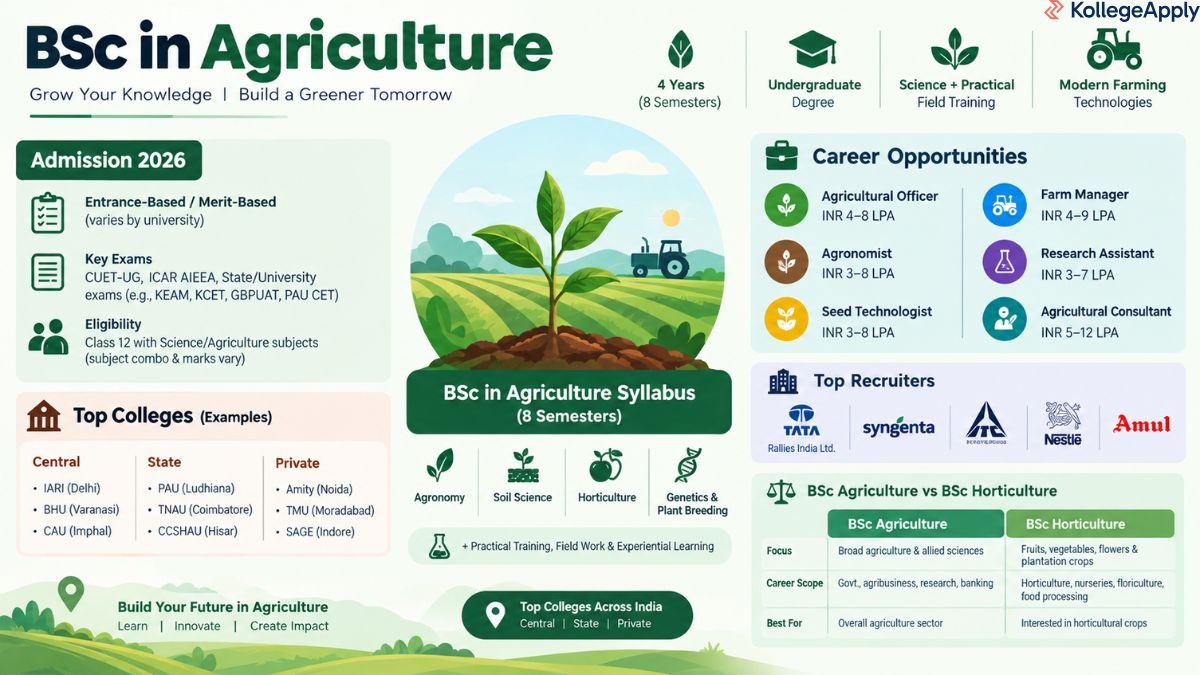
BSc in Agriculture is a four-year undergraduate degree that combines agricultural science with practical field training, laboratory work and modern farming technologies. The BSc in Agriculture course covers areas such as agronomy, soil science, horticulture, genetics and plant breeding, agricultural economics, entomology, plant pathology, agricultural engineering and extension education. The programme is generally structured across eight semesters and includes practical exposure to crop production and farm management.
Students who have completed Class 12 with relevant Science or Agriculture subjects can apply for BSc in Agriculture, although the exact subject combination and minimum marks vary by university. Admission may be through CUET-UG, university-level entrance examinations or state-level admission processes. For the 2026-27 academic year, ICAR's All India Quota admissions to undergraduate agriculture and allied programmes are linked to CUET (UG)-2026, while universities such as GB Pant University and Punjab Agricultural University also conduct their own admission processes.
After completing BSc in Agriculture, graduates can pursue careers in agricultural departments, agribusiness, seed and agrochemical companies, food processing, banking, agricultural extension, research and farm management. Higher studies such as MSc Agriculture, MBA/PGDM in Agribusiness and PhD can further expand career options. Salary varies substantially by employer, role, location, experience and recruitment route; government and research positions follow prescribed pay structures, while private-sector packages differ by organisation.
- BSc in Agriculture Key Highlights
- What is BSc in Agriculture?
- Why Pursue BSc in Agriculture?
- Is BSc in Agriculture Worth It in 2026?
- BSc in Agriculture Eligibility Criteria
- BSc in Agriculture Entrance Exam 2026
- Top BSc in Agriculture Colleges in India
- BSc in Agriculture Admission Process 2026
- BSc in Agriculture Syllabus 2026
- BSc in Agriculture Jobs & Salary
- BSc in Agriculture vs BSc in Horticulture
- BSc in Agriculture FAQs
BSc in Agriculture Key Highlights
This section gives a quick snapshot of the BSc in Agriculture course details like academic structure, duration, eligibility, fee range, and career outcomes. The highlights reflect common course details followed by central universities, state agricultural universities, and private institutions. Check out the table given below for more info:
What is BSc in Agriculture?
The full form of BSc in Agriculture is Bachelor of Science in Agriculture. It is a 4-year undergraduate applied science degree and a professional discipline, combining biological sciences that integrate biology, chemistry, environmental science, with modern technology and farm management practices.
Some of the courses provided under the BSc in Agriculture are Agronomy, Horticulture, Soil Science, Agricultural extension, Farm management and many more popularly required subjects in agriculture. Practical training is an important component of the degree. Students may undertake crop production exercises, laboratory experiments, field visits, rural agricultural activities, experiential learning and internships.
ICAR's Student READY initiative specifically focuses on providing agricultural undergraduates with practical experience, rural entrepreneurship awareness and exposure to real-life agricultural situations. Agricultural universities such as GB Pant University offer BSc Agriculture as an eight-semester programme, while their academic structure also provides progression into several specialised master's and doctoral areas.
Why Pursue BSc in Agriculture?
Agriculture remains one of India’s largest employment-generating sectors, and its shift towards technology-driven farming has increased demand for skilled professionals. The course offers stable career prospects along with long-term growth opportunities. BSc in Agriculture is suitable for students who want a blend of science, fieldwork, and management studies with strong relevance to national development.
- Wide career base: Graduates can work in agriculture departments, agribusiness, banking, food processing, research, seed technology and farm management.
- Practical learning: The course combines classroom education with laboratory work, field experiments, rural exposure and experiential learning.
- Government-sector opportunities: Agriculture graduates can appear for recruitment processes for agriculture-related positions, including Agricultural Officer and Agricultural Field Officer roles, subject to the eligibility rules of the particular recruitment.
- Growing agritech exposure: Precision agriculture, remote sensing, drones, protected cultivation, biotechnology and data-driven farm management are expanding the technical scope of agriculture.
- Higher-study opportunities: Graduates can pursue MSc Agriculture, MBA/PGDM in Agribusiness, specialised master's programmes or PhD.
- Entrepreneurship: Knowledge of crop production, post-harvest management and agribusiness can support ventures in farming, agri-inputs, food processing, nursery management and agricultural services.
Is BSc in Agriculture Worth It in 2026?
BSc in Agriculture remains relevant because agriculture is increasingly connected with biotechnology, climate-resilient farming, soil health, precision agriculture, food processing and digital technologies. ICAR continues to support agricultural education, research and practical training, while its network includes state agricultural universities, central agricultural universities and ICAR institutions.
Career outcomes depend strongly on specialisation, institution, internships, competitive-exam preparation and additional qualifications. Graduates seeking research-oriented positions may need postgraduate qualifications, while those entering private agribusiness can begin with field, sales, technical or management-oriented roles. For example, ICAR's agricultural management programmes have documented placements in agribusiness companies, demonstrating the value of specialised management education after an agriculture degree.
Technology is also changing the skill requirements in agriculture. Soil testing, GIS and remote sensing, farm mechanisation, protected cultivation, biotechnology, data analysis and digital agriculture can complement traditional agricultural knowledge and create additional career pathways.
BSc in Agriculture Eligibility Criteria
Candidates must meet minimum academic and age requirements set by universities and admission authorities. These ensure students possess the foundational science knowledge required for the Program. Eligibility is not completely uniform across India. Students should check the specific university's subject combination and marks requirement before applying.
- Minimum qualification: Class 12 or equivalent from a recognised board.
- Required subjects: Common combinations include PCB, PCM, PCMB, Agriculture or specified combinations of these subjects.
- Minimum marks: Many universities use 50% or higher requirements, while some agricultural universities prescribe different thresholds.
- Reserved-category relaxation: Applicable where provided under the university's admission rules.
- Age limit: Varies by university and admission route.
- Entrance requirement: Candidates may need CUET-UG, a university entrance examination or another prescribed admission route.
For example, GB Pant University specifies four-year BSc (Hons.) Agriculture and has separate eligibility provisions involving Agriculture/Science with Mathematics or Biology. Its 2026 prospectus also specifies detailed academic conditions for undergraduate applicants.
For ICAR-UG admissions, eligibility and subject combinations are programme and university specific. The 2026 ICAR bulletin directs candidates to the relevant university requirements and identifies different Class 12 subject combinations for participating programmes.
BSc in Agriculture Entrance Exam 2026
For admission in BSc in Agriculture, some colleges may require an entrance exam or accept entrance exam scores. BSc Agriculture admission does not require NEET. Agriculture programmes generally use CUET-UG, university entrance tests or state/university-specific admission procedures. The BSc in Agriculture entrance exams that might be required for the admission are listed below:
Top BSc in Agriculture Colleges in India
India has a large network of agricultural universities and institutions. ICAR's official list includes state agricultural universities such as Punjab Agricultural University, TNAU, CCS HAU, GBPUAT and many others. Below are some top Central, State and Private colleges options for pursuing a BSc in Agriculture course:
Choose the Right BSc in Agriculture College
Choosing a BSc in Agriculture college involves more than comparing tuition fees. Students should consider the university’s academic reputation in agriculture, admission route, practical and field-based training, research exposure, campus facilities and overall cost of study. The NIRF Agriculture and Allied Sectors ranking can provide an additional reference point when comparing institutions, while the admission process may differ across universities.
The table below compares selected BSc Agriculture colleges on location, approximate tuition fees, NIRF Agriculture ranking and admission route. Fee figures may vary by academic year and category, so students should verify the latest fee structure on the respective university’s official website before applying.
BSc in Agriculture Admission Process 2026
To get admission in BSc in Agriculture, students need to know the admission process and must meet the eligibility criteria. The process might differ for different colleges and universities, this admission process will give you a rough idea of what is the process that one has to go through for getting admission in a particular college/university. Here is the admission process of BHU:
Step 1: Students are required to check the admission brochure that has all the information regarding.
Step 2: Students should read and understand the requirement for the eligibility of the BSc in Agriculture course.
Step 3: BHU gives the admission on the basis of rank in the CUET-UG. So one must register for the CUET-UG application process 2026 with the required subjects to opt for the BSc in Agriculture course.
Step 4: To register for the CUET exam online, they must fill in their correct personal and academic information, upload all the required documents and then proceed with the admission fee payment.
Step 5: The student now checks the date of the entrance examination on the official website of DU and then compulsorily appears for the examination on the specified date.
Step 6: After the announcement of the CUET results once must visit the website again for their results, they must download their scorecard and save it for future reference. Qualified candidates must compulsorily Register for counseling on the BHU SAMARTH Portal.
Step 7: The students will be allotted seats on the basis of counseling.
Step 8: Lastly, students must confirm their admission by paying the admission fees within the given time to secure the seat allotted .
Document required:
BSc in Agriculture Syllabus 2026
The BSc in Agriculture syllabus at Kumaraguru Institute of Agriculture is structured across eight semesters and combines agricultural sciences with practical training, field-based learning, farm management, technology, entrepreneurship and experiential learning. The curriculum includes subjects such as agronomy, soil science, horticulture, plant pathology, entomology, genetics, agricultural economics, farm machinery, biotechnology and crop production. The later semesters place greater emphasis on practical crop production, Student READY/RAWE, project work and specialised experiential learning.
Semester-Wise BSc in Agriculture Subjects
Practical Training in the BSc Agriculture Syllabus
The KIA curriculum gives significant weight to practical and field-based learning, rather than limiting the programme to classroom subjects. Semester VII includes the Student READY Programme, covering Rural Agricultural Work Experience and Agro-Industrial Attachment, along with project preparation and an All India Study Tour. Semester VIII is dedicated to experiential learning, where students can undertake specialised modules such as commercial seed production, beekeeping, mushroom production, plant tissue culture, protected cultivation and agribusiness-related training.
BSc in Agriculture Jobs & Salary
BSc in Agriculture graduates can work in technical, managerial, extension, and research roles across public and private sectors. Career opportunities exist in government departments, agribusiness companies, seed and fertilizer firms, food processing industries, and banks. With experience and higher education, graduates can move into senior technical and leadership positions.
Note: The figures are indicative private-sector ranges rather than guaranteed salaries. Government and research roles may follow prescribed pay scales, while private-sector compensation varies by employer, location, role and experience.
To check out the complete Jobs, Career Scope & salary details, click BSc Agriculture Career.
BSc in Agriculture vs BSc in Horticulture
BSc Agriculture and BSc Horticulture are related but have different academic emphases. Agriculture provides broader exposure to crop production, soil, economics, extension and allied agricultural sciences, while horticulture concentrates more specifically on fruits, vegetables, flowers, plantation crops and related production systems.
BSc in Agriculture FAQs
Is BSc in Agriculture a good career choice in 2026?
Yes, BSc in Agriculture is a good career choice in 2026, with rising demand in sustainable farming, agritech, food security, and opportunities in government, private firms, research, and startups.
Can PCB students apply for BSc in Agriculture?
Yes, Students who studied Physics, Chemistry, and Biology in Class 12 are eligible for BSc in Agriculture in most universities.
What is the BSc in Agriculture salary for freshers?
Fresh graduates commonly earn around INR 3–6 LPA, although salary varies by employer, role, location and recruitment route.
What higher studies options are available after BSc in Agriculture?
Students can pursue MSc Agriculture in various specialisations, MBA in Agribusiness, or PhD Programs. Many also prepare for competitive exams such as UPSC and banking AFO exams.
Is BSc in Agriculture 3 years or 4 years?
BSc in Agriculture is a 4-year undergraduate degree program consisting of eight semesters, a full-time course focused on agricultural science, technology, plant breeding, and farming methods.
Does a BSc in Agriculture involve practical training?
Yes, BSc in Agriculture blends scientific theory with hands-on field experience. The course includes laboratory work, field experiments, rural internships, and industrial training.
Does BSc in Agriculture need Neet?
No, a Neet result is generally not required for BSc in Agriculture admission in India, admission are primarily based on national-level entrance exams like ICAR AIEEA or CUET, as well as various state-level tests (e.g., MHT CET, TS EAMCET, UPCATET)
Is agriculture hard to study?
Agriculture is one of the best subjects for a BSc course level and less demanding than engineering and other similar challenging subjects.
Can I do MSc after BSc in Agriculture?
Yes, Graduates can pursue MSc Agriculture in areas such as Agronomy, Soil Science, Horticulture, Genetics or Plant Pathology.
What jobs can I get after BSc in Agriculture?
Graduates can work as Agricultural Officers, Agronomists, Farm Managers, Field Officers, Seed Technologists and Agricultural Consultants.
Is BSc in Agriculture difficult to study?
The course combines science, fieldwork and practical training. Students interested in biology, crops and applied science can adapt well to its curriculum.