The JEE Advanced Cutoff 2026 is used in two different ways: the qualifying cutoff required for inclusion in the rank list and the admission cutoff used during JoSAA counselling. For BTech CSE aspirants, the admission cutoff is particularly important because clearing the qualifying marks does not guarantee admission to an IIT or to Computer Science and Engineering. The actual admission cutoff varies by IIT, category, programme, counselling round and seat type.
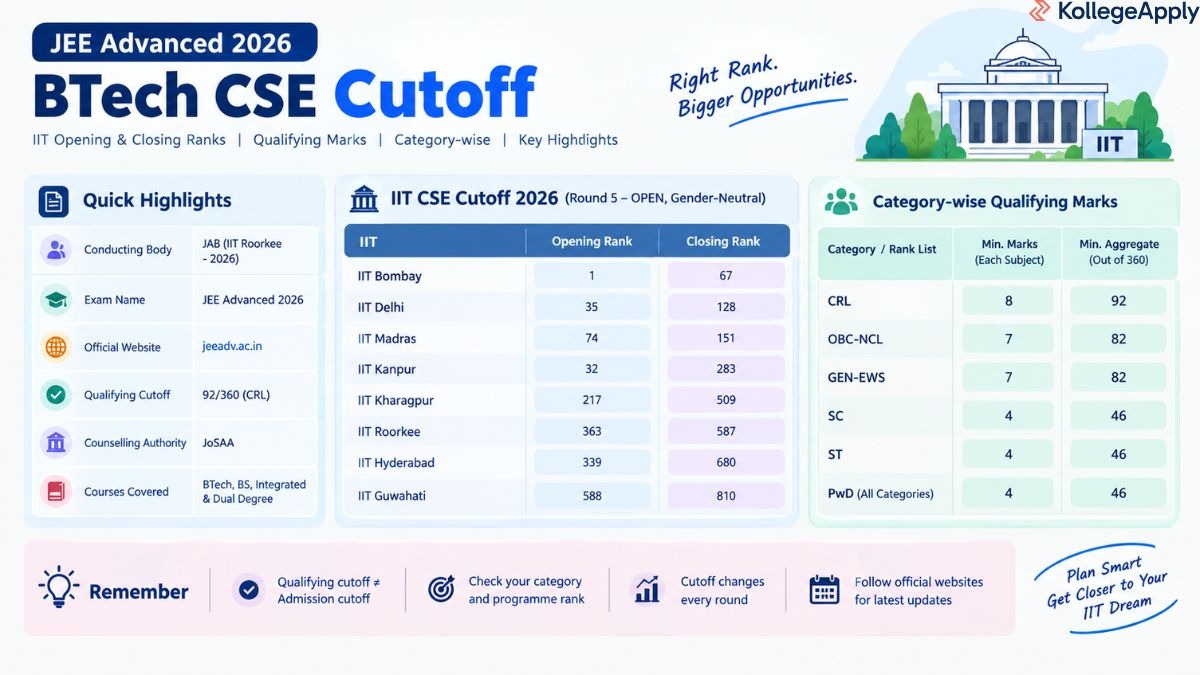
In JEE Advanced 2026, the Common Rank List (CRL) qualifying cutoff was 92 marks out of 360, with candidates required to score at least 8 marks in each subject. However, IIT CSE admission required substantially better ranks at most institutes. For example, in the final JoSAA 2026 round, BTech CSE closed at AIR 67 at IIT Bombay, AIR 128 at IIT Delhi and AIR 151 at IIT Madras for OPEN gender-neutral seats. These figures show why students should compare their actual JEE Advanced rank with the relevant IIT CSE closing rank rather than relying only on the qualifying cutoff.
Table of Contents
- JEE Advanced Cutoff 2026: Quick Highlights
- What is JEE Advanced Cutoff 2026?
- JEE Advanced Cutoff 2026: Latest Updates
- JEE Advanced Cutoff 2026: Category-wise Qualifying Marks
- IIT CSE Cutoff 2026: Category-wise Admission Ranks
- IIT CSE Cutoff 2026: Round-wise Changes
- IIT CSE Cutoff 2026: College-wise Opening & Closing Ranks
- BTech CSE Cutoff: Branch-wise Competition
- JEE Advanced Cutoff Previous Year Trend
- Factors Affecting JEE Advanced Cutoff
- JEE Advanced 2026 Marks vs Rank
- JEE Advanced Cutoff 2027: What Can Students Expect?
- Counselling After JEE Advanced Cutoff
- How to Check the Official JEE Advanced Cutoff
- Documents Required During JoSAA Counselling
- Tips to Get BTech CSE Despite a Higher Rank
- FAQs on JEE Advanced Cutoff
JEE Advanced Cutoff 2026: Quick Highlights
The JEE Advanced cutoff has two separate meanings: the qualifying cutoff released with the JEE Advanced result and the admission cutoff represented by opening and closing ranks during JoSAA counselling. For BTech CSE aspirants, the second figure is usually more useful because clearing the qualifying marks does not guarantee an IIT seat. JEE Advanced 2026 was conducted by IIT Roorkee, while JoSAA managed the subsequent IIT seat allocation process.
What is JEE Advanced Cutoff 2026?
The JEE Advanced Cutoff 2026 is not a single number. The exam authority first sets minimum marks for inclusion in rank lists, while the actual IIT admission cutoff is determined by the rank at which seats are allotted through JoSAA. Therefore, a student can qualify JEE Advanced but still miss BTech CSE at a preferred IIT because the programme closes at a much better rank.
- Qualifying Cutoff - The qualifying cutoff is the minimum subject-wise and aggregate score required for inclusion in a JEE Advanced rank list. In 2026, the Common Rank List required 8 marks in each subject and 92 marks in aggregate out of 360. The OBC-NCL and GEN-EWS rank lists required 7 marks in each subject and 82 aggregate marks.
- Admission Cutoff - The admission cutoff is the opening and closing JEE Advanced rank at which a programme receives seat allocations through JoSAA. For example, IIT Bombay BTech CSE had an OPEN-category opening rank of 1 and closing rank of 67 in the final JoSAA 2026 IIT round.
- Opening Rank - The opening rank is the best rank at which a seat was allotted for a particular programme, category, quota and gender pool in a counselling round.
- Closing Rank - The closing rank is the last rank at which a seat was allotted for that specific programme and seat category in that round. A lower closing rank indicates stronger competition.
JEE Advanced Cutoff 2026: Latest Updates
JEE Advanced 2026 results were declared on June 1, 2026. A total of 1,79,694 candidates appeared in both papers and 56,880 candidates qualified. The highest CRL score was 330 out of 360. After the result, qualified candidates had to participate in JoSAA to be considered for IIT admission.
Latest 2026 Cutoff Updates
- JEE Advanced 2026 result: June 1, 2026
- Candidates appeared in both papers: 1,79,694
- Candidates qualified: 56,880
- JEE Advanced 2026 CRL qualifying marks: 92/360
- JoSAA Round 1: June 13, 2026
- JoSAA Round 4: July 10, 2026
- JoSAA Round 5: July 16, 2026
- Round 5 was the final IIT/IISc seat-allocation round in JoSAA 2026.
For 2027 preparation, students should continue monitoring the official JEE Advanced portal. Or students can also check the JEE Advanced 2027 guide.
JEE Advanced Cutoff 2026: Category-wise Qualifying Marks
JEE Advanced prepares separate rank lists for different categories. The qualifying threshold therefore differs by category, but these marks only determine whether a candidate enters the relevant rank list. They do not represent the rank needed for BTech CSE at an IIT. For admission, candidates must compare their category rank with the programme-specific JoSAA closing rank.
Note: The aggregate is calculated out of 360 marks. Candidates must satisfy both the subject-wise and aggregate requirements for inclusion in the relevant rank list.
IIT CSE Cutoff 2026: Category-wise Admission Ranks
Category-wise admission cutoffs are different from qualifying marks. JoSAA reports opening and closing ranks according to the seat type, category, gender pool and quota. For example, the final 2026 IIT Bombay CSE cutoff for OPEN gender-neutral seats closed at 67, while the EWS, OBC-NCL, SC and ST closing ranks were 20, 62, 39 and 16 respectively.
The table below gives IIT Bombay CSE as a clear example of how category-wise admission cutoffs work. Candidates should use the official JoSAA OR-CR dashboard for their own category and target IIT.
Important: Open-seat ranks are represented using CRL, whereas EWS, OBC-NCL, SC and ST seats use their respective category ranks. PwD seats use the relevant PwD rank.
IIT CSE Cutoff 2026: Round-wise Changes
JoSAA 2026 conducted five seat-allocation rounds for IITs and IISc. The official schedule specifically identifies Round 5 as the final round for IITs/IISc. Therefore, students should not apply the NIT+ counselling structure of later special rounds to IIT CSE admissions. Cutoffs can move between rounds as candidates withdraw, freeze or upgrade their seats. JoSAA states that after each allotment round, institute-wise allotment results and opening/closing ranks are published.
IIT CSE Cutoff 2026: College-wise Opening & Closing Ranks
For BTech CSE aspirants, the most useful 2026 reference is the final Round 5 OPEN, gender-neutral, All India cutoff. These ranks show the range within which CSE seats were allotted at selected IITs. The table should be read as a benchmark rather than a guaranteed 2027 admission range because seat matrix, candidate preferences and rank distribution can change.
The table shows why BTech CSE JEE Advanced Cutoff should be evaluated IIT-wise. IIT Bombay and IIT Delhi remained within the top 130 ranks, while CSE at several newer IITs closed between roughly 1,600 and 4,900. A higher rank therefore does not automatically mean that IIT CSE is unavailable; it changes the set of realistic institutes.
BTech CSE Cutoff: Branch-wise Competition
Computer Science and Engineering remained among the most competitive IIT programmes in 2026. However, candidates should also compare closely related computing branches such as Artificial Intelligence, Mathematics & Computing, Data Science and Electrical Engineering. At some IITs, these programmes have different seat matrices and demand levels, so their closing ranks can be substantially different from CSE.
The right choice should therefore consider both institute and branch. A candidate narrowly focused on software careers may prefer a computing-related programme at a slightly lower-ranked IIT over a branch they do not want at a more preferred institute.
JEE Advanced Cutoff Previous Year Trend
Comparing 2026 with 2025 helps students understand whether competition became tighter or more flexible. However, a higher closing rank does not automatically mean that the exam became easier; the movement can also result from seat changes, candidate preferences, programme additions and the way students filled their JoSAA choices.
The movement is mixed rather than uniformly upward or downward. For example, IIT Madras CSE closed at a better rank in 2026, while IIT Kharagpur and IIT Bhubaneswar closed at higher ranks. This is why using one previous-year cutoff as a fixed prediction for 2027 can be misleading.
Factors Affecting JEE Advanced Cutoff
The JEE Advanced Cutoff marks 2026 and IIT admission ranks are influenced by several variables. Some affect the qualifying threshold directly, while others influence the closing rank during JoSAA. Students should therefore treat previous-year cutoff data as a reference range rather than a guaranteed admission boundary for the next cycle.
- Number of candidates: A change in the number of high-performing candidates can alter rank distribution.
- Difficulty level: A tougher or easier paper can significantly change marks corresponding to a particular rank.
- Number of seats: Changes in the IIT seat matrix can affect closing ranks.
- Reservation: Category-wise seat allocation changes the rank required for different seat types.
- Candidate preferences: Popular programmes such as CSE attract candidates with very high ranks.
- Counselling participation: Seat acceptance, withdrawal and upgrades influence later rounds.
- New programmes: New AI, computing or interdisciplinary programmes can redistribute candidate choices.
- Seat matrix: The number of gender-neutral, female supernumerary and category-specific seats can affect the final closing rank.
JEE Advanced 2026 Marks vs Rank
There is no permanent marks-to-rank conversion in JEE Advanced. The relationship changes every year because the paper difficulty and candidate performance distribution change. In 2026, the maximum aggregate was 360, the CRL qualifying threshold was 92, and the AIR 1 candidate scored 330. Therefore, students should use marks-vs-rank tables only as indicative planning tools and rely on the official result for the actual rank.
What rank is 130 marks in JEE Advanced 2026?
There is no official fixed rank for 130 marks. JEE Advanced prepares ranks from the complete candidate score distribution, so the same marks can correspond to different ranks in different years. For 2027 planning, students should compare their actual JEE Advanced rank with the JoSAA CSE closing ranks rather than treating 130 marks as a guaranteed rank or college predictor.
JEE Advanced Cutoff 2027: What Can Students Expect?
The 2026 cutoff is useful as a baseline for 2027, but an official JEE Advanced 2027 cutoff does not exist before the examination and result. The organising institute, exam pattern, qualifying marks and candidate performance can affect the final numbers. Therefore, the safest 2027 strategy is to use 2026 CSE closing ranks as target benchmarks rather than publishing unsupported numerical predictions. For 2027 preparation:
- Top IIT CSE: Target a rank comfortably better than the previous closing rank.
- Older IITs: Keep CSE, AI, Mathematics & Computing and Electrical options together.
- Newer IITs: Consider CSE at institutes where 2026 closing ranks extended into the 1,500–5,000 range.
- Category candidates: Use the relevant category rank, not only CRL.
- Choice filling: Include realistic, moderate and ambitious choices instead of relying on one IIT.
As of the latest available official 2026 material, the 2027 official information brochure and cutoff have not yet been released. Students should follow the official JEE Advanced portal for the eventual notification and use the KollegeApply JEE Advanced page for consolidated upcoming-exam information.
Counselling After JEE Advanced Cutoff
Clearing the JEE Advanced qualifying cutoff is only the first step. A qualified candidate must participate in JoSAA and submit programme preferences to be considered for IIT admission. The official JEE Advanced FAQ specifically states that qualified candidates must register with JoSAA and fill their course choices within the prescribed timeline. JoSAA explains that candidates must upload documents, submit willingness and pay the seat acceptance fee after allocation to retain the allotted seat.
- JEE Advanced Result: Check aggregate marks, rank and qualifying status.
- JoSAA Registration: Register within the counselling window.
- Choice Filling: Add IITs and programmes in preference order.
- Choice Locking: Review the complete preference list before the deadline.
- Seat Allotment: Check the allotted IIT and programme.
- Document Upload: Submit the documents requested by JoSAA.
- Fee Payment: Pay the applicable seat acceptance fee.
- Willingness: Select Freeze, Float or Slide where applicable.
- Final Reporting: Complete the institute's admission/reporting requirements after allocation.
How to Check the Official JEE Advanced Cutoff
The official qualifying cutoff is available through the JEE Advanced result information, while IIT-wise admission cutoffs are available through the JoSAA Opening and Closing Rank system. Students should not rely on a generic "IIT cutoff" because the rank changes by institute, programme, category, quota and gender pool.
Steps to Check JEE Advanced Qualifying Cutoff
- Visit the official JEE Advanced website.
- Open the 2026 result or result press release.
- Check the rank-list inclusion criteria.
- Compare the marks with the applicable category.
Steps to Check IIT CSE Admission Cutoff
- Visit JoSAA official website.
- Open Opening and Closing Ranks.
- Select 2026.
- Select the required round.
- Choose IITs as institute type.
- Select the IIT and BTech CSE programme.
- Select the relevant category and gender pool.
- Compare the opening and closing ranks.
Documents Required During JoSAA Counselling
Document requirements can vary according to the candidate's category and admission circumstances. Candidates should follow the current JoSAA business rules and the document requirements displayed in their candidate portal rather than relying on an old checklist. JEE Advanced also provides official formats for category and PwD certificates. Commonly required documents include:
- JEE Advanced rank/result details
- JEE Main details, where applicable
- Class 10 certificate or date-of-birth proof
- Class 12 marksheet and certificate
- Category certificate, if applicable
- GEN-EWS certificate, if applicable
- OBC-NCL certificate, if applicable
- SC/ST certificate, if applicable
- PwD certificate, if applicable
- Passport-size photographs
- Valid government-issued identity proof
- Bank/payment details where required
- Other documents specified by JoSAA or the allotted institute
Tips to Get BTech CSE Despite a Higher Rank
A rank above the previous year's preferred cutoff does not mean counselling is over. The better approach is to build a broad preference list using actual JoSAA data. Students should compare the final closing rank with their own category rank and include programmes that match their academic priorities instead of selecting choices only by institute reputation.
- Fill a large and realistic choice list.
- Use the latest JoSAA opening and closing ranks.
- Include CSE-related programmes such as AI, Data Science and Mathematics & Computing.
- Consider CSE at newer IITs if the branch is the priority.
- Add suitable Electrical/ECE options as backups.
- Participate in every applicable JoSAA round.
- Check category-specific closing ranks rather than only OPEN ranks.
- Keep choices in genuine preference order.
- Do not remove a choice solely because the previous-year closing rank was slightly better than your rank.
- Keep a separate backup plan outside the IIT system if CSE is the only acceptable branch.
FAQs on JEE Advanced Cutoff
What is the qualifying cutoff of JEE Advanced 2026 for IIT?
The 2026 CRL qualifying cutoff was 92/360, with 8 marks required in each subject.
What are the IIT CSE cutoffs for 2026?
In the final JoSAA IIT round, CSE closed at 67 in IIT Bombay, 128 in IIT Delhi and 151 in IIT Madras for OPEN seats.
What is the JEE Advanced Cutoff marks 2026 for OBC-NCL?
OBC-NCL candidates needed 7 marks in each subject and 82 marks in aggregate for rank-list inclusion.
What is a good score in JEE Advanced 2026?
There is no fixed good score. A good score is one that produces a rank within the closing rank of your target IIT and branch.
What rank is 130 marks in JEE Advanced 2026?
JEE Advanced has no fixed marks-to-rank conversion. The actual rank depends on the year's score distribution and official result.
Does the JEE Advanced cutoff change every counselling round?
Yes, IIT opening and closing ranks can change as seats are allotted, upgraded, withdrawn or accepted.
Is the qualifying cutoff different from the admission cutoff?
Yes, Qualifying marks only place a candidate in the rank list; admission depends on the JoSAA opening and closing rank.
Is there a separate CSE cutoff for reserved categories?
Yes, JoSAA publishes separate opening and closing ranks for EWS, OBC-NCL, SC, ST and PwD seats.
How can I check the official IIT CSE cutoff?
Use the JoSAA Opening and Closing Rank dashboard and select the IIT, CSE programme, round and category.
Can I get IIT CSE after clearing the JEE Advanced cutoff?
Qualifying JEE Advanced does not guarantee CSE. Admission depends on rank, category, choices, seats and JoSAA allocation.