BTech in CSE, or Bachelor of Technology in Computer Science and Engineering, is a four-year undergraduate engineering programme focused on computing, programming, software development and computer systems. The BTech CSE course covers subjects such as programming, data structures, algorithms, computer networks, database management, operating systems, artificial intelligence and machine learning.
The general BTech in CSE eligibility requires candidates to complete Class 12 or an equivalent examination with Physics and Mathematics along with another prescribed subject. The minimum percentage varies by institution. Admission may be through JEE Main, state-level engineering entrance examinations such as MHT CET, KEAM and OJEE, or university-level examinations such as VITEEE and KIITEE. Some private universities also offer admission based on Class 12 merit.
The course fees of BTech in Computer Science Engineering is different in different colleges. IIT Bombay, Vellore Institute of Technology, NIT Tiruchirappalli, Delhi Technological University, Lovely Professional University, Indian Institute Of Technology (IIT) Bhubaneswar, IIT Jodhpur, Bennett University, JIIT, etc., are some of the colleges for this course. The course fees in these colleges range between INR 5,00,000 – 17,60,000 on average.
After graduation, candidates can work as software developers, data analysts, machine learning engineers, cybersecurity engineers, AI engineers, cloud engineers and DevOps professionals. The average salary is around INR 4–12 LPA for many entry-level roles; specialised and experienced professionals can earn significantly more depending on skills, college, role, location, experience and employer, with higher packages available in specialised technology and product roles.
- BTech in CSE Course Highlights
- What is BTech in CSE?
- Why Pursue BTech in CSE?
- Is BTech in CSE Worth It in 2026?
- BTech in CSE Eligibility Criteria
- BTech in CSE Entrance Exams
- BTech in CSE Colleges in India
- BTech in CSE Admission Process 2026
- BTech in CSE Syllabus
- What Skills are Required for BTech in CSE?
- BTech in CSE Jobs & Salary
- BTech in CSE vs BTech in Information Technology
- BTech in CSE FAQs
BTech in CSE Course Highlights
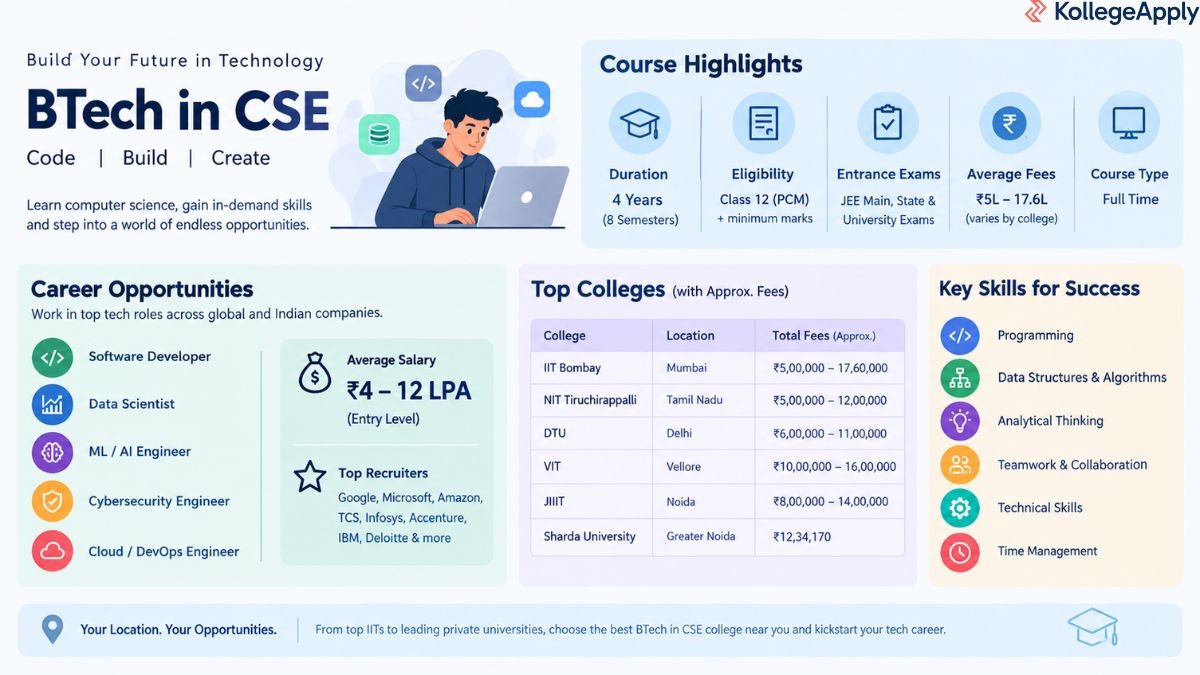
The BTech in CSE Course Highlights below covers the key details students typically check before applying, including course duration, eligibility, entrance exams, admission routes, fees, leading colleges, career options and entry-level salary expectations. Use the table to quickly compare the programme structure and admission requirements.
What is BTech in CSE?
BTech in CSE is a four-year engineering programme that combines computer science concepts with engineering principles. The course is designed to develop the ability to analyse problems, design computational solutions and build software or technology systems.
The BTech CSE subjects generally begin with mathematics, physics, programming and engineering fundamentals. As students progress, they study data structures, algorithms, computer organisation, operating systems, database management, computer networks, software engineering and theoretical computer science.
Modern BTech Computer Science Engineering programmes increasingly include areas such as artificial intelligence, machine learning, cloud computing, cybersecurity, data science, Internet of Things and application development. The exact subjects and electives vary between universities. For example, the official NIT Tiruchirappalli CSE curriculum includes areas such as operating systems, computer networks, algorithms, automata, probability and specialised electives.
Practical learning is an important component of the b tech computer science course. Students may work on programming laboratories, database and networking labs, software projects, internships, hackathons, technical competitions and a final-year project. This makes the course suitable for students interested in software, computing, technology research, product development and entrepreneurship.
Why Pursue BTech in CSE?
The Bachelor of Technology in Computer Science and Engineering (BTech CSE) program prepares students to develop software, solve technological issues, and create creative digital solutions by combining computer science theory with real-world engineering abilities. Students choose BTech in CSE because the degree provides access to a broad range of technology-oriented careers and allows specialisation in emerging areas:
- Wide Career Choices: Graduates can enter software development, data science, AI, cybersecurity, cloud computing, consulting and technology research.
- Strong Technology Demand: Businesses across finance, healthcare, retail, manufacturing, education and e-commerce increasingly depend on digital systems.
- Skill Development: The course develops programming, computational thinking, analytical reasoning, system design and problem-solving skills.
- Salary Opportunities: Technology roles can offer competitive salaries, particularly in software product companies and specialised areas such as AI, data and cybersecurity.
- Leadership Scope: With experience, CSE graduates can progress into technical leadership, architecture, project management and engineering management roles.
- Entrepreneurship Opportunities: Programming and product-development skills can help graduates build software products, applications, SaaS businesses and technology startups.
Is BTech in CSE Worth It in 2026?
BTech in CSE remains a relevant undergraduate engineering option in 2026, particularly for students who are interested in technology and are prepared to continuously update their skills. The course is no longer limited to traditional programming because employers increasingly seek capabilities in AI, cloud infrastructure, cybersecurity, data engineering, automation and software development.
Placement opportunities depend heavily on the institution, academic performance, internships, projects, coding ability and communication skills. Students from established institutions may have access to large recruiter networks, while students at other colleges can improve their employability through internships, open-source contributions, certifications and substantial technical projects.
Technological developments are also changing the nature of CSE careers. Artificial intelligence, generative AI, cloud computing, cybersecurity, data platforms and automation are creating new job functions while changing traditional software-development workflows. Therefore, BTech in CSE is worth considering in 2026, but students should evaluate the curriculum, total fees, placement record, faculty, infrastructure and their own interest in technology before choosing a college.
BTech in CSE Eligibility Criteria
The BTech in CSE eligibility differs between universities and entrance examinations. Candidates should always check the admission notification of the college they intend to join before applying. Therefore, the commonly stated requirement of 60% in Class 12 should not be treated as a universal BTech CSE eligibility rule. The detailed eligibility criteria are as follows:
- Educational Qualification: Candidates generally need to pass Class 12 or an equivalent examination from a recognised board.
- Required Subjects: Physics and Mathematics are commonly required, along with Chemistry, Computer Science, Biotechnology or another subject prescribed by the institution.
- Minimum Marks: The requirement may range from around 45% to 60% or higher depending on the institution and category.
- Entrance Examination: Admission may require JEE Main, a state-level examination, university-level examination or an institutional merit process.
- Category Relaxation: Reserved-category candidates may receive relaxation in minimum qualifying marks where applicable under the rules of the concerned institution or state.
- College-Specific Rules: Private universities can have different eligibility requirements. For example, SGT University lists 45% in the prescribed Class 12 subjects, with relaxation to 40% for reserved categories, while Bennett University specifies 55% for its BTech CSE programme. Sharda University has its own higher Class 12/PCM requirements for BTech admission.
Note: The eligibility criteria provided might differ according to the college preference.
BTech in CSE Entrance Exams
The BTech CSE entrance exam depends on the college, state and admission route. JEE Main is the major national-level examination for undergraduate engineering admissions and is also the qualifying examination route for JEE Advanced. State examinations and university-level tests provide additional routes to BTech CSE.
The JEE Main 2026 bulletin scheduled two sessions, with Session 1 in January and Session 2 in April. JEE Advanced 2026 was conducted in May. Therefore, the following table uses the latest 2026 schedule as the reference point and marks 2027 dates as expected rather than confirmed.
Important: Candidates planning for the 2027 intake should not use the dates above as final deadlines. The respective official examination portals should be checked when 2027 notifications are released.
BTech in CSE Colleges in India
The following colleges represent universities offering BTech programmes in Computer Science and Engineering. NIRF rankings are included where a published 2025 Engineering rank or rank band is available.
Fee note: Actual payable fees may change by academic session and may exclude hostel, examination, development, security, registration or other institutional charges.
BTech in CSE Admission Process 2026
The BTech in CSE admission process differs according to the institution. Candidates targeting IITs and NITs generally follow the national entrance and counselling route, while state colleges may use state-level examinations and private universities may use their own entrance tests, JEE Main scores or Class 12 merit. Admission procedure for the course may vary college to college. For reference, the admission process for BTech Computer Science Engineering course in Kalinga Institute of Industrial Technology (KIIT) is given below:
Step 1: Visit the http://www.kiitee.ac.in website of KIIT.
Step 2: Choose "Online Application."
Step 3: Continue following the steps in filling out the form.
Step 4: Fill and submit the "Online Application Form."
Step 5: Upload photograph, signature, and mark sheet or certificate of 10th grade.
Step 6: Submit the application fees to complete the admission process.
BTech in CSE Syllabus
The BTech in CSE syllabus combines mathematics and engineering fundamentals with programming, data structures, algorithms, computer systems, software development and advanced computing. Exact subjects vary between universities. The official NIT Tiruchirappalli CSE curriculum demonstrates the progression from fundamental programming and data structures towards operating systems, networks, algorithms and specialised electives. For reference, the following structure represents CSE curricula followed at the NIT Tiruchirappalli curriculum.
What Skills are Required for BTech in CSE?
The BTech in CSE curriculum develops a combination of programming, computational, analytical and professional skills that are useful across software and technology careers. Students build these capabilities through programming courses, laboratory work, data structures and algorithms, technical projects, internships and specialised electives. The importance of each skill may vary depending on the career path, such as software development, AI, data science, cybersecurity or cloud computing.
- Programming: Knowledge of languages such as Python, Java, C++, JavaScript or other relevant languages.
- Data Structures and Algorithms: Ability to design efficient solutions and analyse computational complexity.
- Analytical Thinking: Capacity to break complex technical problems into smaller, manageable components.
- Problem Solving: Ability to identify bugs, evaluate alternatives and develop practical solutions.
- Communication: Clear written and verbal communication is important for technical teams and client-facing roles.
- Team Management: Software projects commonly involve collaboration across developers, designers, analysts and managers.
- Technical Skills: Knowledge of databases, APIs, operating systems, networking, cloud platforms and software development tools.
- Strategic Thinking: Ability to understand how technology can solve business or operational problems.
- Time Management: Useful for managing projects, coding assignments, internships and deadlines.
- Continuous Learning: CSE graduates need to keep learning as programming tools, AI systems and technology platforms evolve.
BTech in CSE Jobs & Salary
BTech CSE graduates can enter several technology and software-related roles. The salary varies significantly according to college, employer, technical skills, location, experience and specialisation. The ranges below are indicative rather than guaranteed placement salaries.
Note: These figures are broad indicative ranges. Actual salary offers may be substantially lower or higher depending on the employer, role, location, candidate profile and market conditions.
BTech in CSE vs BTech in Information Technology
BTech CSE and BTech IT overlap considerably, but their academic emphasis can differ. CSE generally provides broader exposure to computer science theory, algorithms and computer systems, while IT focuses more strongly on applying computing technologies to information systems and organisational requirements.
Both degrees can lead to software-development and technology careers. The curriculum, electives, placement record and individual skill development are often more important than the difference in degree title alone.
BTech in CSE FAQs
What is the BTech CSE full form?
BTech CSE means Bachelor of Technology in Computer Science and Engineering. It is a four-year undergraduate engineering programme.
Is BTech in CSE good?
BTech in CSE can be a good option for students interested in technology, programming and problem-solving. Career outcomes depend on skills and college.
Can I do CSE without JEE?
Yes, BTech in CSE can be pursued without JEE through state or university-level exams and merit-based admissions. Rules vary by college.
What are the BTech in CSE subjects?
BTech in CSE subjects include programming, data structures, algorithms, DBMS, operating systems and computer networks. Advanced electives may include AI and ML.
What is the BTech CSE salary for freshers?
A BTech CSE fresher may earn around INR 4–8 LPA in many entry-level roles. The actual package varies by employer and skills.
What is the duration of BTech in CSE?
BTech in CSE is generally a four-year undergraduate programme. The course is usually divided into eight semesters.
What entrance exams are accepted for BTech in CSE?
BTech in CSE admissions may accept JEE Main, state CETs, COMEDK, VITEEE, KIITEE and university-specific exams. Requirements differ by college.
What can I do after BTech in CSE?
After BTech in CSE, graduates can work in software, AI, data, cybersecurity, cloud and DevOps. They can also pursue MTech, MS, MBA or research.
Is BTech in CSE suitable for students without Computer Science in Class 12?
BTech in CSE may be possible without Computer Science in Class 12 if Physics and Mathematics and other required subjects are fulfilled. College rules must be checked.