BTech ECE, or Bachelor of Technology in Electronics and Communication Engineering, is a four-year undergraduate engineering programme covering electronic circuits, communication systems, digital systems, signal processing, embedded systems, microprocessors, wireless communication and related technologies. The curriculum combines mathematics, electronics, programming, laboratory work and engineering design, preparing students for careers across semiconductor, VLSI, embedded systems, telecommunications, electronics, networking, automation and related technology sectors.
Admission to BTech ECE depends on the institute. IITs admit students through JEE Advanced after the JEE Main route, while NITs and other JoSAA institutes use JEE Main. State and private universities may use examinations such as WBJEE, MHT CET, KCET, COMEDK UGET, VITEEE, MET or SRMJEEE, depending on the institution and state.
The annual tuition fee for BTech ECE in India varies between INR 1 - 4 lakh based on the institution that provides the course. Some of the best colleges include IIT Roorkee, NIT Tiruchirappalli, Vellore Institute of Technology (VIT), S.R.M. Institute of Science and Technology, NIT Warangal, NIT Calicut, IIT Bhubaneshwar, Manipal Institute of Technology and Lovely Professional University, among others.
BTech ECE graduates can earn an average of INR 3.5-6 LPA as a fresher and INR 6-12 LPA as mid-level or experienced, based on the role and recruiters. Some of the common job roles are Electronics Engineer, Embedded Developer, PCB Assembler, Associate Software Developer, Network Planning Engineer, Telecommunication Engineer, Control Systems Engineer, Signal Processing Engineer, VLSI Design Engineer, Embedded Systems Engineer, and others.
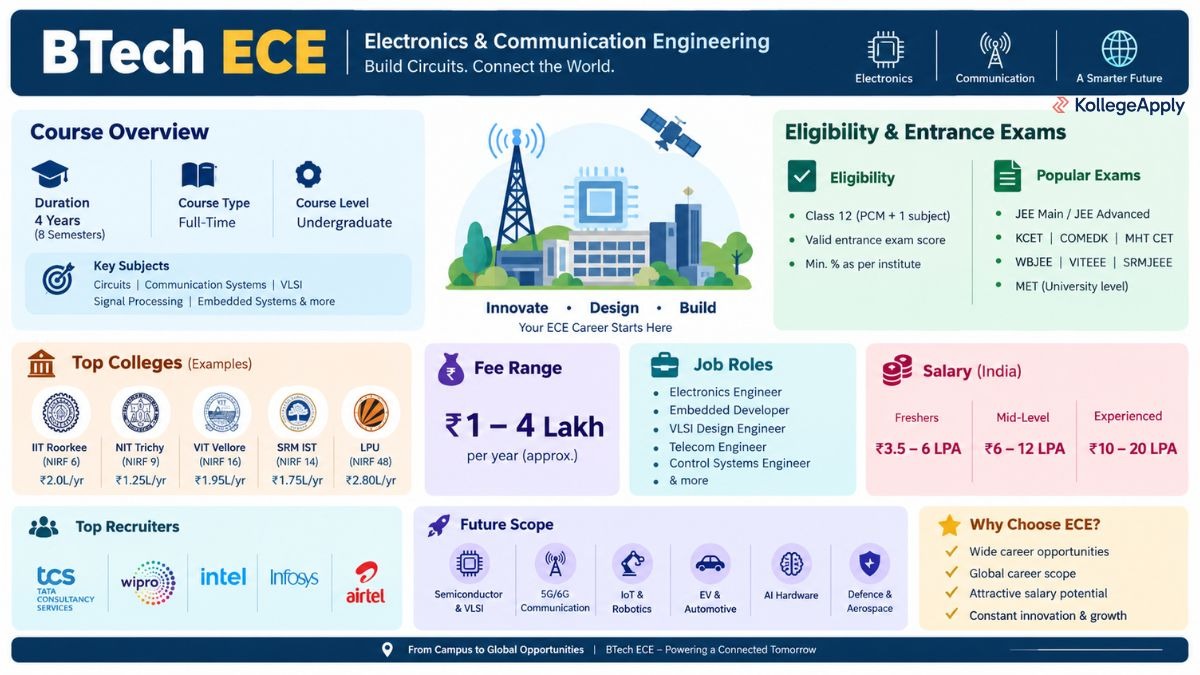
Table of Contents
BTech ECE Key Highlights
The BTech ECE course is a four-year undergraduate engineering programme that combines electronics, communication systems, computing and hardware-oriented technologies. The key course details, admission route, curriculum focus, fees and career areas are summarised below.
What is a BTech ECE?
BTech ECE full form is Bachelor of Technology in Electronics and Communication Engineering, a 4-year undergraduate academic program that provides a specialisation in design, development and maintenance of both electronics and communication technologies. Computer networks, VLSI design, embedded systems, signal processing, wireless and satellite communication, optical fibre communication, analogue and digital electronics, microprocessors and microcontrollers, and control systems are key subjects covered in the curriculum.
Students gain both theoretical and practical knowledge to design, build, and test electronic devices and communication systems. The program integrates practical projects, workshops, laboratory testing, and classroom instruction. BTech graduates are suited for jobs such as research and development, IT, electronics manufacturing, and telecommunications. Candidates can work as VLSI engineers, design engineers, electronics engineers, and more.
Why Study BTech ECE?
BTech Electronics and Communication Engineering (ECE) offers strong career prospects in a rapidly evolving technological landscape. It equips students with skills that are widely applicable across industries and global markets.
- Wide Career Opportunities: Graduates can work in diverse sectors such as telecommunications, electronics, IT, defence, healthcare, and automation. Both private companies and government organizations offer employment opportunities.
- Competitive Salary Potential: B tech ECE graduates receive attractive starting salaries, with significant growth as they gain experience and higher qualifications.
- Global Career Scope: The knowledge and skills acquired are globally relevant, enabling opportunities in international organizations and markets.
- Dynamic and Evolving Field: Continuous technological advancements ensure ongoing learning, skill development, and long-term career sustainability.
BTech ECE Eligibility Criteria
The eligibility criteria for enrolling into BTech ECE course are as follows Candidates must check the admission requirements of the institute they are applying to. Generally, candidates need:
- Class 12 or equivalent qualification.
- Physics and Mathematics as required subjects.
- A third subject such as Chemistry, Computer Science, Biology or another permitted subject, depending on the institute.
- The minimum aggregate/subject-wise marks prescribed by the institute.
- A valid score or rank in the applicable entrance examination, wherever entrance-based admission is required.
- Entrance examination national/ state/ university-level such as JEE Main/JEE Advanced/SRMJEEE/COMEDK.
- Few institutes also allow lateral entry in 2nd year directly for Diploma degree holders in ECE or related disciplines.
- Candidates who have passed a Diploma in Electronics and Communication Engineering are also eligible.
For example, Amity University Noida's B.Tech Electronics & Communication Engineering programme specifies 60% aggregate in Class X and XII and 60% in Physics + Mathematics + a permitted third subject for the non-sponsored category.
Diploma holders may also be eligible for lateral entry at institutes that offer such an admission route. The eligibility, diploma discipline and entrance requirements vary by university.
BTech ECE Entrance Exams 2027
To be eligible for admission in b tech ece, candidates are required to appear for and qualify in the relevant entrance examinations. The specific examination requirements may differ based on the admission policies of the respective institutions.
National Level Exams
The national universities like IITs and NITs accept the application based on the score of the JEE Main and JEE Advanced.
State Level Exams
There are various state level entrance exams as well to get admission in the B Tech ECE program. The details of the entrance exams of various states are given below:
University Level Exams
Some universities conduct their own entrance examinations and grant admission based on the performance of candidates in these tests. The institutions following this admission process include Lovely Professional University, Manipal Institute of Technology, and Vellore Institute of Technology.
BTech ECE Colleges in India
There are various reputed government and private institutions in India offering a B Tech Electronics and Communication Engineering course. Given below are some of the BTech ECE colleges in India including their locations, annual tuition fees, NIRF ranking and admission intake process:
BTech ECE Admission Process 2026
The admission process for enrolling into BTech ECE courses is almost similar in all the colleges. For clear understanding, the admission process for enrolling in B Tech ECE course atIIT Roorkee is as follows:
Step 1: Register for the JEE Main entrance exam and appear for the exam.
Step 2: After qualifying JEE Main candidates are required to register and appear in the JEE Advanced entrance exam.
Step 3: The shortlisting of candidates will be based on JEE Advanced score/rank. After getting shortlisted, candidates need to register on the JoSAA website for taking part in the counseling process.
Step 4: During JoSAA counseling, candidates are required to fill in the preferences of college and course (IIT Roorkee college and B Tech Electronics and Communication Engineering course).
Step 5: The seats are allotted on the basis of the JEE Advanced rank, filled-in options in JoSAA, and availability of seats.
Step 6: After selection, candidates need to report to the IIT Roorkee campus for document verification following seat allotment and pay the fee for securing the admission.
Documents Required:
BTech ECE Syllabus
The syllabus for BTech ECE is almost similar to all the institutes offering the course, however, a few subjects may vary depending on the course curriculum being followed. For reference, the syllabus for the B Tech Electronics and Communication Engineering course atIIT Bhubaneshwar is given below:
List of Elective Courses
BTech ECE Job Opportunities in India
After completing B tech Electronics and Communication Engineering, graduates have a wide range of job opportunities to choose from. Given below are the BTech ECE job for freshers or experienced including Btech ECE salary (may vary, depending on the job location, hiring company, experience and expertise level):
BTech ECE Future Scope
ECE has future scope across semiconductor design, embedded systems, communications, automotive electronics, IoT, robotics, defence electronics and AI-enabled hardware.
One of the major developments relevant to ECE graduates is India's semiconductor ecosystem. The India Semiconductor Mission aims to build a semiconductor and display ecosystem covering electronics manufacturing and design, while its Design Linked Incentive scheme supports semiconductor designs such as ICs, chipsets, SoCs, systems and IP cores. The future scope is therefore broader than traditional telecom engineering. Therefore, students planning a long-term ECE career can consider building skills in:
- Semiconductor and VLSI design
- Chip design and verification
- Embedded systems
- Edge AI
- AI hardware
- 5G/6G communication
- IoT and connected devices
- Automotive electronics
- Robotics
- RF and microwave engineering
- Defence electronics
- Power electronics and EV systems
- Cyber-physical systems
BTech ECE FAQs
What is ECE in B Tech?
The BTech ECE fullform is BTech Electronics and Communication Engineering. It focuses on electronics, circuits, communication systems, signals, embedded systems, and telecom technologies.
Is ECE better than CSE?
BTech CSE suits coding and software roles, while Btech ECE fits electronics, telecom, and hardware. Both of these courses have strong career prospects.
Does ECE have a high salary?
Yes, BTech ECE salaries can be high, especially in VLSI, embedded systems, and telecom. Some of the factors like skills, college, and experience significantly impact earnings.
What is the scope of B.Tech ECE?
The BTech ECE is a high demand course and offers scope in telecom, IT, robotics, IoT, chip design, defense, and research. It also allows transition into software roles.
What are the Btech ECE jobs for freshers?
There are a wide range of job options for freshers as they can work as an electronics engineer, embedded engineer, network engineer, VLSI trainee, telecom engineer, or software developer.
What is the B tech ECE course Fees?
The Annual tuition fees range from INR 1,00,000 to INR 4,00,000 per year in India excluding other charges, depending on government or private colleges and facilities offered.
What are the higher study and research opportunities one can pursue after BTech ECE?
There are multiple options one can pursue after BTech ECE including M.Tech, MS, MBA, PhD, or research in AI, robotics, VLSI, signal processing, communication systems, and embedded tech.
Is GATE necessary after BTech ECE?
No, GATE is not mandatory. It’s useful only when one wishes to pursue M.Tech, PSU jobs, and research roles. For private jobs and IT careers, it is not mandatory.
What are the future technology trends in BTech ECE to prioritize?
Focus on AI chips, 5G/6G, IoT, robotics, VLSI, embedded systems, quantum tech, edge computing, EV electronics, cybersecurity, and semiconductor design for strong future careers.