Students can earn a competitive MBA in Data Analytics salary after completing the two-year programme. Fresh graduates generally earn INR 5 LPA to INR 8 LPA, while the overall average salary for MBA in Data Analytics professionals ranges between INR 5 LPA and INR 15 LPA, depending on skills, employer, and location. With experience, professionals in senior analytics and leadership roles can earn INR 18 LPA to INR 20 LPA or more.
The demand for data analytics professionals continues to grow across industries as organizations increasingly rely on data-driven decision-making. Graduates can explore job roles such as Data Analyst, Business Analyst, Data Scientist, Business Intelligence Manager, and Analytics Consultant. Reputed companies such as Accenture, Oracle, and IBM actively recruit skilled professionals in this field. Students also gain expertise in industry-relevant tools and technologies such as Python, R, Statistics, Machine Learning, and Data Visualization. These skills help graduates secure jobs with an MBA in Data Analytics salary per month ranging from approximately INR 40,000 to INR 1.6 lakh or more, depending on experience, job role, employer, and location.
- What is the MBA in Data Analytics Salary?
- What are the Factors Affecting MBA in Data Analytics Salary?
- Detailed Breakdown of MBA in Data Analytics Salary
- Top Recruiters Offering High MBA in Data Analytics Salary
- Key Skills That Influence MBA in Data Analytics Salary
- MBA in Data Analytics Salary FAQs
What is the MBA in Data Analytics Salary?
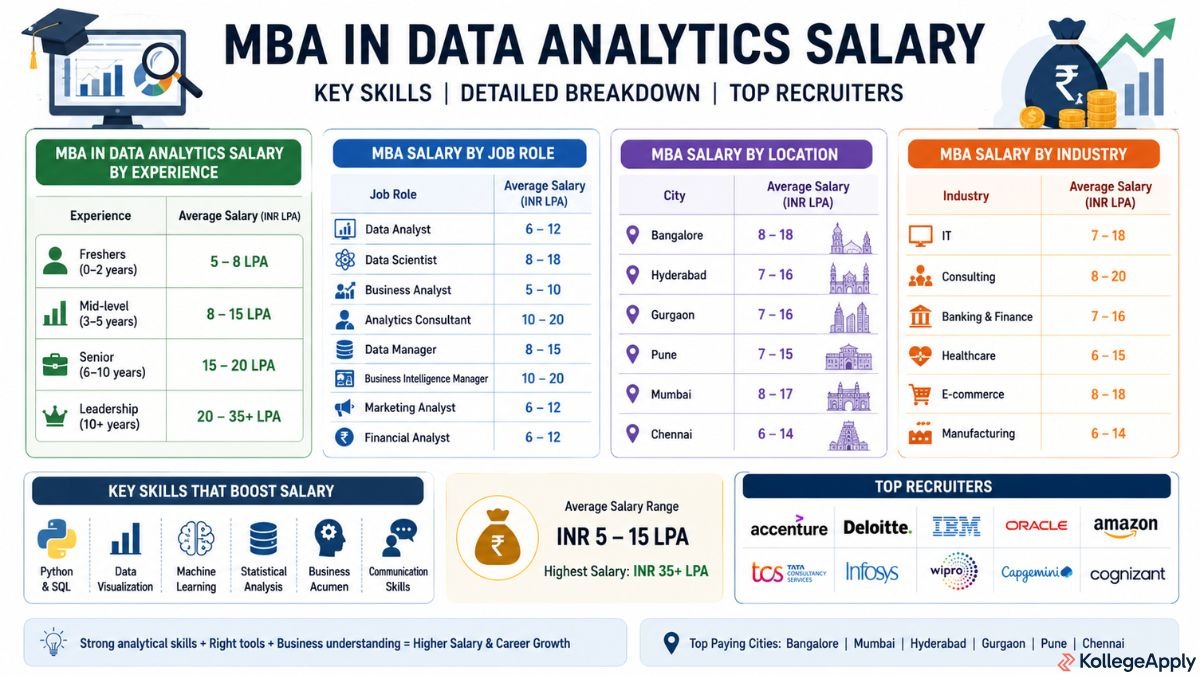
The MBA in Data Analytics salary in India typically ranges from INR 5 LPA to INR 35+ LPA, depending on a candidate's experience, technical skills, industry, and employer. Fresh MBA graduates generally earn INR 5–8 LPA, while professionals with 3–5 years of experience can expect salaries between INR 8–15 LPA. Senior professionals with 6–10 years of experience often receive INR 15–20 LPA, whereas experienced managers, analytics heads, and leadership professionals with 10+ years of experience can earn INR 20–35+ LPA. Candidates with expertise in tools such as Python, SQL, Power BI, Tableau, machine learning, and cloud analytics, along with experience in sectors like IT, consulting, BFSI, e-commerce, and healthcare, often secure higher salary packages.
What are the Factors Affecting MBA in Data Analytics Salary?
The MBA in Data Analytics salary depends on several factors, including a candidate's experience, technical expertise, job role, industry, location, and the recruiting organization. While fresh graduates generally earn INR 5–8 LPA, professionals with specialized skills, industry certifications, and leadership experience can earn INR 20–35+ LPA. Understanding these factors can help candidates improve their earning potential and plan their career growth effectively.
- Work Experience: Experience is one of the biggest determinants of salary. Freshers typically earn INR 5–8 LPA, whereas professionals with 3–5 years of experience can earn INR 8–15 LPA. Senior professionals and leaders with over 10 years of experience may receive INR 20–35+ LPA.
- Technical Skills and Certifications: Expertise in Python, SQL, R, Tableau, Power BI, Machine Learning, Artificial Intelligence, Cloud Analytics, and certifications from platforms like Google, Microsoft, AWS, or IBM can significantly increase salary packages.
- Job Role: Salary varies depending on the position. Roles such as Analytics Consultant, Business Intelligence Manager, and Data Scientist generally offer higher compensation than entry-level positions like Data Analyst or Business Analyst.
- Industry: Professionals working in Consulting, IT, Banking & Finance, and E-commerce often receive higher salaries because these industries rely heavily on data-driven decision-making and advanced analytics.
- Location: Metropolitan cities such as Bangalore, Mumbai, Hyderabad, and Gurgaon usually offer better salary packages due to higher demand for analytics professionals and the presence of leading technology companies.
- Business Knowledge and Soft Skills: Strong communication, leadership, critical thinking, business strategy, and problem-solving abilities help professionals transition into managerial roles, leading to faster salary growth.
Detailed Breakdown of MBA in Data Analytics Salary
MBA in Data Analytics salary depends on various factors such as years of experience, skills acquired, job location, industry, and employer. Graduates can begin their careers across sectors such as IT, Healthcare, Consulting, Finance, E-commerce, and many others. Young professionals can explore job opportunities in roles such as Data Analyst, Analytics Consultant, Data Manager, Business Analyst, and several other analytics-focused positions. The table below provides a detailed breakdown of MBA in Data Analytics salary across different job roles.
MBA in Data Analytics Salary Based on Job Role
The MBA in Data Analytics salary differs based on the job role, required technical expertise, and level of responsibility. Roles involving advanced analytics, business intelligence, and strategic consulting generally offer higher salary packages than entry-level analytical positions. The table below highlights the average annual salary for some of the most popular job roles after an MBA in Data Analytics.
MBA in Data Analytics Salary by Location
The MBA in Data Analytics salary varies across cities due to differences in industry demand, company presence, cost of living, and job opportunities. Major technology and business hubs generally offer higher salary packages because they host leading IT firms, consulting companies, financial institutions, and startups. Cities such as Bangalore and Mumbai offer average salaries of INR 8–18 LPA and INR 8–17 LPA, respectively, while professionals in Hyderabad and Gurgaon can expect INR 7–16 LPA. In Pune, the average salary ranges between INR 7–15 LPA, whereas Chennai offers competitive packages of INR 6–14 LPA. Candidates with strong technical skills and relevant work experience can secure higher salary packages regardless of location.
MBA in Data Analytics Salary by Industry
The MBA in Data Analytics salary varies significantly across industries based on the volume of data handled, business requirements, and the demand for analytics professionals. Sectors such as Consulting, IT, and E-commerce generally offer the highest salary packages due to their heavy reliance on data-driven decision-making, predictive analytics, and business intelligence. Candidates with expertise in AI, machine learning, cloud analytics, and data visualization tools often command higher salaries across these industries.
Top Recruiters Offering High MBA in Data Analytics Salary
MBA in Data Analytics graduates with an MBA in Data Analytics degree can find job opportunities in various industries. Several leading organizations actively recruit skilled professionals for analytics roles in business intelligence, data science, consulting, and strategic decision-making. The companies offer competitive data analytics MBA salary packages, strong career growth opportunities, and exposure to advanced analytics tools and technologies.
Top recruiters such as Accenture, Deloitte, IBM, Oracle, Amazon, TCS, Infosys, Capgemini, and Cognizant hire MBA in Data Analytics graduates for roles in business intelligence, data science, consulting, and analytics strategy. These organizations typically offer salary packages ranging from INR 7–20 LPA, depending on experience, skills, and business requirements. The table below highlights some of the top recruiters known for offering attractive MBA in Data Analytics salary packages:
Key Skills That Influence MBA in Data Analytics Salary
An MBA in Data Analytics salary is influenced not only by academic qualifications but also by the technical and analytical skills a candidate possesses. Employers prefer professionals who can interpret complex data, use advanced analytics tools, and communicate actionable insights to support business decisions. Developing the following skills can improve employability and lead to higher salary packages across industries.
- Data Analysis and Interpretation: Candidates should be able to analyse large datasets, identify patterns, trends, and correlations, and convert raw data into meaningful business insights that support strategic decision-making.
- Programming Skills: Proficiency in programming languages such as Python, R, and SQL is highly valued for data manipulation, database management, automation, and predictive analytics.
- Data Visualisation: Knowledge of tools like Tableau, Power BI, and Microsoft Excel helps professionals create interactive dashboards and present complex data in a simple, visually appealing format.
- Statistical Analysis: Understanding statistical concepts and working with tools such as SPSS, SAS, or Python libraries enables professionals to perform forecasting, hypothesis testing, regression analysis, and predictive modelling.
- Problem-Solving and Critical Thinking: Employers seek professionals who can evaluate business challenges, interpret analytical findings, and recommend practical, data-driven solutions.
- Business and Domain Knowledge: A strong understanding of business operations, finance, marketing, or supply chain management helps analysts apply data insights to solve industry-specific problems and create business value.
- Communication and Presentation Skills: The ability to explain technical findings in a clear and concise manner to non-technical stakeholders is essential for cross-functional collaboration and effective decision-making.
- Machine Learning and AI Fundamentals: Familiarity with machine learning algorithms, artificial intelligence, and predictive analytics provides a competitive advantage for advanced analytics and leadership roles, often resulting in higher salary packages.
MBA in Data Analytics Salary FAQs
What is the MBA in Data Analytics salary for freshers?
The MBA in Data Analytics salary for freshers generally ranges from INR 5 LPA to INR 8 LPA, depending on skills, company, location, and job role.
Which job roles offer the highest MBA in Data Analytics salary?
Roles such as Data Scientist, Analytics Consultant, Business Intelligence Manager, and Data Manager often offer the highest salary packages.
What is the MBA in Data Analytics salary per month?
Fresh graduates generally earn INR 40,000–67,000 per month, while experienced professionals can earn over INR 1.6 lakh per month, depending on their role, company, and experience.
Does work experience affect MBA in Data Analytics salary?
Yes, professionals with relevant experience generally earn higher salaries and can progress to senior analytics and leadership positions.
Which industries offer the best MBA in Data Analytics salary packages?
IT, consulting, finance, e-commerce, healthcare, and technology sectors often offer attractive MBA in Data Analytics salary packages.
What skills can help increase MBA in Data Analytics salary?
Skills such as Python, SQL, Tableau, Power BI, machine learning, data visualization, and statistical analysis can improve earning potential.
Which cities offer the highest MBA in Data Analytics salary in India?
Bangalore, Hyderabad, Mumbai, Pune, Gurgaon, and Delhi NCR generally offer competitive salary packages for data analytics professionals.
What is the data analytics MBA salary after five years of experience?
Professionals with around five years of experience generally earn INR 8 LPA to INR 15 LPA, while those working in specialized or senior analytics roles may earn up to INR 18–20 LPA, depending on skills and employer.
Do top recruiters offer higher MBA in Data Analytics salary packages?
Yes, companies such as Accenture, Deloitte, IBM, Amazon, and Oracle often offer competitive salaries and strong career growth opportunities to MBA in Data Analytics graduates.
Is MBA in Data Analytics a good option for salary growth?
Yes, MBA in Data Analytics offers strong salary growth due to increasing demand for professionals with business and analytical expertise.