An MBA in Marketing is a 2-year postgraduate program, designed to develop strong skills in marketing management and business strategy. It focuses on key areas such as consumer behavior, digital marketing, branding, and market research. The course equips students with the knowledge and practical skills needed to analyze markets, create effective marketing campaigns, and make strategic business decisions.
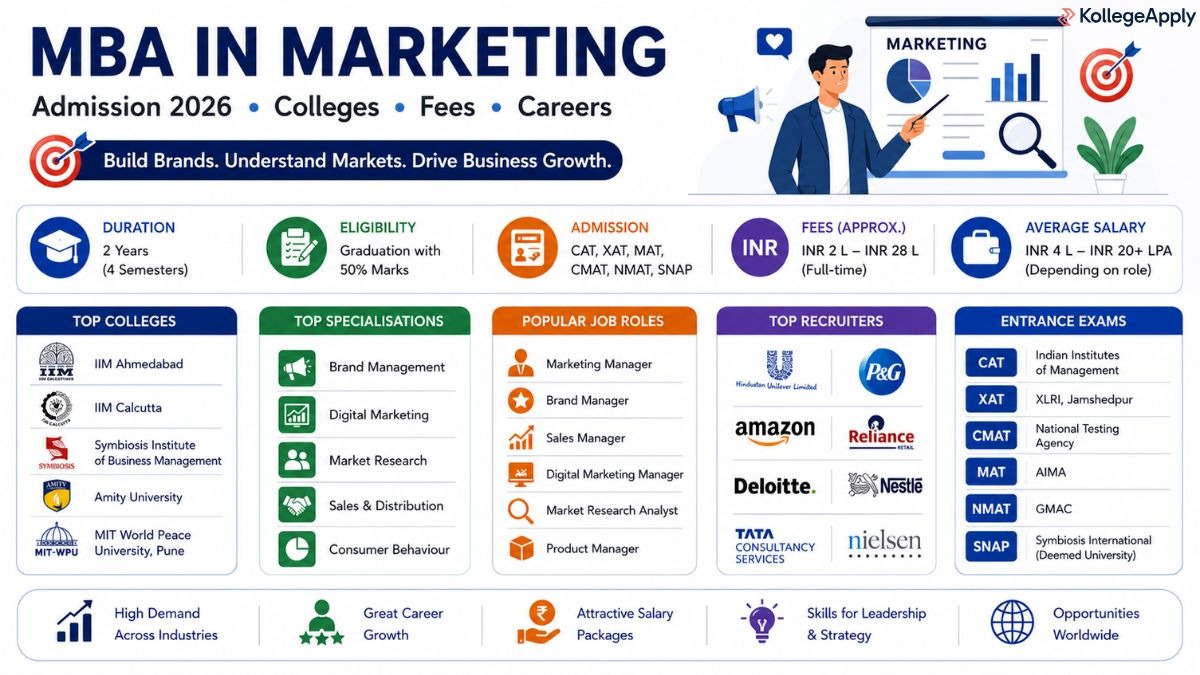
The eligibility criteria for an MBA in Marketing generally require candidates to have completed a bachelor’s degree from a recognized university with at least 50% aggregate marks (with relaxation for reserved categories as per norms), and final-year students may also apply provisionally. The admission is primarily based on performance in national or university-level entrance exams such as CAT, XAT, MAT, CMAT, NMAT, and SNAP, followed by Group Discussions and Personal Interviews.
The MBA in Marketing fees generally range from around INR 2 lakh to INR 28 lakh for full-time programmes, while online and distance MBA programmes may cost between INR 64,000 and INR 2 lakh. Some of the well-known colleges offering this program include Seshadripuram Institute of Management Studies, MIT World Peace University, Shoolini University, Symbiosis Institute of Business Management, and Amity University.
MBA in Marketing Management graduates can work in industries like FMCG, retail, e-commerce, banking, consulting, advertising, and media. They can take up roles such as Marketing Manager, Brand Manager, Sales Manager, Digital Marketing Manager, Market Research Analyst, Product Manager, and SEO Specialist, with opportunities to grow into senior positions like Head of Marketing. The average MBA in Marketing salary in India generally ranges between INR 4 LPA and INR 20 LPA or more, depending on experience, job role, industry, and employer.
- MBA in Marketing Key Highlights
- What is an MBA in Marketing?
- Why study MBA in Marketing?
- Is Pursuing an MBA in Marketing Worth It in 2026?
- MBA in Marketing Eligibility Criteria
- MBA in Marketing Entrance Exams
- MBA in Marketing Colleges in India
- MBA in Marketing Fees in India
- Admission Process for MBA in Marketing
- MBA in Marketing Syllabus
- Skills Developed Through MBA in Marketing
- MBA in Marketing VS MBA in Digital Marketing
- MBA in Marketing Job Opportunities in India
- MBA in Marketing FAQs
MBA in Marketing Key Highlights
MBA in Marketing is one of the most popular management specialisations in India, designed to equip students with the knowledge and skills required to manage branding, sales, advertising, and customer relationships. The table below highlights the important details related to the MBA in Marketing course in India.
What is an MBA in Marketing?
MBA in Marketing, or Master of Business Administration in Marketing, provides a comprehensive understanding of marketing management, consumer behaviour, branding, digital marketing, and how organizations create and deliver value in a competitive market.
It is typically structured across four semesters, and the curriculum covers subjects such as marketing management, consumer behaviour, branding, digital marketing, market research, and sales management, along with practical training that helps students apply marketing concepts in real business environments.
The program helps graduates develop skills in strategic planning, analytical and critical thinking, project management, effective communication with clients and stakeholders, and managing marketing campaigns, budgets, and schedules. After completing this course, graduates can pursue roles such as Marketing Manager, Brand Manager, Sales Manager, Digital Marketing Manager, and Market Research Analyst, helping businesses grow and strengthen their presence across industries.
Why study MBA in Marketing?
MBA in Marketing specialization equips students with strong analytical ability, creativity, and strategic expertise, preparing them for careers across industries such as FMCG, retail, e-commerce, consulting, and advertising. Some of the key reasons to pursue this course include:
- Growing Demand for Marketing Professionals: Companies across industries are increasingly investing in branding, digital marketing, and customer engagement strategies.
- Diverse Career Opportunities: Graduates can work in FMCG, e-commerce, retail, consulting, advertising, and technology sectors.
- Strong Salary Potential: Marketing professionals often receive competitive salary packages with significant growth opportunities.
- Emerging Specialisations: Areas such as Digital Marketing, Marketing Analytics, Social Media Marketing, and Customer Relationship Management are creating new career avenues.
- Leadership and Managerial Roles: The programme prepares students for managerial and leadership positions in sales and marketing functions.
- Entrepreneurial Opportunities: The knowledge gained during the programme can also help aspiring entrepreneurs build and market their own businesses effectively.
Is Pursuing an MBA in Marketing Worth It in 2026?
Yes, pursuing an MBA in Marketing in 2026 can be a worthwhile investment for students interested in brand management, digital marketing, sales, market research, and business strategy. The rapid growth of e-commerce, digital advertising, artificial intelligence (AI)-driven marketing, and data analytics has significantly increased the demand for skilled marketing professionals across industries such as FMCG, retail, consulting, banking, media, and technology.
An MBA in Marketing equips students with industry-relevant skills in consumer behaviour, branding, digital marketing, marketing analytics, customer relationship management, and strategic decision-making. The programme also offers practical exposure through internships, live projects, case studies, and industry interactions, helping graduates become job-ready.
Moreover, MBA in Marketing graduates can explore diverse career opportunities in roles such as Marketing Manager, Brand Manager, Product Manager, Digital Marketing Manager, and Market Research Analyst. The average salary for graduates generally ranges between INR 4 LPA and INR 20 LPA or more, depending on the institute, experience, skills, and job profile. For candidates seeking dynamic career growth, leadership opportunities, and long-term earning potential, an MBA in Marketing remains one of the most valuable management specialisations in 2026.
MBA in Marketing Eligibility Criteria
Candidates seeking admission to an MBA in Marketing programme must fulfil the eligibility requirements prescribed by the respective institute. While the basic criteria remain similar across most universities and business schools, certain requirements such as minimum marks, accepted entrance examinations, and selection procedures may vary from one institution to another. Therefore, aspirants should carefully check the admission guidelines of their preferred colleges before applying. The common eligibility criteria for MBA in Marketing are as follows :
- The candidate should have passed a Bachelor's degree (10+2+3 or 10+2+4 pattern) or equivalent exams of a recognized university with an aggregate of 50% marks or more. The necessary percentage can differ in different institutions.
- The required percentage may vary depending on the institute, and a relaxation of up to 5% may be granted to candidates belonging to reserved categories.
- In most colleges, the candidate is required to take a national or university-level entrance test like CAT, XAT, MAT, CMAT, SNAP, or a state-wide entrance test.
- Certain colleges might need the candidates to take part in additional stages of the selection process, like Group Discussion, Written Ability Test, and Personal Interview, once the entrance test is cleared.
- Not all the institutes require work experience, although prior work experience can prove beneficial in the selection process, particularly in the case of top business schools.
MBA in Marketing Entrance Exams
The candidates are required to qualify for some entrance exams to pursue an MBA Marketing course. Few of the entrance exams to pursue an MBA in Marketing in India are listed below:
MBA in Marketing Colleges in India
There are several MBA in Marketing colleges in India that offer industry-oriented curricula, experienced faculty, and excellent placement opportunities. The country's leading management institutes provide specialised training in areas such as brand management, consumer behaviour, digital marketing, and marketing analytics, helping students develop the skills required for managerial and leadership roles. The MBA in Marketing fees in these colleges generally range from around INR 8 lakh to INR 28 lakh, depending on the institution's reputation, infrastructure, and placement support.
Premier institutes such as IIM Ahmedabad and IIM Calcutta are consistently ranked among the top management schools in India and offer strong placement opportunities with leading recruiters across industries. Private universities like Amity University, Chitkara University, MIT-WPU, and Shoolini University are also popular choices due to their industry collaborations, practical exposure, and specialised marketing programmes. The table below provides a detailed overview of some of the best MBA in Marketing colleges in India, along with their locations, NIRF rankings, and approximate course fees.
MBA in Marketing Fees in India
The MBA in Marketing fees in India vary significantly depending on the type of institution, mode of study, infrastructure, and placement support offered by the college. Government institutions generally provide management education at comparatively lower costs, while private universities and premier business schools may charge higher fees due to their advanced facilities, industry exposure, and strong placement records. Additionally, online and distance MBA programmes are often more affordable and flexible for working professionals and students seeking cost-effective learning options. The table below provides an overview of the approximate MBA in Marketing fees across different types of institutions in India.
Note: The MBA in Marketing fees mentioned above are indicative and may vary depending on the institution, specialisation, location, and additional charges such as hostel fees, examination fees, and registration costs. Candidates are advised to check the latest fee structure on the official website of their preferred institution before applying.
Admission Process for MBA in Marketing
The admission process for MBA in Marketing at MIT World Peace University is based on entrance exam performance followed by further selection rounds. The step-by-step process is as follows:
Step 1: Candidates must register and appear for accepted entrance exams such as CAT, MAT, CMAT, or the university’s own entrance test (MIT-WPU CET).
Step 2: Applicants must obtain a valid score that meets the minimum eligibility criteria set by the university.
Step 3: Now, the candidates need to fill out the online application form on the official MIT-WPU portal and upload required documents along with entrance exam scores.
Step 4: The university then shortlists applicants based on their entrance exam performance and overall academic profile.
Step 5: The shortlisted candidates are called for Group Discussion (GD) and Personal Interview (PI), where communication skills, subject knowledge, and career goals are evaluated.
Step 6: A final merit list is prepared based on entrance score, GD/PI performance, and overall profile. Selected candidates must confirm admission by paying the fees and submitting necessary documents within the given timeline.
Documents Required:
The list of the required documents for MBA in Marketing is given below:
MBA in Marketing Syllabus
The MBA in Marketing Management syllabus at MIT World Peace University (MIT-WPU), Pune is designed to provide students with a strong foundation in management principles while developing specialised knowledge in marketing, business analytics, and strategic decision-making. The curriculum combines core management subjects with industry-oriented electives, practical training, and research-based learning to prepare students for leadership roles in the corporate sector.
During the first year, students study fundamental subjects such as Accounting for Business, Managerial Economics, Marketing Management, Financial Management, and Operations and Supply Chain Management, which help build managerial and analytical skills. In the second year, the programme focuses on advanced topics, electives, business analytics, sustainability, and practical exposure through internships and a capstone project. The semester-wise MBA in Marketing Management syllabus at MIT-WPU is provided below for reference.
Skills Developed Through MBA in Marketing
An MBA in Marketing equips students with a combination of managerial, analytical, and creative skills that are essential for succeeding in today's competitive business environment. The programme focuses on developing both technical marketing expertise and soft skills, enabling graduates to manage brands, understand consumer behaviour, and make data-driven business decisions. Some of the key skills developed through an MBA in Marketing are listed below:
MBA in Marketing VS MBA in Digital Marketing
MBA in Marketing and MBA in Digital Marketing are two popular management specialisations that prepare students for careers in the marketing domain. While both programmes focus on understanding consumer behaviour and developing marketing strategies, they differ significantly in terms of curriculum, tools, and career opportunities. An MBA in Marketing primarily covers traditional marketing concepts such as branding, sales, advertising, and market research, whereas an MBA in Digital Marketing focuses on online marketing channels, digital platforms, and data-driven marketing strategies.
Choosing between the two programmes depends on a candidate's career interests, preferred industry, and long-term professional goals. Students interested in conventional marketing roles and managerial positions may prefer an MBA in Marketing, while those inclined towards online branding, social media, and performance marketing may find an MBA in Digital Marketing more suitable. The table below provides a detailed comparison between the MBA in Marketing and MBA in Digital Marketing:
MBA in Marketing Job Opportunities in India
MBA in Marketing graduates can find opportunities across industries such as FMCG, retail, e-commerce, consulting, banking, media, and technology. Depending on their experience and skills, they can pursue managerial and specialist roles in marketing, branding, sales, and digital marketing. Below are some of the employment positions that the MBA Mkt graduates can get, the company that hires them, the experience needed, and the average salary (that may vary on the basis of expertise, skills, experience, locations and recruiters):
MBA in Marketing FAQs
What is MBA in Marketing?
MBA in Marketing is a two-year postgraduate management programme that focuses on marketing strategy, consumer behaviour, branding, digital marketing, sales management, and market research to prepare students for leadership roles in business.
What are the eligibility criteria for MBA in Marketing?
Candidates must hold a bachelor's degree from a recognised university with at least 50% aggregate marks. Final-year students can also apply provisionally. Some institutes offer relaxation to reserved category candidates.
Which entrance exams are accepted for MBA in Marketing admission?
MBA in Marketing admissions are generally based on entrance exams such as CAT, XAT, MAT, CMAT, NMAT, and SNAP, followed by Group Discussions and Personal Interviews in some institutes.
What subjects are taught in MBA in Marketing?
MBA in Marketing subjects include Marketing Management, Consumer Behaviour, Brand Management, Digital Marketing, Sales Management, Market Research, Business Analytics, and Customer Relationship Management.
What is the duration of MBA in Marketing?
MBA in Marketing is a two-year postgraduate programme divided into four semesters and includes classroom learning, internships, live projects, and industry interactions.
What are the fees for MBA in Marketing in India?
MBA in Marketing fees generally range from INR 2 lakh to INR 28 lakh for full-time programmes, while online and distance MBA programmes may cost between INR 64,000 and INR 2 lakh.
Which are the top MBA in Marketing colleges in India?
Some of the top MBA in Marketing colleges in India include IIM Ahmedabad, IIM Calcutta, SIBM Pune, Amity University, MIT-WPU, Chitkara University, and Shoolini University.
What is the salary after MBA in Marketing in India?
The average MBA in Marketing salary in India generally ranges between INR 4 LPA and INR 20 LPA or more, depending on the institute, job role, industry, skills, and experience.
What are the career opportunities after MBA in Marketing?
Graduates can work as Marketing Managers, Brand Managers, Sales Managers, Product Managers, Digital Marketing Managers, and Market Research Analysts across industries such as FMCG, retail, e-commerce, consulting, and media.
Is MBA in Marketing worth pursuing in 2026?
Yes, MBA in Marketing remains one of the most sought-after specialisations due to the growing demand for professionals in digital marketing, branding, market analytics, and customer relationship management.
Which pays more, HR or Marketing?
MBA in Marketing generally offers higher earning potential, especially in roles such as Product Manager, Brand Manager, and Digital Marketing Manager. However, salaries in both fields depend on skills, experience, and industry.
Can MBA in Marketing graduates become entrepreneurs?
Yes, MBA in Marketing equips students with skills in branding, market research, customer acquisition, and business strategy, which can help them start and grow their own ventures successfully.
Can students from non-commerce backgrounds pursue MBA in Marketing?
Yes, students from engineering, science, humanities, and other academic backgrounds can pursue MBA in Marketing, provided they fulfil the eligibility criteria and qualify for the required entrance examinations.
What are the 4 types of MBA?
The four main types of MBA programmes are Full-Time MBA, Part-Time MBA, Executive MBA (EMBA), and Online/Distance MBA. Students can pursue MBA in Marketing through any of these modes depending on their career goals and flexibility requirements.
Is MBA in Marketing a good career option?
Yes, MBA in Marketing offers diverse career opportunities in branding, digital marketing, sales, and product management, with average salaries ranging from INR 4 LPA to INR 20+ LPA.
Can I pursue MBA in Marketing without work experience?
Yes, most MBA in Marketing colleges accept fresh graduates. However, prior work experience can be beneficial during admissions and placements at top business schools.