The MBA in Hospitality Management Syllabus combines core business management concepts with specialised hospitality knowledge. It gradually introduces students to management, marketing, finance, human resources, tourism and hospitality operations before progressing towards internships, strategic learning and specialised electives.
The curriculum also emphasises practical learning through internships, projects, skill-enhancement courses, and industry-oriented electives. Students can explore areas such as digital marketing, revenue management, sustainability, resort and destination management, hospitality asset management, and entrepreneurship. This combination of classroom learning and practical exposure helps graduates build careers in hotels, resorts, tourism companies, airlines, event management, hospitality technology, and other service-oriented organisations.
- MBA in Hospitality Management Syllabus Semester-wise
- What subjects are included in an MBA in hospitality management syllabus?
- Practical Training / Internship in MBA in Hospitality Management
- Skills Developed Through MBA in Hospitality Management Syllabus
- Books for MBA in Hospitality Management Syllabus
- FAQs on MBA in Hospitality Management Syllabus
MBA in Hospitality Management Syllabus Semester-wise
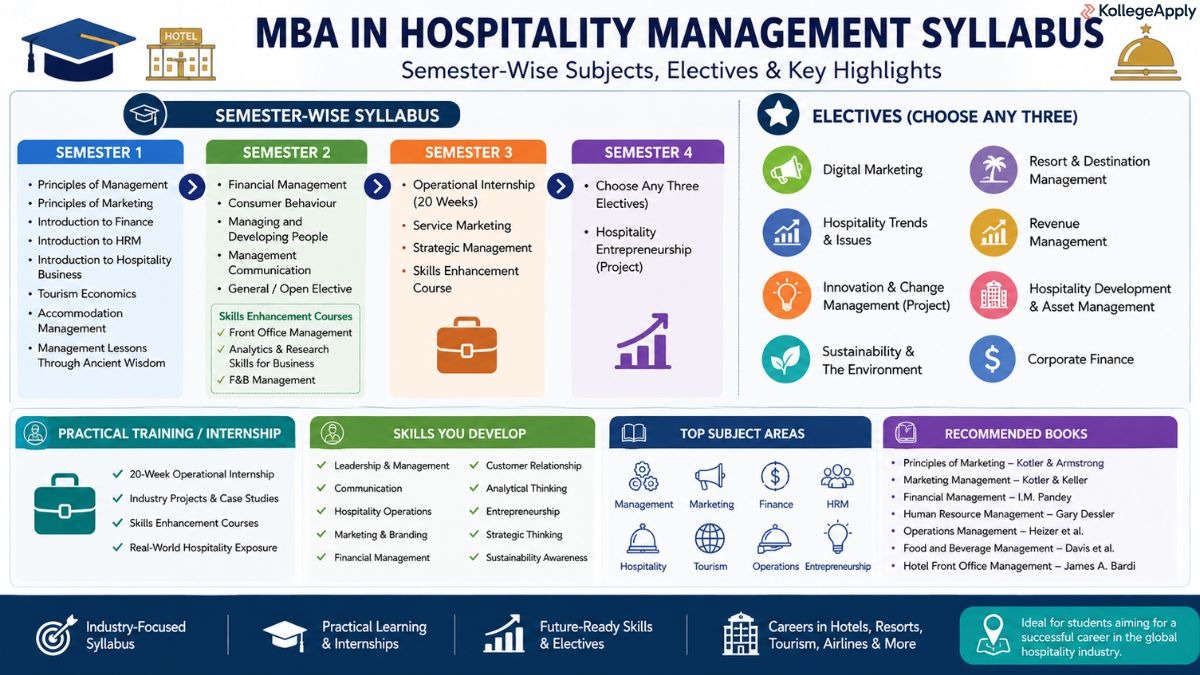
MBA in Hospitality Management is a postgraduate course covering a wide range of skills and knowledge in financial and functional skills, addressing the hospitality industry specifically. The curriculum combines a foundation of core business courses with industry electives, experience-based internship programs, and development of skills to prepare graduates to work in a fast-moving global economy. Mentioned below is the syllabus at Gurugram University:
Skills Enhancement Course
The Skills Enhancement Course in an MBA Hospitality syllabus focuses on developing practical and industry-relevant skills that complement core management knowledge. These courses help students strengthen their operational, analytical, communication, and entrepreneurial abilities required for hospitality careers. Depending on the university, subjects may include:
Electives in MBA in Hospitality Management Syllabus
Elective courses in an MBA Hospitality Management syllabus allow students to specialise in areas that match their career interests and the evolving needs of the hospitality industry. As per the mentioned Gurugram University curriculum, students choose three electives after completing Semester 3 from the options offered by the university. These subjects provide deeper knowledge of emerging business practices, technology, sustainability, and hospitality operations. The elective options include:
What subjects are included in an MBA in hospitality management syllabus?
MBA Hospitality subjects combine general management concepts with specialised hospitality knowledge. The curriculum is intended to help students understand how organisations are managed while also developing expertise in accommodation, tourism, service marketing, people management, finance, hospitality operations, and customer experience.
Practical Training / Internship in MBA in Hospitality Management
Practical training is an important part of the MBA Hospitality syllabus because it allows students to apply classroom concepts in real hospitality environments. Depending on the university, students may complete internships, operational training, projects, field visits, case studies, or industry-based assignments during the programme.
The Gurugram University curriculum mentioned in the provided syllabus includes a 20-week operational internship in Semester 3. During this period, students can gain exposure to hospitality operations, customer service, front office functions, food and beverage services, management processes, and workplace communication. The duration and structure of practical training can vary across institutions. Students should check the latest curriculum of their chosen university for internship requirements.
Also Read: Diploma in Hospitality Management
Skills Developed Through MBA in Hospitality Management Syllabus
The MBA in Hospitality Management Syllabus is designed to develop both managerial and industry-specific capabilities. Along with theoretical knowledge, students learn to handle customer-facing situations, analyse business performance, manage teams, understand financial decisions, and respond to changing hospitality trends.
- Hospitality Operations: Understanding accommodation, front office, food and beverage, and service operations.
- Leadership and Management: Developing the ability to manage teams and coordinate organisational activities.
- Communication Skills: Improving professional communication, negotiation, presentation, and interpersonal skills.
- Marketing Skills: Understanding hospitality branding, customer engagement, service marketing, and digital promotion.
- Financial Management: Learning budgeting, financial planning, revenue optimisation, and investment concepts.
- Customer Relationship Management: Understanding consumer behaviour and creating better guest experiences.
- Analytical Skills: Using business data and research techniques to support managerial decisions.
- Entrepreneurial Skills: Developing business ideas and understanding the fundamentals of hospitality entrepreneurship.
- Strategic Thinking: Learning how organisations formulate and implement long-term business strategies.
- Sustainability Awareness: Understanding environmental responsibility and sustainable hospitality practices.
- Problem-Solving: Developing the ability to respond to operational and managerial challenges.
- Adaptability: Preparing for changing technologies, consumer expectations, and trends in the hospitality sector.
Books for MBA in Hospitality Management Syllabus
Recommended books can help students strengthen their understanding of management principles and hospitality-specific concepts covered in the MBA Hospitality syllabus. Students should prioritise the latest editions prescribed by their university and use additional reference books for deeper conceptual and practical understanding.
Important: Students should also refer to university-provided study material, case studies, research papers, industry reports, and current hospitality business examples to understand how theoretical concepts are applied in real organisations.
FAQs on MBA in Hospitality Management Syllabus
What is included in the MBA in Hospitality Management Syllabus?
The syllabus covers management, marketing, finance, HR, tourism, accommodation, service marketing, operations, strategy, electives, and practical training.
How many semesters are there in an MBA Hospitality course?
MBA Hospitality is generally a two-year programme divided into four semesters, although the structure can vary slightly by university.
What are the main MBA Hospitality Management subjects?
Major subjects include management, finance, marketing, HR, tourism economics, accommodation management, service marketing, and strategic management.
Which electives are offered in MBA Hospitality Management?
Common electives include digital marketing, revenue management, sustainability, resort management, hospitality asset management, and corporate finance.
Is an MBA in Hospitality Management 3 years or 4 years?
An MBA in Hospitality Management is generally a two-year postgraduate programme divided into four semesters, although programme structures can vary by institution.
Does the MBA Hospitality syllabus include an internship?
Yes, many programmes include practical training or internships. The duration varies, while some curricula may include an extended operational internship.
Is Digital Marketing part of the MBA Hospitality syllabus?
Digital Marketing may be offered as an elective, helping students understand online branding, social media, digital promotion, and hospitality customer engagement.
What skills does an MBA Hospitality course develop?
The course develops leadership, communication, hospitality operations, marketing, financial, analytical, customer service, strategic, and entrepreneurial skills.
Which books are useful for the MBA Hospitality Management Syllabus?
Students can use books on marketing, finance, HR, operations, front office, food and beverage management, tourism, and other subjects prescribed by their university.
What is the career scope after an MBA in Hospitality Management?
Graduates can pursue roles in hotel operations, resorts, tourism, events, sales, marketing, revenue management, hospitality consulting, and entrepreneurship.
Is an MBA in Hospitality Management worth pursuing?
It can be valuable for students seeking management roles in hospitality and tourism, particularly when the programme offers strong internships and industry exposure.