MBA in Hospitality Management is a two-year postgraduate management program designed for students who want to build careers in the hospitality, tourism, hotel, and service industries. The course combines business administration principles with hospitality operations, preparing students for leadership and managerial roles in hotels, resorts, airlines, cruise lines, event companies, and tourism organizations.
Candidates seeking admission to MBA in Hospitality Management must hold a bachelor's degree from a recognized university with at least 50% aggregate marks (45% for reserved categories in many institutions). Admissions are generally based on national or university-level entrance exams such as CAT, MAT, XAT, CMAT, SNAP, and NMAT. The admission process usually includes entrance exam scores, group discussions, personal interviews, and academic evaluation.
Graduates can pursue career opportunities in hotels, resorts, travel companies, aviation, luxury retail, event management, and tourism organizations. They generally earn INR 4 LPA to INR 7 LPA as fresher, while experienced professionals can earn INR 8 LPA to INR 20+ LPA, depending on their role, employer, and industry experience. The hospitality industry also provides global exposure, dynamic work environments, and excellent opportunities for long-term career growth and professional development.
- MBA in Hospitality Management Course Highlights
- What is MBA in Hospitality Management?
- Why Pursue MBA in Hospitality Management?
- Is MBA in Hospitality Management Worth It in 2026?
- MBA in Hospitality Management Eligibility Criteria
- MBA in Hospitality Management Entrance Exams
- MBA in Hospitality Management Colleges in India
- MBA in Hospitality Management Admission Process
- MBA in Hospitality Management Syllabus
- What skills are acquired through MBA in Hospitality Management?
- MBA in Hospitality Management Jobs & Salary
- What is the Salary After an MBA in Hospitality Management?
- Top Recruiters for MBA in Hospitality Management
- What is the Scope of MBA in Hospitality Management?
- MBA in Hospitality Management vs MBA in Tourism Management
- MBA in Hospitality Management FAQs
MBA in Hospitality Management Course Highlights
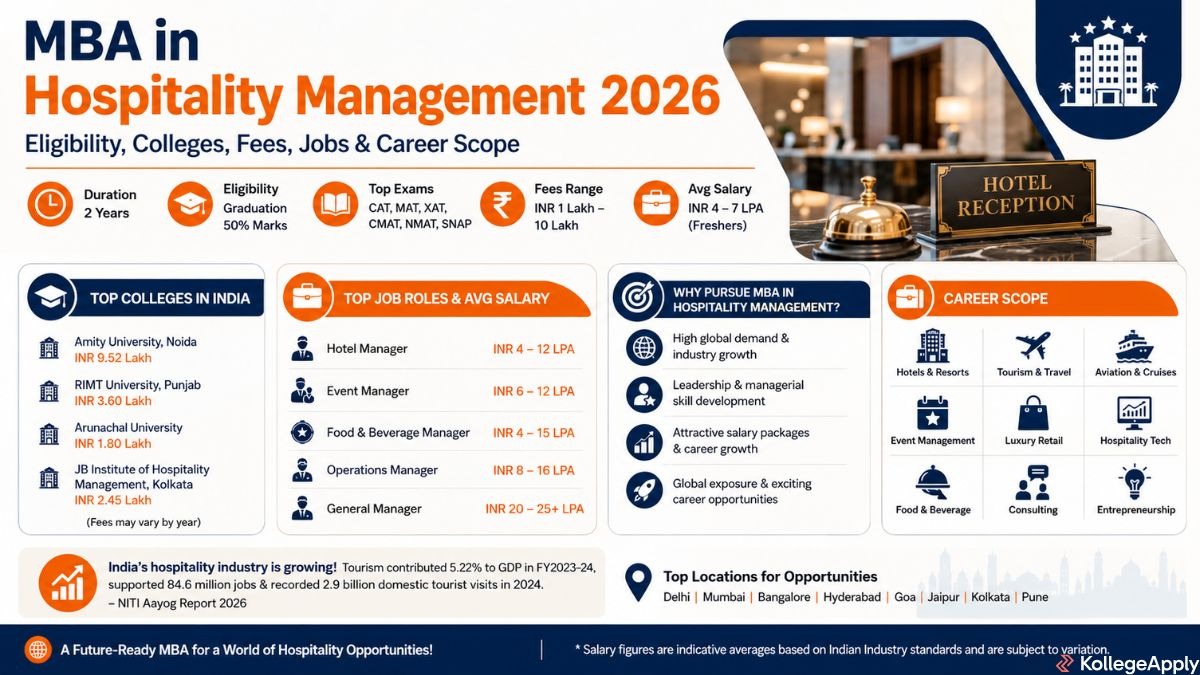
MBA in Hospitality Management is a career-oriented postgraduate program that combines business management principles with hospitality industry expertise. Below are the key highlights related to the course structure, eligibility, fees, career opportunities, and salary prospects:
Note: Fees, eligibility, admission criteria and salary figures vary by institution, location, role and experience.
What is MBA in Hospitality Management?
MBA in Hospitality Management is a specialized management course that focuses on the hospitality and tourism industry. The program prepares students for managerial roles in hotels, resorts, airlines, event management firms, and tourism organizations. It combines core management education with hospitality-specific operational training.
The MBA Hospitality Management syllabus includes subjects related to hotel operations, food and beverage management, tourism management, customer relationship management, hospitality marketing, financial management, strategic management, and human resource management.
The course also provides strong industry exposure through internships, practical training, workshops, seminars, and industrial visits. Many colleges collaborate with hospitality brands to offer students real-world learning experiences and placement opportunities.
The program helps students develop communication, leadership and problem-solving skills required for managerial roles in hospitality businesses. It is ideal for candidates interested in working in fast-paced service industries with global career opportunities.
Why Pursue MBA in Hospitality Management?
Pursuing an MBA Hospitality Management can be a great career choice for students interested in hotel management, tourism, luxury services, and event management. The course not only provides industry-focused knowledge but also helps students develop managerial and leadership skills required in the global hospitality sector. Some of the major benefits of pursuing this course are mentioned below:
- High Global Demand: The tourism and hospitality industry is expanding rapidly, creating strong demand for skilled professionals across the world.
- Leadership Skill Development: Students learn essential skills such as communication, team management, customer service, and problem-solving.
- Attractive Salary Packages: Graduates can secure rewarding managerial roles in hotels, airlines, resorts, and travel companies.
- Excellent Career Growth: The course offers opportunities to move into senior management and leadership positions over time.
- Entrepreneurial Opportunities: Students gain business knowledge that can help them start their own hospitality or tourism ventures.
Is MBA in Hospitality Management Worth It in 2026?
MBA in Hospitality Management is expected to remain a promising career choice in 2026 due to the steady expansion of the hospitality, tourism, and travel industries. The growth of luxury tourism, domestic travel, destination weddings, MICE activities, and hospitality startups has increased the demand for skilled professionals who can manage operations, customer experience, revenue strategies, and business growth.Industry reports indicate that India's hospitality sector is expected to continue growing in 2026 due to increasing domestic tourism, business travel, weddings, and premium hospitality demand. Premium hotel segments are also expected to witness stronger demand, creating opportunities for qualified hospitality managers.
The sector’s growth is further supported by India’s expanding tourism ecosystem. A 2026 report by NITI Aayog highlighted that tourism contributed around 5.22% of India’s GDP in FY2023–24, supported approximately 84.6 million jobs, and recorded nearly 2.9 billion domestic tourist visits in 2024.
An MBA in Hospitality Management is worth pursuing for candidates interested in managerial roles across hotels, resorts, tourism companies, and event management firms. However, career outcomes depend on factors such as college reputation, internships, and industry exposure. Students should also consider that hospitality careers may involve flexible working hours, weekend shifts, and relocation.
MBA in Hospitality Management Eligibility Criteria
Candidates must fulfill certain basic eligibility requirements before applying for admission to MBA in Hospitality Management programs. The common eligibility criteria followed by most management colleges in India are listed below:
- Minimum Qualification: Applicants must possess a valid bachelor's degree in any discipline (BBA, BHM, etc.) from a recognized university.
- Required Marks: At least 50% aggregate marks (45% for reserved categories in many institutions).
- Relaxation Criteria: Candidates belonging to reserved categories (SC/ST/OBC/PwD) receive a 5% relaxation, requiring a minimum of 45% aggregate marks.
- Entrance Exams: Students must qualify in accepted entrance examinations as required by the respective institution.
MBA in Hospitality Management Entrance Exams
Admission to MBA in Hospitality Management in many colleges is generally based on national-level and university-level management entrance exams. Some of the entrance exams along with their registration date, exam date, application fees and conducting body is listed below:
MBA in Hospitality Management Colleges in India
India has several reputed government and private institutions offering MBA in Hospitality Management with industry-oriented curriculum and placement support. These colleges provide practical training, internships, and exposure to the hospitality and tourism industries. Choosing the right college depends on factors such as fees, rankings, infrastructure, and placement opportunities. MBA in Hospital Management course fees in India generally range from INR 1 lakh to INR 10 lakh or above, depending on the institution type, infrastructure, location, and placement opportunities. Some of the colleges offering this course along their respective approximate fees is mentioned below:
Note: Fee can change by academic year and may exclude hostel/other charges.
MBA in Hospitality Management Admission Process
The admission process for MBA in Hospitality Management generally follows multiple stages and is largely similar in most of the colleges. Candidates must first appear for accepted entrance exams and then apply to colleges based on their scores. For reference, the step-wise admission process is listed below:
- Entrance Exam Registration: Candidates register for entrance exams such as CAT, MAT, CMAT, or other accepted management tests.
- Application Form Filling: Students apply to their preferred colleges by submitting academic details, personal information, and entrance exam scores.
- Shortlisting Process: Colleges shortlist candidates based on entrance exam cutoffs and academic performance.
- GD/PI Rounds: Shortlisted candidates attend Group Discussions (GD) and Personal Interviews (PI) to assess communication skills, confidence, and managerial aptitude.
- Merit List Release: Colleges prepare the final merit list based on entrance exam scores, GD/PI performance, academics, and work experience (if applicable).
- Document Verification: Selected candidates submit original documents for verification.
- Fee Payment: Students pay the admission fee to confirm their seat in the program.
Documents Required
MBA in Hospitality Management Syllabus
The MBA in Hospitality Management syllabus is designed to provide students with both managerial knowledge and hospitality industry expertise. The curriculum includes subjects related to hotel operations, tourism management, marketing, finance, customer service, and strategic management. Along with classroom learning, students also gain practical exposure through internships and industry projects. The semester-wise syllabus followed at Amity University:
What skills are acquired through MBA in Hospitality Management?
MBA in Hospitality Management helps students develop a wide range of managerial, communication, and operational skills required in the hospitality sector. The course focuses on enhancing leadership abilities, customer service expertise, and strategic thinking to prepare students for dynamic hospitality careers. The most acquired skills are:
- Communication Skills: Improves interaction with customers, teams, and clients
- Leadership Skills: Develops managerial and decision-making abilities
- Analytical Thinking: Helps in solving operational and business problems
- Customer Service Skills: Enhances guest handling and satisfaction techniques
- Team Management: Builds coordination and teamwork abilities
- Strategic Thinking: Helps in planning business growth and operations
- Time Management: Enables efficient handling of multiple hospitality tasks
- Financial Management: Develops budgeting and revenue management knowledge
- Problem-Solving Skills: Helps manage customer and operational challenges
- Technical Hospitality Skills: Provides industry-specific operational expertise
MBA in Hospitality Management Jobs & Salary
MBA in Hospitality Management graduates can explore careers across hotels, tourism companies, aviation, luxury hospitality brands, and event management firms. The hospitality industry offers opportunities in operations, customer service, administration, and strategic management with competitive salary packages and career growth. The jobs roles along with the job description and average salary according to job roles are given below:
What is the Salary After an MBA in Hospitality Management?
The salary after an MBA in Hospitality Management depends on factors such as work experience, job role, employer, location, property category, and managerial responsibilities. Fresh graduates generally begin in operational or supervisory positions, while professionals with several years of experience can move into managerial, strategic, and leadership roles. The hospitality sector also offers opportunities across hotels, resorts, restaurants, airlines, travel companies, event management firms, and hospitality technology companies. The table below highlights the indicative salary progression for MBA Hospitality Management graduates in India.
Note: Salary figures are indicative and can vary significantly by employer, city, property category, role, experience, skills, and performance. They should not be interpreted as guaranteed placement salaries.
Top Recruiters for MBA in Hospitality Management
One of the biggest advantages of pursuing an MBA in Hotel Management is the opportunity to work with leading hospitality and tourism companies. The table below highlights some Top recruiters hiring MBA Hospitality Management Graduates :
What is the Scope of MBA in Hospitality Management?
The scope of MBA in Hospitality Management extends beyond hotel management. Graduates can build careers in hotels, resorts, tourism, travel, airlines, cruise lines, event management, restaurants, luxury retail and hospitality technology.
The growing demand for domestic travel, premium accommodation, destination weddings, MICE events and experience-based tourism is expanding the range of hospitality-related careers. In addition, technology is creating opportunities in revenue management, digital marketing, customer analytics and hospitality technology.
Major career areas after MBA Hospitality Management
- Hotel and resort management
- Food and beverage management
- Tourism and travel management
- Event and MICE management
- Revenue and yield management
- Hospitality sales and marketing
- Customer experience and guest relations
- Luxury hospitality
- Aviation and airport hospitality
- Cruise hospitality
- Hospitality consulting
- Hospitality technology
- Entrepreneurship
MBA in Hospitality Management vs MBA in Tourism Management
Both MBA in Hospitality Management and MBA in Tourism Management are popular management specializations within the service industry. While Hospitality Management focuses on hotel operations, guest services, and hospitality businesses, Tourism Management emphasizes travel planning, destination management, and tourism services. The comparison below highlights the key differences between these two MBA programs:
MBA in Hospitality Management FAQs
What is MBA in Hospitality Management?
MBA in Hospitality Management is a postgraduate program focused on hotel operations, tourism, and hospitality business management. It prepares students for leadership and service management roles.
What is the duration of MBA in Hospitality Management?
MBA in Hospitality Management is generally a 2-year postgraduate degree program. The course is divided into four semesters with practical industry exposure.
Which entrance exams are accepted for MBA in Hospitality Management?
Common entrance exams include CAT, MAT, XAT, CMAT, NMAT, and SNAP. Admission criteria may vary depending on the college or university.
What is the average salary after MBA in Hospitality Management?
MBA in Hospitality Management graduates can earn around INR 4–12 LPA depending on experience and job role. Salaries are usually higher in luxury hospitality and international companies.
Is an MBA in hospitality management good?
MBA in Hospitality Management offers strong career opportunities in hotels, tourism, and event management. It is suitable for students interested in customer-focused industries.
What are the colleges for MBA in Hospitality Management?
Popular colleges include Arunachal University, IMTS Institute, JB Institute of Hospitality Management, and Amity University. These institutes offer quality education with good placement opportunities.
Can I pursue an MBA in Hospitality Management after graduation?
Yes, students from any recognized graduation stream can apply for the course. Some colleges may also require entrance exam scores for admission.
What jobs are available after MBA in Hospitality Management?
Graduates can work as Hotel Managers, Event Managers, and Hospitality Consultants. Opportunities are available in hotels, airlines, resorts, and tourism companies.
Does an MBA in Hospitality Management offer international career opportunities?
Yes, graduates can find opportunities in international hotels, airlines, and cruise companies. Global hospitality brands regularly hire skilled management professionals.
Are there distance or online learning alternatives available for working executives?
Yes, many institutions offer online and distance MBA programs in Hospitality Management. These programs help working professionals continue their studies flexibly.
What is the scope of MBA in Hospitality Management?
Graduates can work in hotels, resorts, tourism, airlines, cruise, events, luxury services and hospitality technology.
What are the 7 rules of hospitality?
They include welcoming guests, listening, personalisation, clear communication, quick problem-solving, cleanliness and follow-up.
What are the highest-paying jobs after MBA Hospitality Management?
General Manager, Operations Manager, Revenue Manager, Hospitality Consultant and Business Development Manager are among the higher-paying roles.
What is the average fee for MBA Hospitality Management?
Fees generally range from around INR 1 lakh to INR 10 lakh or more, depending on the institution and program.