MSc Biotechnology colleges in India offer postgraduate training in molecular biology, genetics, microbiology, bioinformatics, genetic engineering and other areas of modern biotechnology. The programme is generally two years long and combines classroom learning with laboratory work, research projects and, in some universities, internships or dissertation-based training. Government universities generally offer lower academic fees, while private universities may charge higher fees but provide different infrastructure, admission routes and industry-oriented opportunities.
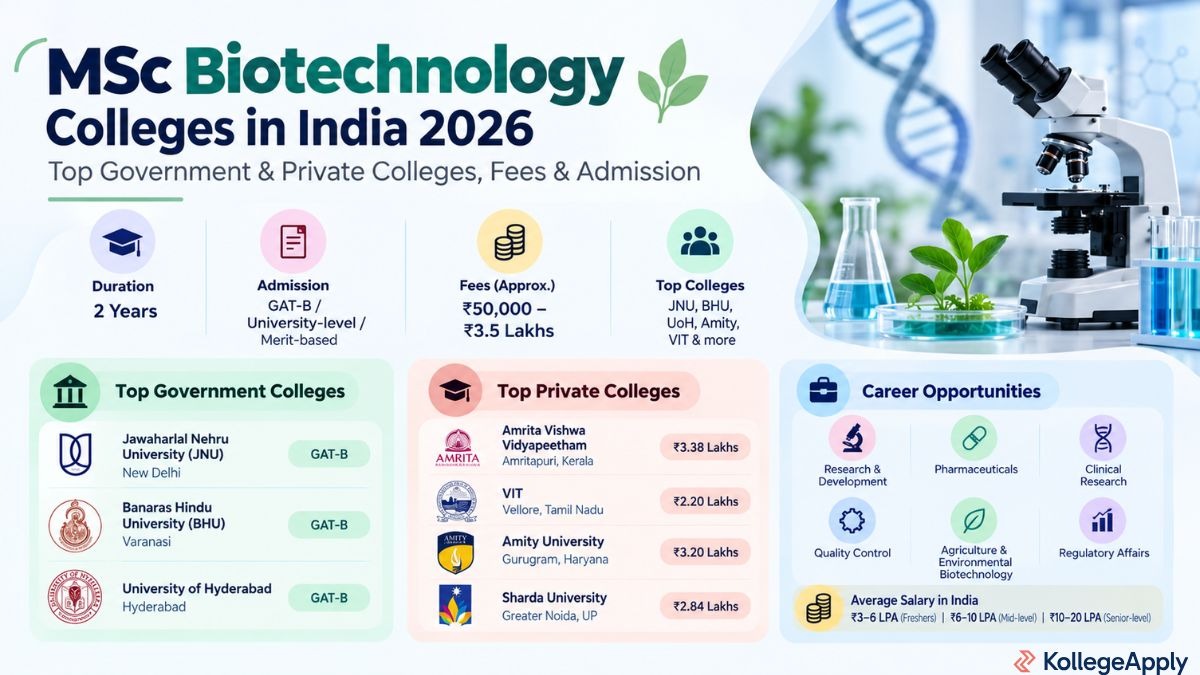
For 2026 admissions, students can find M.Sc Biotechnology programmes through national-level examinations such as GAT-B, university-specific entrance tests and, in some cases, merit-based selection. The admission route is not the same for every institution. For example, JNU and the University of Hyderabad use GAT-B for their M.Sc Biotechnology admissions, while VIT admits students to its two-year M.Sc Biotechnology programme based on undergraduate merit. Therefore, students should check the exact admission route before applying.
Top Government MSc Biotechnology Colleges in India
Government and public universities can be attractive options for students looking for research-oriented education at comparatively lower academic fees. However, admission can be competitive, and students must carefully check the entrance examination and programme-specific eligibility. The following institutions have official information confirming the M.Sc Biotechnology programme for the current admission cycle or academic year.
Top Private MSc Biotechnology Colleges in India
Private universities provide another route for students who want to pursue an M.Sc Biotechnology without limiting their applications to government institutions. Their admission processes can include university-level entrance examinations, interviews, merit-based selection or direct university applications. The following colleges offer MSc Biotechnology:
Note: Fee may include tuition and/or examination and other academic components depending on the university. Students should verify the final payable amount from the latest admission fee schedule.
What is the Eligibility Criteria for MSc Biotechnology?
The MSc Biotechnology eligibility varies across universities, so there is no single percentage or bachelor's degree requirement applicable to every college. Most institutions require graduation in biotechnology, life sciences or another relevant biological or allied science discipline. Some universities also accept pharmacy, agriculture, medicine, engineering or other related qualifications. Students should therefore check the programme-specific eligibility before selecting an entrance examination or submitting an application. The common eligibility requirements include:
- Candidates should hold a recognised bachelor's degree in Biotechnology, Biological Sciences, Life Sciences or a related discipline.
- Some universities accept bachelor's degrees in pharmacy, agriculture, veterinary sciences, medicine, engineering or allied sciences.
- Minimum marks generally range from 50-60%, depending on the institution.
- Reserved-category candidates may receive relaxation according to the university's admission rules.
- Some universities accept final-year students subject to submission of the qualifying-degree documents within the prescribed deadline.
- JNU requires at least 55% marks in the relevant bachelor's qualification for its M.Sc Biotechnology programme.
- The University of Hyderabad requires a relevant bachelor's degree with at least 55% marks and a qualified GAT-B score.
- VIT requires a relevant bachelor's degree with 60% marks for M.Sc Biotechnology.
- Amrita requires graduation in Biological Sciences, Biotechnology Engineering, Medicine or an equivalent discipline with a biology background and 60% aggregate marks.
- Admission requirements can change between academic sessions, so candidates should refer to the 2026 admission notification of their selected college.
MSc Biotechnology Entrance Exams and Admission Routes
There is no single entrance exam accepted by every MSc Biotechnology college in India. GAT-B is particularly important for DBT-supported postgraduate biotechnology programmes, while universities such as VIT use undergraduate merit and other private universities may conduct their own selection process. Students should shortlist colleges first and then identify the examination or admission route applicable to each programme.
For 2026, GAT-B was conducted on May 17, 2026, while individual universities subsequently conducted their own admission and counselling processes. Candidates should not assume that qualifying a national examination automatically completes university admission; a separate institutional application may be required.
For detailed MSc Biotechnology eligibility, syllabus, entrance exam dates, fees and career information, refer to the MSc Biotechnology course guide
MSc Biotechnology Fees in India
MSc Biotechnology fees vary significantly between government universities and private institutions. Public universities generally have lower tuition costs, whereas private universities may charge higher fees for laboratory facilities, academic infrastructure and other institutional services. The fee range from around INR 40,560 in tuition at some public universities to more than INR 3 lakh at several private universities. However, the amount and fee components vary by institution.
The latest official fee information shows a wide range. For example, the University of Hyderabad lists tuition of INR 10,140 per semester, making the four-semester tuition total INR 40,560. Amrita's 2026-27 structure lists INR 82,000 tuition and INR 2,500 examination fee per semester, while VIT lists INR 1.10 lakh per year for its two-year M.Sc Biotechnology programme.
The exact components included in the published amount differ between institutions. Students should verify tuition, examination, registration, caution deposit, hostel and other applicable charges before payment.
Note: Fees are indicative and based on the latest official institutional information available for the relevant academic session. Universities may revise fees, and additional charges may apply.
MSc Biotechnology Admission Process 2026
The MSc Biotechnology admission process depends on the college selected by the candidate. Government universities such as JNU and the University of Hyderabad follow entrance-based admission through GAT-B, while VIT follows undergraduate merit for its two-year M.Sc Biotechnology programme. Private universities may use their own entrance examination, interview or merit-based selection. Therefore, candidates should complete both the examination and university-level application requirements wherever applicable. The general admission process is as follows:
- Check college-wise eligibility: Confirm the accepted bachelor's degree, minimum marks and subject requirements.
- Choose the required entrance route: Apply for GAT-B, CUET PG or a university-level examination if required.
- Appear for the examination: Complete the relevant entrance test and retain the scorecard.
- Apply to the university: Submit a separate university application wherever required.
- Submit academic details: Provide graduation marks, category details and entrance examination information.
- Check merit or selection lists: Universities release merit lists, shortlists or counselling/allotment results according to their admission rules.
- Complete counselling or interview: Attend the required selection stage if applicable.
- Verify documents: Submit original academic and identity documents as prescribed.
- Pay the admission fee: Complete fee payment within the deadline to confirm the allotted seat.
Documents Required for MSc Biotechnology Admission
How to Choose the Best MSc Biotechnology College?
The best college for MSc Biotechnology depends on a student's academic background, career plans, budget and preferred admission route. Instead of selecting a college only because it appears in a ranking list, students should compare the exact M.Sc Biotechnology curriculum, laboratory exposure, research opportunities, faculty expertise, dissertation work and total academic cost. The availability of relevant electives and opportunities for internships or industry projects can also influence the value of the programme. Students should consider the following factors:
- Exact programme: Confirm that the college offers a two-year M.Sc Biotechnology rather than an integrated or differently named programme.
- Admission route: Check whether the college accepts GAT-B, CUET PG, a university examination or merit.
- Curriculum: Compare molecular biology, genetic engineering, bioinformatics, bioprocessing, genomics and other relevant subjects.
- Laboratory facilities: Practical exposure is important for biotechnology-related careers and research.
- Research opportunities: Check dissertation, project and faculty research opportunities.
- Fees: Compare total academic costs rather than tuition alone.
- Location: Consider access to biotechnology, pharmaceutical, healthcare and research organisations.
- Higher studies: Students planning a PhD should assess the research orientation of the programme.
- Career support: Look at internships, industry projects and placement support rather than relying only on headline placement claims.
MSc Biotechnology Colleges in India: NIRF Ranking
NIRF rankings can provide a broad institutional comparison, but they should not be treated as a programme-specific ranking for M.Sc Biotechnology. The latest NIRF university ranking available for comparison is NIRF 2025. For example, Manav Rachna International Institute of Research and Studies was placed at 96 in the 2025 University ranking, while Sharda University was placed at 87. Rankings should therefore be considered alongside programme quality, research facilities, fees and admission criteria.
Note: NIRF ranking is an institutional ranking and does not represent the ranking of the M.Sc Biotechnology programme itself. Students should use it as one comparison factor rather than the sole basis for college selection.
FAQs on MSc Biotechnology Colleges
Which are the best colleges for MSc Biotechnology?
JNU, BHU, University of Hyderabad, Amrita, VIT and other verified universities offer M.Sc Biotechnology.
Is there any entrance exam for MSc Biotechnology colleges?
Yes, GAT-B is important for several universities, while others use merit or their own entrance process.
Which exam is accepted by JNU for MSc Biotechnology?
JNU admits students to M.Sc Biotechnology through GAT-B ranking, whereas the other MSc Biotechnology colleges uses other admission routes.
Does BHU offer MSc Biotechnology?
Yes. BHU offers M.Sc Biotechnology and conducts programme-specific admission through its 2026 admission process.
Does University of Hyderabad offer MSc Biotechnology?
Yes, Its M.Sc Biotechnology admission is based on GAT-B 2026 scores.
What is the fee for MSc Biotechnology at VIT?
VIT lists INR 1.10 lakh per year for its two-year M.Sc Biotechnology programme.
Which private college is good for MSc Biotechnology?
Amrita, VIT, Amity, Sharda, Manav Rachna and other verified universities offer different options.
Can I pursue a PhD after MSc Biotechnology?
Yes, MSc Biotechnology graduates can apply for PhD and research programmes subject to eligibility and entrance requirements.