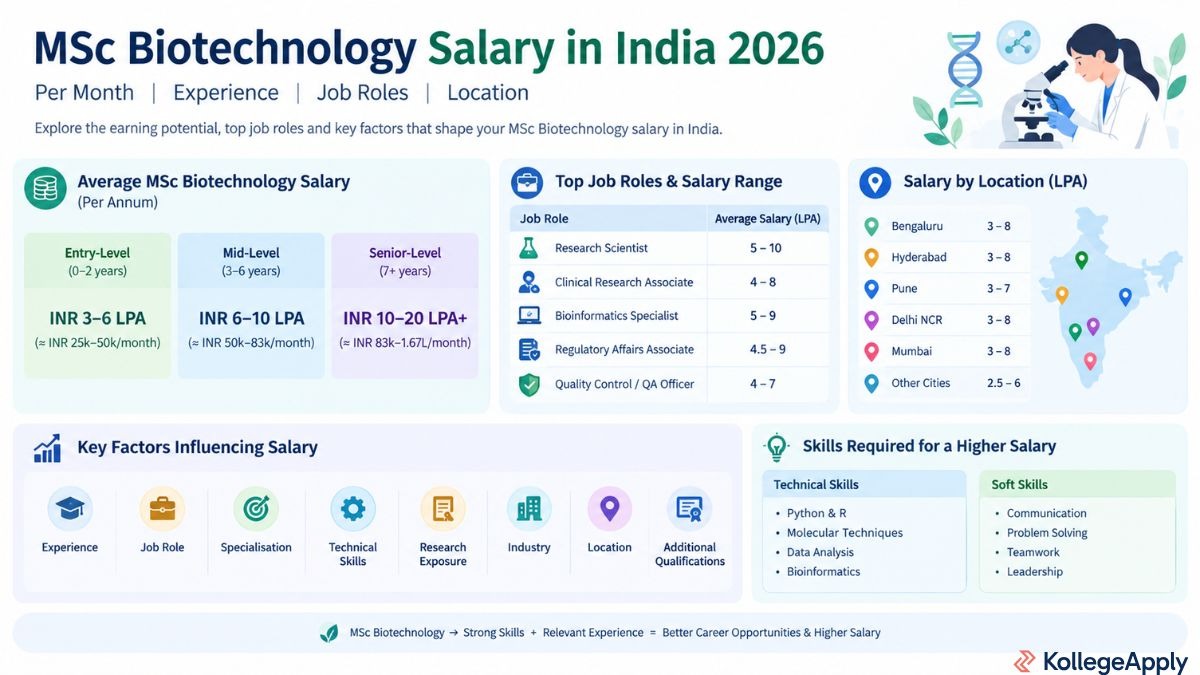
The MSc Biotechnology salary in India varies by experience, job role, specialisation, employer and location. Fresh graduates can generally expect around INR 3–6 LPA, while professionals with relevant experience may earn INR 6–10 LPA at the mid-level and INR 10–20 LPA or more in senior roles.
Salary after MSc Biotechnology also depends on the skills a candidate develops and the career path they choose. Research, pharmaceuticals, clinical research, bioinformatics, diagnostics, quality control and regulatory affairs can offer different growth and earning opportunities. This article covers MSc Biotechnology salary per month, experience-wise pay, job-role and location-wise salary, and skills that can improve earning potential.
- What is the MSc Biotechnology Salary in India?
- Factors Influencing MSc Biotechnology Salary
- Detailed Breakdown of MSc Biotechnology Salary
- MSc Biotechnology Salary for Freshers
- MSc Biotechnology Salary Per Month
- Highest Salary After MSc Biotechnology
- Skills Required for High MSc Biotechnology Salary
- MSc Biotechnology Salary by Career Path
- MSc Biotechnology Salary After PhD
- How to Increase Salary After MSc Biotechnology?
- FAQs on MSc Biotechnology Salary
What is the MSc Biotechnology Salary in India?
The MSc Biotechnology salary in India generally ranges from around INR 3–6 LPA at entry level. Actual pay depends on the role, employer, specialisation, location, skills and experience.
For a candidate comparing the MSc Biotechnology salary per month, these annual figures translate broadly to about INR 25,000–50,000 per month at entry level, INR 50,000–83,000 per month at mid-level and INR 83,000–1.67 lakh per month at senior levels before deductions. These are indicative CTC-based figures, not guaranteed in-hand salaries.
Note: Salary ranges are indicative. Actual CTC and monthly in-hand salary vary by employer, location, role, deductions and benefits.
Factors Influencing MSc Biotechnology Salary
The MSc Biotechnology salary is not determined by the postgraduate degree alone. Candidates with similar academic qualifications may receive different packages because they enter different industries and job functions. Laboratory experience, research exposure, computational skills and knowledge of quality or regulatory practices can affect employability. Location also matters because biotechnology and pharmaceutical employment is concentrated in major research, healthcare and manufacturing hubs. Key factors influencing salary after MSc Biotechnology include:
- Experience: Salary generally increases as professionals take on specialised or senior responsibilities.
- Job role: Research, bioinformatics, clinical research, regulatory and project-management roles can have different salary levels.
- Specialisation: Skills in genomics, molecular biology, bioinformatics, clinical research or bioprocessing may open specialised career paths.
- Technical skills: Python, R, statistics, molecular techniques and biological-data analysis can strengthen a candidate's profile.
- Research experience: Projects, internships, dissertations and publications can be useful for research-oriented careers.
- Industry: Pharmaceuticals, biotechnology, diagnostics, CROs and research institutions have different compensation structures.
- Location: Major biotech and pharmaceutical hubs can offer more opportunities and, in some cases, higher compensation.
- Additional qualifications: NET, PhD or specialised training may be relevant for particular academic or research career paths.
Detailed Breakdown of MSc Biotechnology Salary
The salary after MSc Biotechnology can be understood more clearly by comparing experience, job role and location separately. Experience usually has the strongest influence on progression because professionals move from supervised technical work to independent research, specialist responsibilities and eventually project or team leadership. However, the highest-paying pathway varies by individual; a specialised technical role may progress differently from a research or management career.
MSc Biotechnology Salary Based on Experience
Experience plays an important role in determining MSc Biotechnology salary because responsibilities generally increase with professional growth. Freshers usually enter trainee, laboratory, research-assistance, QC or project-based positions. With several years of experience, candidates may take ownership of research activities, quality functions, regulatory work, clinical operations or specialised data analysis.
MSc Biotechnology Salary Based on Job Roles
Different MSc Biotechnology jobs salary levels reflect the responsibilities and skills required for each position. Entry-level research and laboratory roles generally start lower, while specialised or managerial positions can command higher compensation after relevant experience. For example, LPU lists Research Associate salaries around INR 3.5–6 LPA, Clinical Research Associate around INR 3–5 LPA and Project Manager around INR 9–12 LPA.
Note: These figures should be treated as broad market benchmarks rather than fixed salaries. Job requirements, experience, company size and location can substantially change an individual's offer.
MSc Biotechnology Salary Based on Location
Location can influence MSc Biotechnology salary in India because biotechnology employment is concentrated in cities with pharmaceutical companies, research organisations, clinical research firms, diagnostics companies and biotechnology clusters. Bengaluru, Hyderabad, Pune and Delhi NCR are among the major biotechnology employment hubs. However, candidates should compare the actual job offer with living costs rather than choosing a city only on the basis of salary.
The following ranges are indicative salary benchmarks based on available job-portal data and biotechnology-sector salary trends. Actual MSc Biotechnology salary can vary significantly depending on experience, job role, employer, specialisation and skills.
Note: Salary ranges are indicative and should not be treated as fixed city-wise salaries. Job-portal data shows substantial variation even within the same city. For example, reported MSc Biotechnology salaries include around INR 24,000–26,000 per month in Bengaluru, INR 19,000–21,000 per month as a base-pay average in Hyderabad, and INR 3–4 LPA in Pune.
MSc Biotechnology Salary for Freshers
The MSc Biotechnology fresher salary commonly falls around INR 3–6 LPA, although some job-market sources show fresher opportunities extending beyond this range depending on the role and employer. The job portal's current India salary data also shows substantial variation in reported MSc Biotechnology pay, reinforcing the need to treat online salary figures as indicative rather than fixed. Candidates with internships, dissertation experience, laboratory exposure or computational skills may be better positioned for relevant entry-level opportunities. Freshers may start in roles such as:
- Research Assistant
- Project Assistant
- Research Associate
- QC Analyst
- Laboratory Associate
- Clinical Research Coordinator
- Bioinformatics Trainee
- Regulatory Affairs Trainee
- Bioprocess Associate
- Scientific Content Writer
MSc Biotechnology Salary Per Month
The MSc Biotechnology salary per month depends on annual CTC, deductions, incentives and benefits. For comparison, an annual package of INR 3 LPA is equivalent to INR 25,000 per month before deductions, while INR 6 LPA is equivalent to INR 50,000 per month. These calculations represent monthly gross/CTC equivalents and should not be confused with take-home salary. The actual amount credited to the employee can be lower after applicable deductions, taxes and other components of the compensation package.
Highest Salary After MSc Biotechnology
There is no single highest salary after MSc Biotechnology because long-term earnings depend on the career path chosen. Senior research, technical management, project management, specialised computational work and certain industry-facing roles can offer stronger earning potential than routine entry-level laboratory positions. Higher salaries generally require relevant experience, specialised expertise and greater responsibility rather than the MSc qualification alone. Career areas that can offer comparatively strong long-term earning potential include:
- Biotechnology R&D
- Bioinformatics and computational biology
- Clinical research
- Regulatory affairs
- Bioprocessing
- Scientific project management
- Product and application support
- Intellectual property and technology-related roles
- Senior research and technical management
For candidates planning a research-heavy career, a PhD can provide access to additional research and academic pathways, subject to eligibility and career requirements.
Skills Required for High MSc Biotechnology Salary
A higher MSc Biotechnology salary usually depends on how effectively a candidate combines biological knowledge with practical, analytical and industry-oriented skills. Laboratory expertise is valuable for experimental roles, while programming and statistics can strengthen computational career options. Documentation, scientific communication, quality practices and regulatory awareness are also useful because many biotechnology jobs involve structured processes and compliance requirements.
MSc Biotechnology Salary by Career Path
Salary progression can differ considerably between research, industry, clinical, computational and regulatory careers. A candidate who develops specialised expertise may progress differently from someone who moves into project coordination or management. Therefore, MSc Biotechnology salary growth should be assessed together with the responsibilities, skills and qualifications required for the selected career path.
MSc Biotechnology Salary After PhD
An MSc Biotechnology graduate who pursues a PhD may move towards advanced research, specialised scientific and academic career paths. However, a PhD should not be viewed only as a salary-increasing qualification. Its value is strongest for candidates interested in research-intensive roles, scientific specialisation or academic careers. The career progression may broadly follow:
MSc Biotechnology → Research Experience → PhD → Advanced Research/Scientific Career
The actual salary after a PhD depends on the research area, employer, publications, technical expertise, experience and the nature of the position.
How to Increase Salary After MSc Biotechnology?
Salary growth after MSc Biotechnology is generally linked to developing expertise that employers value in specific roles. Candidates should avoid relying only on the postgraduate qualification and instead build evidence of practical capability through projects, internships, technical skills and relevant work experience. Practical ways to improve earning potential include:
- Build strong laboratory or computational skills.
- Gain internship and project experience.
- Choose a specialised career area.
- Learn Python/R and statistics for computational pathways.
- Develop quality and regulatory knowledge for industry roles.
- Build scientific writing and communication skills.
- Track relevant biotechnology vacancies and employer requirements.
- Consider NET or PhD for suitable research and academic pathways.
- Change roles strategically after gaining relevant experience.
- Continue updating technical skills as the field evolves.
FAQs on MSc Biotechnology Salary
What is the MSc Biotechnology salary in India?
MSc Biotechnology salary generally ranges from INR 3–6 LPA at entry level, with higher pay possible with experience and specialisation.
What is MSc Biotechnology salary per month?
MSc Biotechnology salary per month can be around INR 25,000–50,000 at entry level before deductions, depending on the annual package.
What is the MSc Biotechnology fresher salary?
MSc Biotechnology fresher salary is commonly around INR 3–6 LPA, but offers vary by role, employer, skills and location.
What is the salary after MSc Biotechnology?
Salary after MSc Biotechnology varies by career path, with research, bioinformatics, clinical and industry roles offering different pay levels.
Is biotech a high-paying job?
Biotechnology can become well-paying with specialised skills, experience and progression into senior technical, research or management roles.
Which job has the highest salary in biotechnology?
Senior research, technical management, project management and specialised computational roles can offer comparatively high biotechnology salaries.
Can I get a government job after MSc Biotechnology?
Yes, MSc Biotechnology graduates can apply for eligible research, technical and project positions notified by government institutions.
Is MSc Biotechnology a good career?
MSc Biotechnology can be a good career for students interested in research, pharma, diagnostics, bioinformatics and applied life sciences.
Which skills increase MSc Biotechnology salary?
Molecular biology, bioinformatics, Python/R, statistics, research, quality practices and regulatory knowledge can improve career opportunities.
Which is better, MSc Zoology or MSc Biotechnology?
MSc Biotechnology suits applied life-science careers, while MSc Zoology is better suited to animal science, ecology and related research.