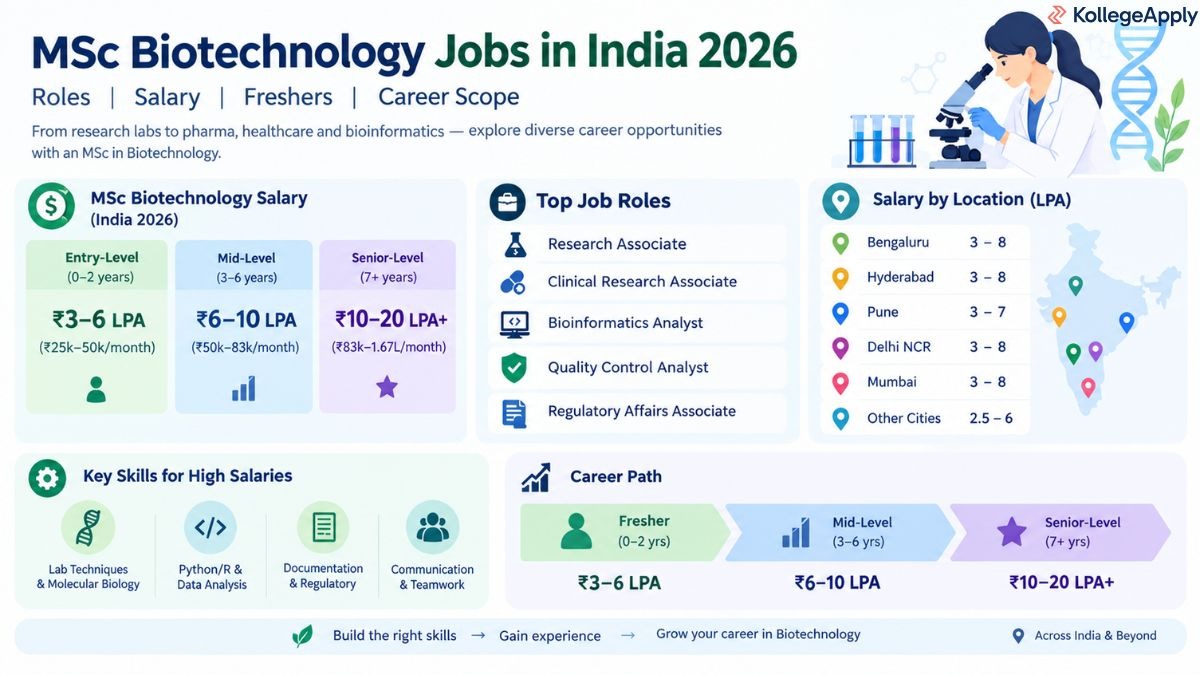
MSc Biotechnology jobs are available across research and development, pharmaceuticals, biotechnology, clinical research, quality control, bioinformatics, regulatory affairs, diagnostics, agriculture and environmental biotechnology. The type of job available depends on the candidate's specialisation, laboratory skills, research experience, computational knowledge and employer requirements.
Fresh graduates can begin with roles such as research associate, project assistant, quality control analyst, clinical research coordinator, laboratory associate, bioinformatics trainee and regulatory affairs associate. With experience and additional qualifications, professionals can move into specialised research, scientific, regulatory, project management and data-oriented roles.
- What Are the Jobs After MSc Biotechnology?
- MSc Biotechnology Jobs for Freshers
- Government Jobs After MSc Biotechnology
- MSc Biotechnology Jobs in the Private Sector
- Where Can MSc Biotechnology Graduates Work?
- What is the Salary After MSc Biotechnology?
- Which Job Has the Highest Salary in Biotechnology?
- Skills Required for MSc Biotechnology Jobs
- MSc Biotechnology Scope in India
- MSc Biotechnology Jobs Abroad
- Is MSc Biotechnology Good for Jobs?
- How to Get a Job After MSc Biotechnology?
- MSc Biotechnology Jobs: Career Path
- FAQs on MSc Biotechnology Jobs
What Are the Jobs After MSc Biotechnology?
MSc Biotechnology graduates can choose between laboratory-based, research, clinical, computational, regulatory and industry-oriented careers. Some roles are directly related to biotechnology research, while others use biotechnology knowledge in pharmaceuticals, healthcare, diagnostics or data analysis.
The exact eligibility varies by employer. Research positions may require laboratory or project experience, while computational roles may require programming and data-analysis skills. Common job profiles include:
- Research Associate
- Project Associate
- Research Assistant
- Quality Control Analyst
- Quality Assurance Executive
- Clinical Research Coordinator
- Clinical Research Associate
- Bioinformatics Analyst
- Regulatory Affairs Associate
- Laboratory Associate
- Bioprocess Associate
- Scientific Content Writer
- Technical Application Associate
- IP/Patent Analyst
- Project Coordinator
MSc Biotechnology Jobs for Freshers
MSc Biotechnology jobs for freshers are commonly available in research laboratories, pharmaceutical companies, biotechnology companies, clinical research organisations, diagnostic laboratories and academic research projects.
Entry-level salary varies considerably by role, employer and location. Current career and job-market sources indicate that many M.Sc Biotechnology freshers start in the broad range of about INR 3–7 LPA, although individual offers can be lower or higher.
Government Jobs After MSc Biotechnology
Government opportunities for MSc Biotechnology graduates are concentrated mainly in research projects, scientific support, technical positions, public laboratories, healthcare research and biotechnology-related programmes.
Government recruitment is notification-specific. Candidates should check the educational qualification, experience, age limit, selection process and whether the position is permanent or project-based before applying.
For example, current 2026 CSIR recruitment notifications include project positions where a Master's degree in Biotechnology/Life Sciences is an eligible qualification, demonstrating that MSc Biotechnology can be relevant for specialised research and project appointments. Possible employment areas include:
MSc Biotechnology Government Jobs Through NET
Candidates interested in academic research and teaching can also consider CSIR NET and other relevant eligibility examinations. NET qualification alone should not be presented as a guarantee of a teaching post; appointment depends on the institution, position and applicable eligibility rules.
MSc Biotechnology Jobs in the Private Sector
The private sector offers opportunities across pharmaceuticals, biotechnology, clinical research, diagnostics, healthcare, bioinformatics and manufacturing. The employer and role should be evaluated individually because an MSc Biotechnology degree does not automatically qualify a candidate for every position within a biotechnology or pharmaceutical company.
Where Can MSc Biotechnology Graduates Work?
MSc Biotechnology graduates can work across multiple industries depending on their specialisation and practical skills. Employment is not limited to laboratory research, as opportunities are also available in pharmaceuticals, clinical research, bioinformatics, diagnostics, agriculture and environmental biotechnology. The nature of work can range from experimental research and quality testing to data analysis, regulatory documentation and process support.
Biotechnology and Research
Graduates can work in R&D laboratories, biotechnology companies, research institutes and funded projects. Research-oriented roles usually involve experimental work, data interpretation, literature review and scientific documentation.
Pharmaceutical Industry
Pharmaceutical companies recruit life-science graduates for areas such as quality control, quality assurance, research support, regulatory documentation and clinical research.
Clinical Research
Clinical research organisations and healthcare research companies offer opportunities in clinical operations, clinical data, trial documentation and research coordination.
Bioinformatics and Computational Biology
Students with programming, statistics and biological-data skills can explore bioinformatics and computational biology. Python, R, statistics, databases and data visualisation can improve employability in this area.
Diagnostics and Molecular Testing
Molecular diagnostics laboratories can offer roles involving sample processing, molecular techniques, testing and laboratory documentation, depending on the employer's qualification requirements.
Agriculture and Food Biotechnology
Biotechnology is also applied to crop improvement, plant tissue culture, food microbiology, fermentation and related agricultural and food applications.
Environmental Biotechnology
Graduates can work in areas involving environmental monitoring, waste treatment, microbial applications and sustainability-related biotechnology.
What is the Salary After MSc Biotechnology?
The MSc Biotechnology salary generally increases with technical expertise, industry experience and specialisation. Research, clinical research, regulatory and project-management positions can have different salary trajectories.
Graduates can improve their earning potential by developing specialised skills in bioinformatics, clinical research, regulatory affairs, molecular diagnostics, bioprocessing, genomics or data analysis and by gaining relevant research or industry experience.
For a detailed breakdown by job role, experience and location, refer to the MSc Biotechnology Salary guide.
Which Job Has the Highest Salary in Biotechnology?
There is no single highest-paying job for every MSc Biotechnology graduate. Salary depends on specialisation, experience, employer and whether the position is technical, managerial, computational or research-oriented. Senior research, management and specialised technical positions can offer significantly higher salaries than entry-level laboratory roles. With an MSc, comparatively strong long-term opportunities can develop in areas such as:
- Bioinformatics and computational biology
- Biotechnology R&D
- Clinical research
- Regulatory affairs
- Bioprocessing
- Scientific project management
- Intellectual property
- Product and application support
Skills Required for MSc Biotechnology Jobs
The skills required for MSc Biotechnology jobs vary by career path. Laboratory-based roles require practical knowledge of molecular and microbiological techniques, while bioinformatics positions depend more on programming and data analysis. Research, pharmaceutical and regulatory roles also require documentation, scientific communication, quality practices and the ability to interpret biological data.
MSc Biotechnology Scope in India
The MSc Biotechnology scope in India extends across research, pharmaceuticals, healthcare, diagnostics, agriculture, environmental biotechnology and computational biology. Students interested in research-heavy careers may pursue a PhD in Biotechnology, Molecular Biology, Bioinformatics, Genetics, Microbiology or related disciplines. Career progression can follow different paths:
MSc Biotechnology → Entry-Level Role → Specialisation → Senior/Technical Role
or
MSc Biotechnology → Research Experience → PhD → Advanced Research/Academic Career
MSc Biotechnology Jobs Abroad
MSc Biotechnology graduates can also explore international opportunities in research, pharmaceuticals, diagnostics, bioinformatics and healthcare. However, international employment depends on country-specific qualification recognition, visa rules, professional requirements and employer eligibility.
Instead of presenting fixed INR salary figures for foreign countries, candidates should compare jobs using the local salary, tax, living costs and qualification requirements of the destination country.
For students planning to work abroad, a PhD, specialised technical experience, research publications or computational skills can strengthen the profile for research-oriented positions.
Is MSc Biotechnology Good for Jobs?
MSc Biotechnology can be a useful qualification for students interested in life-science research and applied biotechnology, but career outcomes depend heavily on specialisation and practical experience.
Students seeking purely clinical or professional healthcare roles should also compare MSc Biotechnology with specialised programmes such as MSc Medical Biotechnology and other life-science master's programmes. The degree is particularly relevant for candidates who want to build careers in:
- Biotechnology research
- Pharmaceutical R&D
- Clinical research
- Bioinformatics
- Quality control
- Regulatory affairs
- Molecular diagnostics
- Bioprocessing
- Academic research
How to Get a Job After MSc Biotechnology?
Getting an MSc Biotechnology job requires matching your skills and experience with the requirements of the target role. Candidates can improve their employability by focusing on a relevant specialisation, gaining practical exposure and preparing for the recruitment process. A practical approach is to:
- Choose a career area such as R&D, QC, clinical research or bioinformatics.
- Build practical skills relevant to that area.
- Complete internships or research projects.
- Develop a concise biotechnology-focused CV.
- Apply for entry-level and project-based positions.
- Build familiarity with laboratory documentation and industry practices.
- Consider NET, PhD or specialised certifications when required for the chosen career path.
- Continue developing technical skills after joining the industry.
MSc Biotechnology Jobs: Career Path
The career path after MSc Biotechnology generally progresses from entry-level technical or research roles to specialised and senior positions. The timeline is not fixed and depends on the candidate’s skills, experience, specialisation, employer and additional qualifications. Research, industry, clinical and computational pathways can therefore have different progression patterns.
Note: Not every candidate follows the same progression. Promotions and salary growth depend on technical expertise, performance, employer, specialisation and additional qualifications.
FAQs on MSc Biotechnology Jobs
What are the jobs after MSc Biotechnology?
MSc Biotechnology graduates can work in R&D, pharma, clinical research, QC/QA, bioinformatics, diagnostics, regulatory affairs and biotechnology.
What is the salary of MSc Biotechnology?
MSc Biotechnology salary often starts around INR 3–6 LPA, but pay varies by role, employer, location, skills and experience.
Can I get a government job after MSc Biotechnology?
Yes, Graduates can apply for eligible research, technical and project positions in government institutes based on recruitment notifications.
Which MSc Biotechnology job is best?
The best MSc Biotechnology job depends on your interest in research, laboratory work, data, clinical research, regulation or industry.
Is MSc Biotechnology good for freshers?
Yes, freshers can enter research, QC, clinical research, laboratory, regulatory and bioinformatics roles with relevant practical skills.
Which skills are important for MSc Biotechnology jobs?
Laboratory techniques, molecular biology, data analysis, bioinformatics, documentation, scientific writing and communication are useful skills.
Can I get a job in bioinformatics after MSc Biotechnology?
Yes, especially with additional skills in Python, R, statistics, biological databases and computational biology.
Can I do a PhD after MSc Biotechnology?
Yes, MSc Biotechnology graduates can pursue PhD programmes in biotechnology and related life-science disciplines, subject to institute eligibility.
Does MSc Biotechnology have jobs abroad?
Yes, Graduates can explore international research, pharmaceutical, diagnostics and bioinformatics roles, subject to local requirements.
What is the scope of MSc Biotechnology?
MSc Biotechnology scope includes research, pharma, clinical research, diagnostics, bioinformatics, agriculture, environmental biotechnology and higher studies.