MSc Biotechnology is a two-year postgraduate programme that combines advanced biological sciences with laboratory techniques, research methodology and biotechnology applications. The MSc Biotechnology syllabus generally covers subjects such as molecular biology, biochemistry, genetics, microbiology, immunology, bioinformatics, bioprocess technology, genomics and proteomics. The exact MSc Biotechnology subjects vary by university and may include electives, projects, laboratory courses and a dissertation.
The syllabus for M Sc Biotechnology is designed to balance theoretical knowledge with practical and research-based learning. For example, Delhi Technological University (DTU) includes core subjects, generic electives, discipline-specific electives, laboratory work and project work, while Manav Rachna International Institute of Research and Studies follows a four-semester, 80-credit curriculum with compulsory and elective courses.
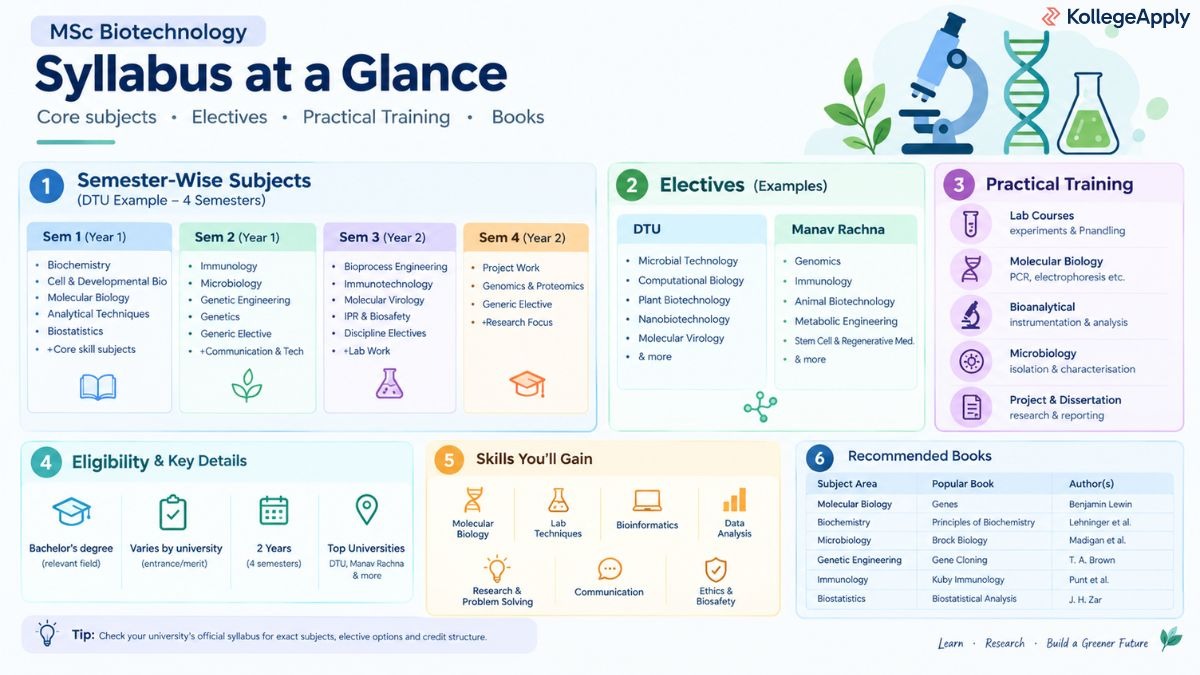
Table of Contents
- MSc Biotechnology Syllabus Semester-Wise
- MSc Biotechnology Syllabus in Private University
- Electives in MSc Biotechnology Syllabus
- Practical Training / Internship in MSc Biotechnology
- Skills Developed Through MSc Biotechnology Syllabus
- Books for MSc Biotechnology Syllabus
- MSc Biotechnology Syllabus FAQs
MSc Biotechnology Syllabus Semester-Wise
The DTU M.Sc Biotechnology curriculum is spread across four semesters and includes foundational subjects in the first year, followed by advanced biotechnology, electives, laboratory work and project-based learning. The structure also allows students to choose subjects according to their academic and professional interests.
1st Year Syllabus
The DTU MSc Biotechnology syllabus in the first year is divided into two semesters that progress from core biological concepts to applied biotechnology. Semester 1 covers Biochemistry, Cell and Developmental Biology, Molecular Biology, Analytical Techniques and Biostatistics, while Semester 2 introduces Immunology, Genetics, Genetic Engineering and Industrial Applications of Microbiology.
Along with these core subjects, students also complete Seminar, Communicative English, Generic Elective, Project Proposal Presentation and Fundamentals of Computers during the first year. These components add research, communication and computational skills to the subject-based curriculum.
2nd Year Syllabus
The second year of the DTU MSc Biotechnology syllabus shifts from foundational concepts to advanced and application-oriented biotechnology. Semester 3 covers bioprocess engineering, immunotechnology, molecular virology, IPR and biosafety, along with discipline-specific electives and an elective-based laboratory.
Semester 4 has a stronger research and project focus, with Project Work and advanced subjects such as Genomics and Proteomics. Students also complete a generic elective, allowing the final semester to combine specialised learning with research-oriented work.
Note: The subjects listed above are based on the DTU M.Sc Biotechnology curriculum. Universities may have different subjects, credit structures and elective options.
MSc Biotechnology Syllabus in Private University
Private universities may structure the MSc bio syllabus differently from government universities. Manav Rachna International Institute of Research and Studies (MRIIRS), for example, follows an 80-credit, four-semester curriculum for its M.Sc Biotechnology programme, with 60 credits from compulsory courses and 20 credits from electives.
Semester 1
The first semester at Manav Rachna focuses on advanced molecular and cellular biology, microbial physiology, biomolecules, analytical techniques and biostatistics. These subjects are supported by laboratory components, allowing students to connect theoretical concepts with experimental techniques.
Semester 2
The second semester introduces genetic engineering, bioprocess technology and computational biology, along with a research project component. Students can also select from the university's elective basket, depending on the courses offered in the semester.
Semester 3
The third semester expands into plant, environmental, food and enzyme biotechnology while continuing project work. The elective basket allows students to develop knowledge in areas such as genomics, animal biotechnology, metabolic engineering and regenerative medicine.
Semester 4
The final semester is primarily devoted to dissertation work. Students are expected to undertake research, identify a suitable problem, apply appropriate methodology, analyse findings and communicate their work through an academic or research-oriented format.
Notes: Manav Rachna's official curriculum states that the programme uses a Choice Based Credit System and includes laboratory courses, projects and dissertation work as part of the academic structure.
Electives in MSc Biotechnology Syllabus
Electives allow students to explore specialised areas beyond the compulsory MSc Biotechnology subjects. The options differ by university. DTU provides two discipline-specific elective groups, while Manav Rachna has elective baskets covering areas such as genomics, immunology, animal biotechnology and regenerative medicine.
DTU MSc Biotechnology Electives
DTU also allows students to take other elective courses offered by departments running M.Sc. and B.Tech. programmes. The university's curriculum further mentions learning opportunities through platforms such as MOOCs, SWAYAM and NPTEL.
Manav Rachna Elective Examples
Manav Rachna's 2025–27 curriculum includes domain-specific electives such as Bioethics, Biosafety & IPR, Genomics, Immunology, Biofertilizer and Biopesticide, Functional Genomics and Proteomics, Animal Biotechnology, Metabolic Engineering and Stem Cell & Regenerative Medicine.
Practical Training / Internship in MSc Biotechnology
Practical learning is an important part of the MSc Biotechnology syllabus because biotechnology careers require laboratory, analytical and research skills. The curricula reviewed here include laboratory courses, project phases and dissertation work rather than treating the programme as purely theory based.
For example, Manav Rachna's curriculum includes practical work involving DNA isolation, agarose gel electrophoresis, PCR, restriction mapping, protein isolation and SDS-PAGE. Its programme page also highlights research projects, industrial experience, workshops and specialised software training.
A separately named internship is not shown as a compulsory component in the cited DTU and Manav Rachna syllabus structures. Students should therefore check their university's current academic calendar or programme guidelines if they specifically want an internship requirement.
Skills Developed Through MSc Biotechnology Syllabus
The combination of theory, laboratory work, electives and research helps students develop both technical and transferable skills. These skills can support careers in research, pharmaceuticals, diagnostics, food biotechnology, environmental biotechnology, quality control and other life-science sectors.
DTU's stated programme outcomes include research-based problem solving, experimental design, data interpretation and biotechnology applications, while Manav Rachna's curriculum emphasises critical thinking, research aptitude, technical skills, entrepreneurship and professional ethics.
Books for MSc Biotechnology Syllabus
The best books for the MSc Biotechnology syllabus depend on the subjects selected and the university curriculum. Students should first follow the textbooks specified by their department and then use standard references for deeper understanding of molecular biology, microbiology, biochemistry, genetics and biotechnology.
Note: Several of these titles are specifically listed in Manav Rachna's official 2025–27 curriculum, including Molecular Cell Biology, Brock Biology of Microorganisms, Principles of Biochemistry, Gene Cloning, Kuby Immunology and Biostatistical Analysis.
MSc Biotechnology Syllabus FAQs
How many subjects are in MSc Biotechnology?
There is no fixed number. Universities vary in core, elective, laboratory, project and dissertation subjects across four semesters.
What are the main MSc Biotechnology subjects?
Common subjects include molecular biology, genetics, microbiology, biochemistry, immunology, bioinformatics and bioprocess technology.
Is MSc Biotechnology hard?
It can be challenging because it combines advanced biology, laboratory work, data analysis and research, but regular practical work can make it manageable.
What is the salary of M.Sc. biotechnology?
Salary varies by role, experience and sector. Research, pharma, clinical, regulatory and biotechnology roles have different salary ranges.
Which is better, MSc Zoology or M.Sc. Biotechnology?
Biotechnology suits molecular and applied research, while Zoology is better for animal science, ecology and related biological fields.
Does the MSc Biotechnology syllabus include practicals?
Yes, Practical courses, laboratory work, projects and research training are included in many university curricula.
Does MSc Biotechnology have electives?
Yes, Universities may offer electives such as genomics, animal biotechnology, diagnostics, vaccines, computational biology and stem cell biology.
Is bioinformatics included in the MSc Biotechnology syllabus?
It is included in several curricula through subjects such as computational biology, bioinformatics and genomics-related coursework.
Does MSc Biotechnology include a dissertation?
Many programmes include dissertation or project work in the final semester to provide independent research experience.
Can I pursue a PhD after MSc Biotechnology?
Yes, MSc Biotechnology can provide the academic and research foundation required for doctoral study, subject to the PhD programme's eligibility rules.