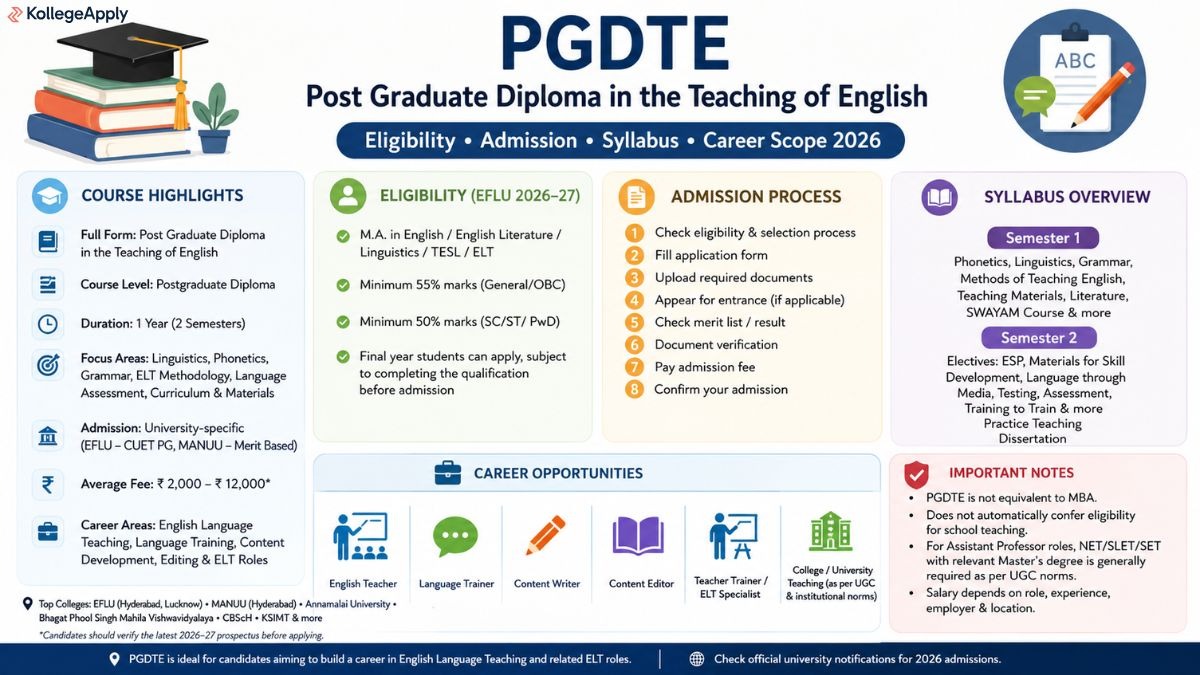
The PGDTE full form is Post Graduate Diploma in the Teaching of English. It is a specialised postgraduate-level programme designed to develop professional skills in English language teaching (ELT), including language pedagogy, linguistics, grammar, phonetics, curriculum design and language assessment. The programme is generally completed in one year or two semesters, although the exact structure and admission rules vary by university. EFLU, one of India's specialised universities for English and foreign languages, lists PGDTE as a one-year, two-semester programme for 2026–27.
For 2026 admissions, eligibility should not be presented as “graduation in any discipline”. At EFLU, candidates need an M.A. in English, English Literature, Linguistics, TESL or ELT, with 55% marks for General/OBC candidates and 50% for SC/ST/Differently-abled candidates. EFLU also permits candidates pursuing the qualifying programme to apply subject to completing the required qualification before admission.
PGDTE can be useful for English-language teaching, teacher training, language education, content development and related ELT roles. However, the diploma should not be treated as an automatic licence or qualification for every school or college teaching post. Recruitment requirements depend on the institution, level of teaching and applicable regulatory rules.
PGDTE Course Highlights
PGDTE offers focused training in teaching methods, classroom practices and educational skills for learners seeking to build or strengthen their careers in the teaching field. The key course features, including duration, eligibility, admission process and other academic details, are summarised below.
What is PGDTE?
PGDTE is a specialised programme in English Language Teaching rather than a general teaching degree. Its purpose is to help learners understand how English can be taught effectively through appropriate pedagogical approaches, language analysis, teaching materials and assessment techniques.
EFLU has offered PGDTE as a teacher-training programme for several decades. Its Directorate of Distance Education states that the programme was introduced in 1974 to address the needs of in-service teachers of English and focuses on teaching methods, teaching materials, scientific language analysis and interpretation of literary texts. MANUU's Department of English also lists the Post Graduate Diploma Course in Teaching English (PGDTE) among its academic programmes.
Why study PGDTE?
The course is particularly relevant for candidates who already hold a postgraduate qualification in English or a related discipline and want specialised training in English Language Teaching rather than a general teacher-education programme. The key benefits include:
- Develops knowledge of English Language Teaching methodologies.
- Builds understanding of linguistics, phonetics and language structure.
- Introduces language assessment and testing techniques.
- Helps candidates understand curriculum and teaching-material development.
- Can strengthen teaching and communication skills.
- May support career progression for existing English-language teachers.
- Provides specialised ELT training without requiring another full master's degree.
- Can complement other qualifications required for teaching or academic careers.
However, candidates should select PGDTE according to their career goal. It should not be chosen simply because it contains the word teaching. Candidates targeting school teaching should separately check B.Ed., TET/CTET and recruitment requirements applicable to their target school and teaching level.
Is PGDTE Worth It in 2026?
PGDTE can be worth it in 2026 for candidates who specifically want to specialise in English Language Teaching, particularly those with a relevant master's degree or existing teaching experience. Its value is strongest when the programme is pursued from a recognised university and combined with relevant professional qualifications or experience.
For university teaching, PGDTE alone is not a substitute for the qualifications prescribed for Assistant Professor recruitment. UGC regulations generally require a relevant master's degree with the prescribed marks along with NET/SLET/SET, subject to applicable exemptions and current recruitment rules.
PGDTE Eligibility Criteria 2026
PGDTE eligibility is university-specific, so candidates should not use a single “50% graduation in any stream” rule for all institutions. Other universities may prescribe different eligibility conditions. Therefore, candidates should always check the programme-specific prospectus before applying. For EFLU's 2026–27 PGDTE, candidates must have:
- An M.A. in English, English Literature, Linguistics, TESL or ELT.
- At least 55% marks for General/OBC candidates.
- At least 50% marks for SC/ST/Differently-abled candidates.
- Candidates pursuing the qualifying programme may also be eligible, provided they complete the required qualification by the time of admission and meet the prescribed marks requirement.
PGDTE Entrance Exams
There is no single entrance examination for PGDTE admissions across India. The admission route depends on the university. EFLU uses CUET (PG) for its 2026–27 PGDTE admission, while MANUU has listed PGDTE under merit-based admission. Candidates should check the current notification of the university they wish to join.
PGDTE Admission 2026
PGDTE admission in 2026 varies across universities, with institutions following their own eligibility requirements, selection criteria and application schedules. For example, EFLU uses CUET (PG) for PGDTE, while MANUU has specified a merit-based admission route. The university-specific routes are outlined below.
EFLU PGDTE Admission 2026
For EFLU, PGDTE admission follows the university's prescribed postgraduate admission process. The 2026–27 prospectus lists PGDTE as a one-year/two-semester programme and specifies CUET (PG) test paper codes COQP03/LAQP01. The university's 2026 admission notification also lists PGDTE at the Hyderabad and Lucknow campuses.
MANUU PGDTE Admission 2026
At MANUU, PGDTE is offered under its English academic programmes, with admission handled according to the university's notified selection criteria. For 2026, MANUU identified PGDTE admissions as merit-based and issued a June 2026 notification regarding the extension of applications for PGDTE under the merit-based admission route.
General PGDTE Admission Process
While the exact procedure differs between institutions, applicants can generally expect the following stages:
- Check the university's current PGDTE eligibility criteria.
- Confirm whether selection is based on CUET (PG), merit or another university-specific process.
- Complete the application form within the prescribed deadline.
- Upload the required academic and identity documents.
- Appear for the applicable entrance process, if required.
- Check the merit list or admission result.
- Complete document verification.
- Pay the prescribed admission fee to confirm admission.
Important: PGDTE does not follow a single admission route across all universities. The selection method may be entrance-based, merit-based or institution-specific, so applicants should refer to the latest official admission notification of the university they wish to join.
PGDTE Syllabus
At EFLU, PGDTE is a one-year programme divided into two semesters. Duration and semester structure may vary across universities. The following are the course details of the subjects covered in the 1st and 2nd semesters. There are only two semesters in this course, because it is a 1 year program subdivided into two halves. For reference, the curriculum followed at EFLU is structured below:
PGDTE Colleges in India
Several universities and institutes offer PGDTE or related teacher-education programmes, but availability, programme structure and fees can differ by academic year. The following institutions are included based on official university information available for the 2026 admission cycle, along with the indicative annual fees shown below.
Note: Candidates should verify the latest 2026–27 prospectus before applying.
PGDTE Fees
There is no single national PGDTE fee structure. Fees vary according to the university, campus, category, mode of study and other institutional charges. Therefore, the earlier blanket claim of INR 2,000 to INR 12,000 should not be presented as a universal 2026 fee range unless it is supported by current fee notices from the specific institutions. For admissions, candidates should check:
- Tuition fee
- Registration/application fee
- Examination fee
- Hostel charges, if applicable
- Library and laboratory/language-lab charges
- Other university or student-service charges
PGDTE Jobs and Career
Pursuing a PGDTE ensures a promising career. It opens up the door for several career pathways that PGDTE graduates can explore. Few of the career prospects are as follows:
PGDTE Salary in India
There is no standard salary specifically associated with PGDTE. Earnings depend on the role, employer, experience, location and additional qualifications. Salary portals may report different ranges for English teachers, language trainers, content writers and other related roles, at approximately INR 2.5 lakh to INR 5 lakh per year, depending on experience, employer and location, so these figures should not be treated as the salary of a PGDTE graduate. A more accurate way to present salary is:
Important: PGDTE does not itself determine salary. Additional qualifications, teaching experience, subject expertise, digital teaching skills and employer type can significantly influence earnings.
PGDTE Vs. D.Ed.
The following is a comparison between two similar courses which are available in education: the PGDTE Postgraduate Diploma in Teaching English and the D.Ed. Diploma in Education, which is a diploma in education. Both are diploma courses:
PGDTE Future Scope
A post-graduate diploma in teaching not only provides theoretical knowledge but also equips you to impart that knowledge in the classroom. Individuals with a postgraduate diploma in the teaching of English (PGDTE) have diverse career and academic opportunities. Below is the future scope for PGDTE graduates:
- Teaching: PGDTE graduates can work as English teachers or lecturers in schools, colleges, and universities, teaching the English language and literature.
- Content Development: Content writers, editors, and copywriters can be found in publishing houses, media houses, and corporate segments.
- Linguistics Experts: PGDTE graduates work as translators or linguistic consultants, making use of their English expertise.
- Teacher Training: PGDTE graduates can train other educators in efficient teaching techniques.
- Corporate Jobs: English communication skills are generally demanded for jobs in BPOs, KPOs, the aviation industry, the hospitality industry, and the travel sector.
- Journalism: Postgraduate opportunities include becoming a journalist or editorial team member.
PGDTE FAQs
What is the full form of PGDTE?
PGDTE stands for Post Graduate Diploma in the Teaching of English.
What does PGDTE stand for?
PGDTE stands for Post Graduate Diploma in the Teaching of English, a specialised postgraduate programme in English Language Teaching.
Who is eligible for PGDTE?
Eligibility varies by university. For EFLU's 2026–27 programme, candidates need an M.A. in English, English Literature, Linguistics, TESL or ELT with 55% marks for General/OBC candidates and 50% for SC/ST/Differently-abled candidates.
Is PGDTE equivalent to MBA?
No, PGDTE specialises in English Language Teaching, whereas an MBA is a master's-level management qualification.
Is PGDTE enough to become a school teacher?
Not necessarily, School-teacher eligibility depends on the teaching level, school type, recruiting authority and applicable professional teacher-education and TET requirements. Candidates should check the latest NCTE and recruiting-authority rules.
Is PGDTE enough to become an Assistant Professor?
No, PGDTE alone should not be presented as sufficient for Assistant Professor recruitment. UGC regulations prescribe additional eligibility requirements, generally including a relevant master's degree and NET/SLET/SET, subject to applicable rules and exemptions.
What is the salary after PGDTE?
There is no fixed PGDTE salary. Earnings depend on the job role, employer, experience, location and additional qualifications. Current English Language Teacher salary data shows a broad range rather than one fixed salary.
What is the scope of PGDTE?
PGDTE can support careers in English Language Teaching, language training, teacher development, educational content, editing, publishing and related communication roles. Additional qualifications may be required for regulated teaching and higher-education positions