
• Updated on 30 Sept, 2026 by Arjun Jaiswal
What's new?
MHT CET Latest news and articles
MHT CET Preparation 2027 includes preparation tips for each subject. MHT CET is one of the most popular and competitive engineering entrance exams in India. To perform well in the MHT CET 2027 Exam, candidates must follow smart preparation tips and strategies. These tips will not only help in scoring well in MHT CET but also be useful for other similar entrance exams.
MHT CET is a state-level exam conducted by the State Common Entrance Test Cell, Government of Maharashtra. It is held for admission to various undergraduate programs offered by colleges across Maharashtra in fields like engineering, pharmacy, agriculture, and technology.
To achieve a good rank in MHT CET 2027, candidates should focus on a proper study plan, regular practice, and solving mock tests and past year papers. These effective preparation
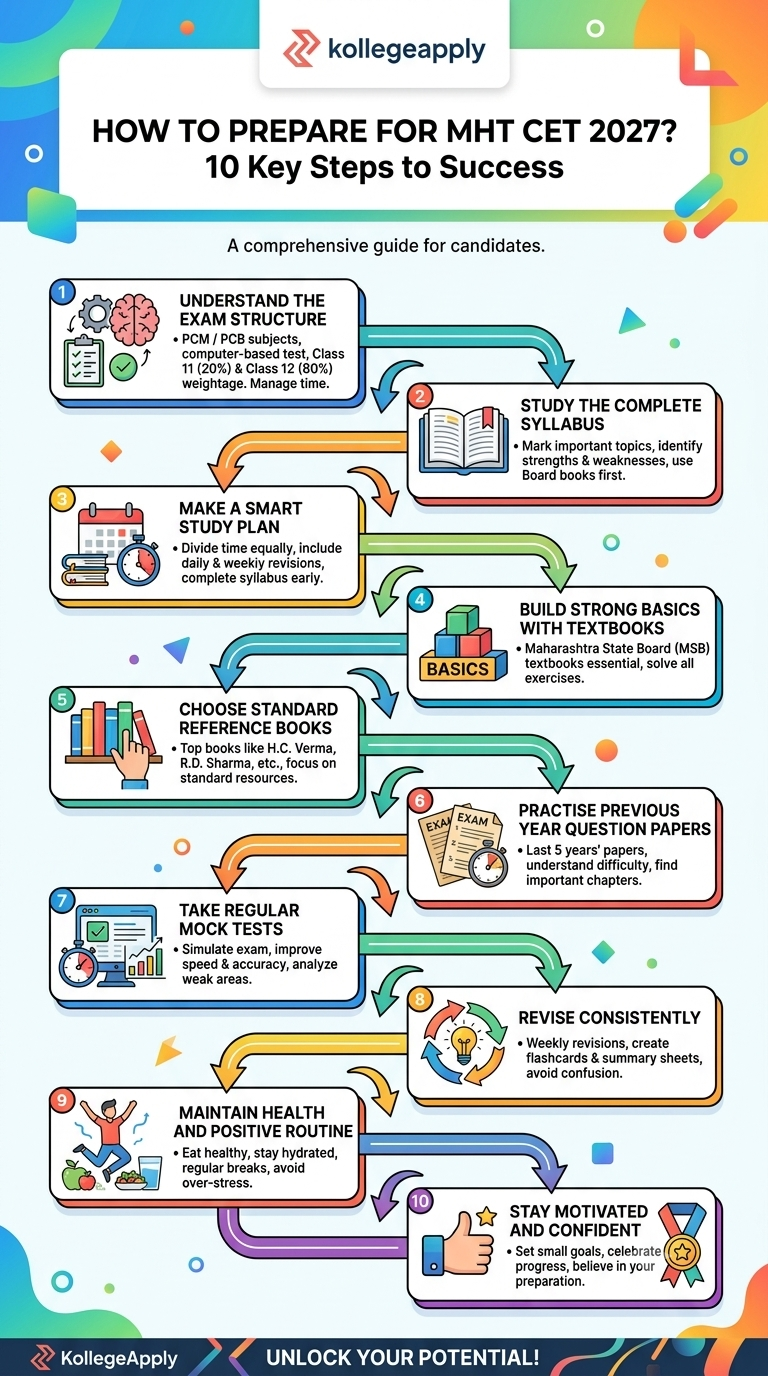
How to Prepare for MHT CET 2027?
Students are advised to follow the MHT CET Syllabus 2027 thoroughly as they prepare for the MHT CET 2027. One important point to note is that Class 11 contributes 20% and Class 12 contributes 80% of the total weightage. Solving Maharashtra State Board Textbooks will help students immensely to clear the MHT CET examination.
Candidates preparing for the MHT CET 2027 exam must go through the preparation tips below.
MHT CET 2027 Subject-wise Preparation Tips
Here are clear and simple tips for candidates preparing for MHT CET 2027. The exam tests Physics, Chemistry, and Mathematics (or Biology for pharmacy). Each subject needs a focused study plan. These tips will help candidates prepare well and improve their scores.
Physics Preparation Tips
- Understand Concepts First: Candidates should focus on understanding the basic laws, formulas, and principles. Clear concepts help solve questions easily.
- Use Maharashtra State Board Textbooks: These books cover the official syllabus for MHT CET. Reading them carefully is very important.
- Practice Numerical Problems: Physics has many numerical questions, so practice is key. Solve problems from previous years and standard books like H.C. Verma.
- Make Formula Notes: Writing important formulas and laws separately helps quick revision before the exam.
- Focus on Class 12 Topics: Usually, Class 12 topics have more weightage. Candidates should give them special attention.
Chemistry Preparation Tips
- Divide Chemistry into Three Parts: Physical, Organic, and Inorganic Chemistry need different study approaches.
- Physical Chemistry: Practice numerical problems regularly to gain speed and accuracy.
- Organic Chemistry: Memorise important reactions and mechanisms. Writing helps in remembering better.
- Inorganic Chemistry: Focus on understanding concepts and memorising important facts and tables.
- Revise from State Board Textbooks: These help cover direct theory questions that often appear in the exam.
- Solve Previous Year Questions: This helps candidates get familiar with question styles and difficulty.
Mathematics Preparation Tips
- Build Strong Basics: Candidates must understand formulas and theorems from Classes 11 and 12.
- Practice Regularly: Mathematics requires consistent problem-solving practice to improve speed and accuracy.
- Focus on Important Topics: Topics like Algebra, Calculus, Coordinate Geometry, and Trigonometry must be practised well.
- Use Maharashtra Board Books: They closely match the MHT CET syllabus and questions.
- Learn Shortcuts and Tricks: Time management is crucial, so memorising shortcuts helps answer questions faster.
- Attempt Mock Tests: This builds exam confidence and helps identify weak topics.
Biology Preparation Tips (for Pharmacy Candidates)
- Study Class 11 and 12 NCERT Textbooks: These form the base for MHT CET Biology syllabus.
- Understand Diagrams and Processes: Many questions are based on diagrams and biological processes.
- Focus on Important Topics: Genetics, Human Physiology, Plant Physiology, and Ecology are often tested.
- Make Flashcards for Terms: This method helps memorise definitions and functions easily.
- Practice Previous Exam Papers: Helps get used to the types of questions and improve answering speed.
General Tips for Every Subject
- Create a Study Schedule: Allocate time for each subject according to difficulty and importance.
- Regular Revision: Revising frequently helps retain important formulas, facts, and concepts.
- Solve Mock Tests and Sample Papers: Practice under timed conditions boosts confidence and exam readiness.
- Stay Healthy: Good food, rest, and exercise keep the mind alert and focused.
- Stay Positive and Consistent: Regular study and a positive mindset help in steady improvement.
MHT CET Preparation 2027 FAQs
How should candidates start MHT CET 2027 preparation?
Candidates should start by understanding the syllabus and exam pattern. Know which subjects and chapters are included. Begin with the basics from the NCERT books for Physics, Chemistry, and Mathematics. Make a timetable covering daily goals. Solve simple problems before moving to difficult ones. Set realistic targets and follow them every day. Practising past papers helps in becoming familiar with question types. Keep notes ready for revision and focus on understanding concepts, not just memorising.
Which books are best for MHT CET preparation?
Candidates should use NCERT books for Class 11 and Class 12 to learn the basics. For extra practice, refer to standard books like H.C. Verma for Physics, O.P. Tandon for Chemistry, and M.L. Khanna or R.D. Sharma for Mathematics. Avoid using too many books at the same time. Complete one book before starting another. Previous year papers and mock tests also work as useful study material. Keep reference guides for quick revision and problem-solving.
How much time should candidates give to revision?
Candidates should revise regularly, not just before the exam. Reserve at least one hour daily for revision while preparing. Weekly revision is also important for recalling old chapters. Make short notes of formulas, key points, and shortcuts. In the last month before MHT CET, focus more on revising than learning new topics. Revision time helps strengthen memory and improve answer speed in the exam. Continuous revision reduces mistakes and builds confidence.
How can candidates manage time in the exam?
Time management needs practice. Candidates should solve mock tests under timed conditions. Decide how much time to spend on each section and stick to it. Skip difficult questions first and return to them later. Practice answering questions quickly without losing accuracy. Do not get stuck on one question for too long. Improve speed with daily timed problem-solving sessions. Good time management ensures all questions are attempted within the exam duration.
Are previous year papers important for MHT CET prep?
Yes, they are very important. Candidates can understand question patterns and difficulty levels from them. Solving past papers helps in identifying topics that are repeated often. It improves speed and confidence. Analyse mistakes after solving each paper. Check how much time different sections take. Practice at least five years’ papers before the exam. Past papers give a realistic idea of what to expect in the actual MHT CET exam.
How many mock tests should candidates take?
Candidates should take at least one mock test every week during preparation. In the final two months, aim for two to three tests per week. Mock tests help in practising under real exam conditions. Review each test carefully to find weak areas. Focus on improving those topics before the next test. Mock tests build confidence and help candidates manage time better. Consistent practice makes answering questions easier and faster.
What is the MHT CET syllabus like?
The syllabus is based on the Maharashtra State Board curriculum for Classes 11 and 12. Class 11 topics carry less weight, while Class 12 topics carry more marks. Engineering aspirants have Physics, Chemistry, and Mathematics. Pharmacy aspirants have Physics, Chemistry, and Biology. Candidates should go through the official syllabus document before starting preparation. Understanding the syllabus helps in planning the study schedule and avoiding unimportant topics that are not included.
How should candidates prepare for Physics?
In Physics, focus on concepts first. Start with NCERT books and then move to H.C. Verma for detailed problems. Practise numerical problems daily. Make notes of formulas and key laws. Use diagrams to understand ideas better. Solve past papers to see which topics frequently appear. Manage time by practising easy questions first, then tough ones. Candidates should revise regularly to remember formulas and definitions before the exam.
How should candidates prepare for Chemistry?
For Chemistry, understand both theory and numerical problems. Use NCERT books for basics and O.P. Tandon for physical chemistry. Revise inorganic chemistry regularly to remember facts and reactions. Organic chemistry needs practice with reaction mechanisms. Create notes of important formulas and periodic table trends. Candidates should solve MCQs to improve speed. Past papers help in knowing common topics. Revision and practice make chemistry preparation better and faster.
How should candidates prepare for Mathematics?
Mathematics needs strong fundamentals. Learn formulas and practise their application daily. NCERT books give a basic understanding, while R.D. Sharma or M.L. Khanna offer harder problems. Focus on chapters with high weightage like Calculus, Algebra, and Coordinate Geometry. Take time to understand each concept before solving. Practice past papers to improve speed. Keep a formula sheet for quick revision. Regular problem-solving improves accuracy and confidence for the exam.
Exam Calendar
Explore exam calendars tailored to your interest