BSc IT Colleges in India offer undergraduate programmes that combine programming, databases, networking, software development and information technology with practical learning. The standard BSc IT programme is generally 3 years, although some universities now offer 4-year Honours or Honours with Research pathways under the National Education Policy (NEP). BSc IT Colleges in India generally charge around INR 1.5 lakh to INR 7.8 lakh or more for the course, based on the colleges listed. Fees vary by university, programme structure, scholarship, category and additional charges.
Admission to BSc IT colleges varies by institution. Some colleges offer admission through Class 12 merit, while others accept CUET UG scores or conduct university-level entrance tests. The eligibility criteria also differ, particularly for Mathematics, Computer Science and other subjects studied in Class 12.
For students planning a career in software development, web development, data analytics, networking, cybersecurity or cloud computing, choosing the right college can be as important as choosing the degree itself. Factors such as curriculum, practical training, internships, fees, faculty, infrastructure and placement support should therefore be considered before taking admission.
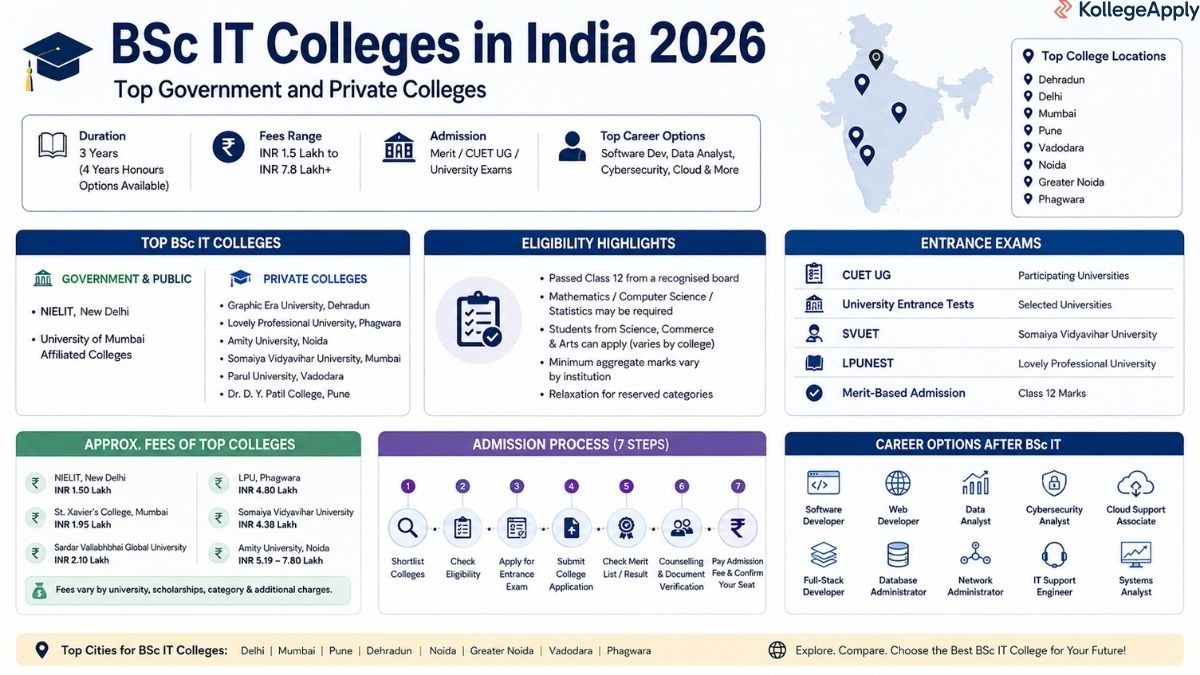
Table of Contents
- Top Government and Private BSc IT Colleges in India
- BSc IT Colleges Eligibility Criteria
- Entrance Exams for BSc IT Colleges
- BSc IT Colleges Fees in India
- BSc IT Graphic Era University Fees 2026
- BSc IT Colleges Admission Process
- How to Choose the Best BSc IT College?
- BSc IT Colleges Placement and Career Scope
- BSc IT Colleges FAQs
Top Government and Private BSc IT Colleges in India
The best BSc IT colleges for a student depend on factors such as location, fee budget, admission route, curriculum, practical training opportunities and career goals can all influence the final choice of the colleges.
BSc IT programmes are offered by government institutions, public university-affiliated colleges and private universities across India. Government and public institutions may appeal to students looking for comparatively affordable education, while private universities often provide specialised curricula and additional academic pathways. Rather than considering the following list a fixed national ranking, students can use it as a starting point to compare colleges based on their individual preferences and admission requirements.
Government and Public BSc IT Colleges
Government and public institutions can be attractive for students seeking relatively affordable education. However, the availability of BSc IT and the admission route varies considerably across states and universities. NIELIT, under the Government of India, offers a 3-year BSc IT programme with an intake of 40 students. Its published course eligibility specifies Class 12 Science with 45% marks for the open category and 40% for specified categories.
BSc IT is also offered through colleges affiliated with public universities. For example, several University of Mumbai-affiliated institutions offer the programme, with eligibility and admission procedures governed by the university and college rules.
Private BSc IT Colleges
Private universities and institutions offer a wider range of BSc IT pathways, including specialised programmes in areas such as cybersecurity, artificial intelligence, data analytics, cloud computing and full-stack development. Graphic Era's official 2026 BSc IT fee page shows a dedicated BSc IT programme and uses Class 12 aggregate/CUET score slabs for scholarship-linked fee calculations.
Somaiya Vidyavihar University offers BSc IT as a 3-year regular degree as well as 4-year Honours and Honours with Research pathways. The university also states that students from Arts, Commerce and Science backgrounds can apply to BSc IT under its current admission framework.
Parul University offers a 3-year BSc IT programme covering areas such as web and mobile application development, cloud integration and UI/UX. It currently lists a fee of INR 1.45 lakh per year for the standard BSc IT programme.
BSc IT Colleges Eligibility Criteria
Eligibility is one of the first factors students should check before shortlisting BSc IT colleges. For example, Somaiya Vidyavihar University currently states that students from Arts, Commerce and Science can apply for BSc IT, with a minimum aggregate requirement and preference for English and Mathematics.
Parul University's current BSc IT eligibility accepts candidates from Science, Commerce and Arts, provided they have English and Mathematics or Statistics, with the university also allowing these subjects to be considered from Class 10 in specified cases. There is no single eligibility rule applicable to every institution because universities may prescribe different Class 12 subjects, minimum marks and selection conditions. Common requirements include:
- Candidates should have passed Class 12 or an equivalent examination from a recognised board.
- Minimum aggregate marks generally vary by institution.
- Mathematics, Computer Science, Informatics Practices, Statistics or another relevant subject may be required.
- Some colleges accept students from Science, Commerce and Arts streams.
- Candidates appearing for their Class 12 examination may be allowed to apply provisionally.
- Reserved-category candidates may receive relaxation according to applicable rules.
- Entrance-based colleges may have additional examination requirements.
Entrance Exams for BSc IT Colleges
Admission to BSc IT colleges can be merit-based or entrance-based. Students should first shortlist the universities they want to apply to and then check which examination, if any, is accepted for BSc IT.
CUET UG is an important route because its participating-university list includes central, state, deemed and private universities. However, CUET is not compulsory for every BSc IT college. The exact subject combination required in CUET also varies between participating universities. Candidates should check the programme-specific requirements before selecting subjects.
BSc IT Colleges Fees in India
The fees charged by BSc IT colleges vary significantly based on the type of institution, location, programme structure and facilities. Government and aided colleges generally cost less, while private universities may charge higher tuition for specialised programmes and additional infrastructure. Graphic Era's official 2026 fee structure lists BSc IT tuition at INR 65,700 per semester in the first year, INR 67,150 in the second year and INR 70,508 in the third year before applicable scholarship adjustments. Additional admission, enrolment, caution and other charges also apply. BSc IT Colleges in India generally charge around INR 1.5 lakh to INR 7.8 lakh or more for the course, based on the colleges listed. Fees vary by university, programme structure, scholarship, category and additional charges.
LPU's current BSc IT fee information available for 2026 lists tuition of around INR 80,000 per semester, with total tuition of approximately INR 4.8 lakh for six semesters.
Parul University currently lists INR 1.45 lakh per year for its standard 3-year BSc IT programme, making the tuition approximately INR 4.35 lakh over three years before any applicable changes or additional charges.
Based on the colleges listed below, the total BSc IT course fees can range from approximately INR 1.5 lakh to INR 7.8 lakh or more. The final amount may vary depending on scholarships, category, programme structure, campus, payment mode and additional institutional charges.
Note: Fees can change by academic session, domicile, scholarship, category and payment mode. Students should verify the final fee structure with the college before admission.
For detailed information on the admission process, eligibility criteria, and entrance exams, read ourBSc IT Admission guide.
BSc IT Graphic Era University Fees 2026
Graphic Era University follows a semester-wise fee structure for BSc IT, with the tuition fee increasing slightly each year. The fees changes based on the applicable scholarship and payment amount depend on the student's Class 12 aggregate percentage or CUET NTA score. The table below shows the semester-wise tuition fee, scholarship available under each category, and the corresponding total fee payable for the course.
Note: The total fee figures are based on the fee structure published by Graphic Era University and should not be interpreted as the complete three-year course fee unless specifically stated by the university.
BSc IT Colleges Admission Process
The admission process differs across colleges, but most students follow a similar sequence. Checking eligibility first is important because the required Class 12 subjects and entrance examinations can vary significantly between institutions. The common steps to follow in admission process are given below:
Step 1: Shortlist BSc IT Colleges - Compare colleges based on location, course structure, fees, admission mode, internships, laboratories and placement support.
Step 2: Check Eligibility - Verify Class 12 marks, stream and subject requirements. Students without Mathematics should check the subject requirements of each college carefully, as BSc IT eligibility differs across institutions.
Step 3: Apply for the Required Entrance Exam - If the college accepts CUET UG or conducts its own entrance examination, complete the relevant registration within the prescribed deadline.
Step 4: Submit the College Application - Some universities require a separate application even after students appear for CUET. Complete the institution's application form and upload the required documents.
Step 5: Check Merit List or Entrance Result - Colleges release merit lists, entrance results or selection lists based on their admission criteria.
Step 6: Attend Counselling or Document Verification - Shortlisted candidates may need to participate in counselling or submit original documents for verification.
Step 7: Pay the Admission Fee - After receiving a seat, pay the prescribed admission fee within the deadline to confirm admission.
How to Choose the Best BSc IT College?
A good choice depends on academic requirements, budget and career plans. For example, Somaiya highlights internships, technical specialities and project-based exposure in its BSc IT programme, while Parul highlights practical training in web, mobile and cloud technologies. Students should compare:
BSc IT Colleges Placement and Career Scope
BSc IT graduates can pursue careers across software, data, networking, technical support and cybersecurity. However, placement outcomes depend on the college, individual skills, internships, location and employer. The curriculum of many BSc IT colleges increasingly includes programming, databases, cloud technologies, cybersecurity, data analytics and web development. These areas can help graduates align their skills with changing technology requirements. Common career options include:
- Software Developer
- Web Developer
- Full-Stack Developer
- Data Analyst
- Database Administrator
- Network Administrator
- IT Support Engineer
- QA/Test Engineer
- Cybersecurity Analyst
- Cloud Support Associate
- Systems Analyst
BSc IT Colleges FAQs
Which college is best for BSc IT in India?
The best BSc IT college depends on your budget, location, eligibility, curriculum and placement preferences. Students can compare Graphic Era, LPU, Amity, Somaiya Vidyavihar and Parul University.
How can I get admission to BSc IT colleges after 12th?
To get admission to BSc IT colleges after 12th, students must meet the eligibility criteria of the selected university. Admission may be based on Class 12 merit, CUET UG or a university-level entrance test.
What is the eligibility for BSc IT colleges in India?
Eligibility for BSc IT colleges generally requires passing Class 12 or an equivalent examination from a recognised board. Minimum marks and subject requirements, including Mathematics or Statistics, vary by college.
Which entrance exam is required for BSc IT admission?
There is no single entrance exam for all BSc IT colleges. Depending on the university, admission may be based on CUET UG, a university-level entrance test or Class 12 merit.
What are the fees of BSc IT colleges in India?
BSc IT colleges listed in this article have fees ranging from around INR 1.5 lakh to INR 7.8 lakh or more, depending on the university. Scholarships, programme structure and additional charges can affect the final fee.
Which are the top private BSc IT colleges in India?
Some private BSc IT colleges students can compare include Graphic Era, LPU, Amity University, Somaiya Vidyavihar University and Parul University. Fees, eligibility, curriculum and placements differ across these institutions.
Can I pursue BSc IT after Commerce or Arts?
Yes, some colleges offering BSc IT accept students from Commerce and Arts backgrounds. However, eligibility varies by institution, and subjects such as Mathematics, Statistics or English may be required.
Is BSc IT better than BCA?
BSc IT focuses on information technology, while BCA generally emphasises computer applications and software development. Neither is universally better, so students should compare curriculum, fees, skills and placements.
Is BSc IT a good course for a career in India?
BSc IT can be a good option for students interested in software development, data analytics, networking, cybersecurity and cloud computing. Projects, internships and technical skills can improve career opportunities.
What are the career options after BSc IT?
Graduates from BSc in IT colleges can pursue roles such as Software Developer, Web Developer, Data Analyst, Network Administrator, Cybersecurity Analyst, Database Administrator and Cloud Support Associate.