The BTech CSE JEE Main Cutoff 2026 refers to the JEE Main rank at which seats in Computer Science and Engineering are allotted through the relevant counselling process. For NITs, IIITs and other participating institutes, the admission cutoff is published as opening and closing ranks during JoSAA counselling. The cutoff differs by institute, programme, category, quota and counselling round.
Students should also distinguish the JEE Main qualifying cutoff from the BTech CSE admission cutoff. NTA's qualifying cutoff determines eligibility for JEE Advanced, while the CSE admission cutoff represents the rank at which a particular institute's CSE seat was allotted. Therefore, qualifying at 93 percentile, for example, does not mean that a candidate can secure CSE at an NIT.
For 2026, NTA has released the final category-wise qualifying percentile for JEE Advanced eligibility. The General category cutoff is 93.4123549 percentile, while the cutoffs are 82.4164528 for EWS, 80.9232583 for OBC-NCL, 63.9172792 for SC and 52.0174712 for ST. Meanwhile, JoSAA has published the 2026 opening and closing ranks for participating institutes.
As of October 2026, the regular JoSAA 2026 allocation process has concluded with Round 5. CSAB has also published the 2026 Special Round opening and closing ranks for the NIT+ system.
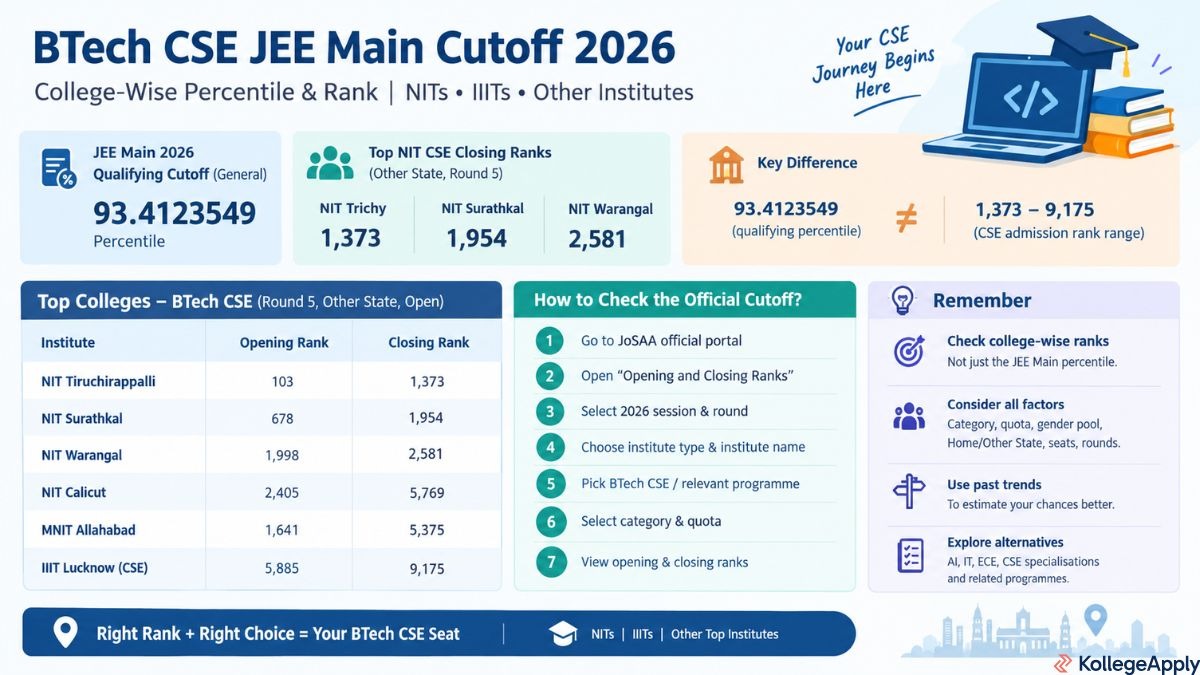
Table of Contents
- What Is the BTech CSE JEE Main Cutoff?
- JEE Main 2026 Qualifying Cutoff vs BTech CSE Admission Cutoff
- BTech CSE JEE Main Cutoff 2026: Latest Status
- JEE Main 2026 Qualifying Cutoff: Category-Wise Percentile
- BTech CSE JEE Main Cutoff 2026: College-Wise Closing Ranks
- BTech CSE Cutoff 2026: Round-Wise Changes
- Previous Year BTech CSE Cutoff Trend
- JEE Main Rank Required for BTech CSE
- Factors Affecting BTech CSE JEE Main Cutoff
- Counselling After JEE Main Cutoff
- How to Check BTech CSE JEE Main Cutoff 2026?
- FAQs on BTech CSE JEE Main Cutoff
What Is the BTech CSE JEE Main Cutoff?
The BTech CSE JEE Main cutoff is the rank within which candidates receive a Computer Science and Engineering seat at a particular institute during counselling. It is not one fixed percentile applicable to every CSE college.
The cutoff is generally represented through an opening rank and a closing rank. The opening rank is the highest or first rank at which a seat is allotted, while the closing rank is the last rank at which a seat is allotted for a specified category, quota, gender pool and round.
For example, in the 2026 JoSAA Round 5 data, NIT Tiruchirappalli's CSE Other State Open category closed at rank 1,373, while NIT Warangal's corresponding CSE cutoff closed at rank 2,581. This shows why students should compare institute-specific ranks rather than rely on a single JEE Main percentile.
Qualifying cutoff vs admission cutoff
The admission cutoff can be much more competitive than the qualifying cutoff. A candidate may qualify JEE Main comfortably but still need a substantially better rank to secure CSE at a highly demanded NIT or IIIT.
JEE Main 2026 Qualifying Cutoff vs BTech CSE Admission Cutoff
NTA releases the qualifying percentile after considering candidate performance and the eligibility requirement for JEE Advanced. It is therefore a national-level qualifying benchmark, not a college-specific CSE cutoff. The table below contains the officially released 2026 category-wise qualifying cutoffs. These values should not be interpreted as the CSE admission cutoff for NITs or IIITs. Admission depends on the candidate's JEE Main rank and the choices submitted during counselling.
Note: For UR-PwBD, NTA's published table gives a percentile range rather than a single comparable category threshold; the lower end shown above is the reported value in the official result notice.
BTech CSE JEE Main Cutoff 2026: Latest Status
The 2026 JEE Main result and final NTA scores have been declared. NTA recorded 15,38,468 unique candidates appearing across both JEE Main 2026 sessions for Paper 1. JoSAA then conducted its 2026 seat-allocation process. The fifth round was the final JoSAA allocation round for the NIT+ system, after which candidates could proceed to the subsequent admission processes applicable to their allotted institute.
JEE Main 2026 Qualifying Cutoff: Category-Wise Percentile
The category-wise qualifying cutoff is useful for understanding who met the JEE Advanced eligibility threshold. However, it should not be used as a predictor of a particular BTech CSE seat. For CSE admission, candidates should compare their JEE Main rank with the opening and closing ranks of the desired institute, quota and category.
The large difference between these qualifying thresholds and competitive CSE closing ranks is important. A candidate should not assume that crossing the NTA qualifying percentile guarantees admission to an NIT or IIIT CSE programme.
BTech CSE JEE Main Cutoff 2026: College-Wise Closing Ranks
The following table uses the JoSAA 2026 Round 5 Open, Gender-Neutral data for the Other State quota for selected NITs. This makes the comparison more consistent because NIT cutoffs can differ substantially between Home State and Other State quotas.
The below figures should be read as final-round benchmarks, not guaranteed admission ranks. A candidate's actual allotment also depends on category, gender pool, quota, choice order and seat availability.
For NITs, Home State candidates should not directly compare their rank with the Other State figures in the table. Home State and Other State have separate cutoff records.
BTech CSE Cutoff 2026: Round-Wise Changes
Cutoffs can move between counselling rounds because seats are accepted, upgraded, withdrawn or left vacant. A later round may therefore have a different closing rank from Round 1.
For example, the General-All India CSE closing rank at NIT Surathkal moved from 1,605 in Round 1 to 1,954 in Round 5. At NIT Trichy, the corresponding General-All India closing rank moved from 1,317 in Round 1 to 1,373 in Round 5.
A later closing rank does not mean the course suddenly became less competitive in every category. It simply indicates that the final seat allocation extended to that rank under the specific quota and category represented in the data.
Previous Year BTech CSE Cutoff Trend
Comparing multiple years can help students understand whether a particular CSE programme is becoming more or less competitive. However, the comparison should use the same institute, programme, quota and category.
For example, NIT Surathkal's General-All India CSE closing rank was 1,827 in 2025 and 1,954 in 2026. The higher 2026 closing rank indicates that the final allotment extended to a slightly larger rank number than in 2025.
Note: The comparison must be interpreted using the same counselling category and quota. Historical round structures can differ between years.
A higher closing rank means seats remained available for candidates with numerically higher ranks. Conversely, a lower closing rank generally indicates stronger competition for the same seat pool.
JEE Main Rank Required for BTech CSE
There is no single JEE Main rank required for BTech CSE because every institute and counselling category has a different closing rank. The 2026 Round 5 data demonstrates this variation. Among the selected institutes above, CSE/closely related computing programmes closed from 1,373 at NIT Tiruchirappalli to 9,175 at IIIT Lucknow under the specified Open category records. A practical approach is to divide choices into three groups:
- Reach choices: institutes where the previous closing rank is better than the candidate's rank.
- Realistic choices: institutes where the candidate's rank is close to the previous closing rank.
- Backup choices: institutes where the previous closing rank is comfortably beyond the candidate's rank.
Students should also include related programmes such as Artificial Intelligence, Information Technology, Mathematics and Computing, Electronics and Communication Engineering, or Computer Science specialisations if they are willing to consider alternatives to core CSE.
Factors Affecting BTech CSE JEE Main Cutoff
The BTech CSE JEE Main cutoff is not fixed in advance. It emerges during the seat-allocation process as candidates with different ranks compete for a limited number of CSE seats. This is why the closing rank can vary significantly across institutes and can also change between categories, quotas and counselling rounds. Students should consider the following factors before using a previous cutoff to estimate their admission chances.
- Number of Candidates: JEE Main attracts a large candidate pool, and changes in the number of candidates can affect rank distribution and competition for popular programmes.
- Difficulty Level: The difficulty of the examination affects the distribution of NTA scores and ranks. However, the final admission cutoff is determined during counselling rather than by NTA alone.
- Number of CSE Seats: A programme with fewer seats can have a tighter closing rank if demand remains high. The official JoSAA seat matrix should therefore be considered along with the cutoff.
- Candidate Preferences: CSE, AI and IT-related programmes generally attract strong preference. Candidates' choice-filling behaviour can therefore affect how far seats move in later rounds.
- Home State and Other State Quota: For NITs, Home State and Other State candidates can have substantially different closing ranks. A candidate should never use an Other State cutoff as the direct prediction for a Home State seat.
- Category and Gender Pool: OPEN, EWS, OBC-NCL, SC, ST and PwD seats have separate rank records. Gender-neutral and female-only pools can also have different cutoffs.
- Counselling Round: Cutoffs can move as seats are upgraded, accepted or vacated. This is why Round 1 and final-round closing ranks should be considered separately.
Counselling After JEE Main Cutoff
For BTech CSE admission through JoSAA, clearing the JEE Main examination is followed by the counselling and seat-allocation process. JoSAA's 2026 schedule began candidate registration and choice filling on June 2. Round 1 allocation was released on June 13, followed by Rounds 2, 3, 4 and 5. The final Round 5 allocation for the NIT+ system was followed by the CSAB process. The major steps are:
- JEE Main result and rank declaration
- JoSAA registration
- Choice filling and ordering
- Mock seat allocation
- Choice locking
- Seat allocation
- Online reporting
- Document upload and verification
- Seat acceptance fee payment
- Freeze, Float or Slide decision where applicable
- Further-round participation or withdrawal, as permitted
How to Check BTech CSE JEE Main Cutoff 2026?
Students can check the official cutoff through the counselling authority rather than relying only on college-prediction websites. JoSAA specifies that ranks for OPEN seats represent CRL, while EWS, OBC-NCL, SC and ST seats use their respective category ranks.
For seats available after the regular JoSAA process, candidates should check the CSAB Special Opening and Closing Ranks 2026 separately.
For NITs and IIITs through JoSAA
- Open the official JoSAA counselling portal.
- Go to Opening and Closing Ranks.
- Select the 2026 counselling session.
- Choose the required counselling round.
- Select the institute type.
- Select the institute name.
- Choose the BTech CSE or relevant computing programme.
- Select the required seat category and quota.
- Check the opening and closing ranks.
FAQs on BTech CSE JEE Main Cutoff
What is the JEE Main cutoff for 2026?
The BTech CSE JEE Main Cutoff 2026 qualifying percentile is 93.4123549 for General. This is for JEE Advanced eligibility, not direct CSE admission.
What rank is required for BTech CSE in NITs?
The BTech CSE JEE Main Cutoff varies by NIT, category and quota. In 2026, Round 5 Open OS CSE closed at 1,373 in NIT Trichy.
Can I get CSE with 97 percentile in JEE Main?
A 97 percentile exceeds the qualifying cutoff, but the BTech CSE JEE Main Cutoff depends on your rank, category, quota and preferred institute.
What are the NIT CSE cutoffs for 2026?
The BTech CSE JEE Main Cutoff 2026 varied across NITs. Round 5 Open OS CSE closed at 1,373 in Trichy, 1,954 in Surathkal and 2,581 in Warangal.
Does the BTech CSE cutoff change every counselling round?
Yes, The BTech CSE JEE Main Cutoff can change as candidates upgrade or withdraw. NIT Surathkal CSE moved from 1,605 in Round 1 to 1,954 in Round 5.
Is the qualifying cutoff the same as the CSE admission cutoff?
No, The BTech CSE JEE Main Cutoff is the admission closing rank, while the qualifying cutoff is the NTA percentile for eligibility.
Is there a separate CSE cutoff for reserved categories?
Yes, The BTech CSE JEE Main Cutoff has separate records for OPEN, EWS, OBC-NCL, SC, ST and applicable PwD and gender pools.
Which IIT can I get at 13,000 rank?
The BTech CSE JEE Main Cutoff does not determine IIT admission. IIT BTech seats are allotted using JEE Advanced rank, not JEE Main rank.
How can I check the official BTech CSE JEE Main cutoff?
Check the BTech CSE JEE Main Cutoff on JoSAA's Opening and Closing Ranks page. Select the year, round, institute, programme, category and quota.
What factors affect the BTech CSE JEE Main cutoff?
The BTech CSE JEE Main Cutoff depends on rank, seat intake, category, quota, gender pool, candidate preferences and counselling-round movement.