BTech Mechanical Engineering syllabus is generally structured as a 4-year undergraduate programme divided into eight semesters. The curriculum starts with foundation subjects such as Mathematics, Physics, Chemistry, Programming and Engineering Mechanics and gradually moves towards core mechanical engineering subjects.
The major BTech Mechanical Engineering subjects include Thermodynamics, Strength of Materials, Fluid Mechanics, Manufacturing Processes, Kinematics and Dynamics of Machines, Heat Transfer, Machine Design, Materials Engineering, Automation and Computer-Aided Design. Depending on the institute, students may also study Artificial Intelligence, Data Science, Finite Element Analysis, Robotics, Mechatronics and other interdisciplinary subjects.
The syllabus combines classroom learning with laboratory work, workshops, design assignments, internships and project-based learning. However, the exact subjects, semester in which they are taught and elective options vary across universities and autonomous institutions.
- BTech Mechanical Engineering Syllabus Semester-Wise
- BTech Mechanical Engineering 1st Year Syllabus
- BTech Mechanical Engineering Syllabus in Government Colleges
- BTech Mechanical Engineering Syllabus in Private Colleges
- BTech Mechanical Engineering Subjects: Core Areas
- Practical Training / Internship in BTech Mechanical Engineering
- Skills Developed Through BTech Mechanical Engineering Syllabus
- BTech Mechanical Engineering Syllabus Books
- BTech Mechanical Engineering Syllabus FAQs
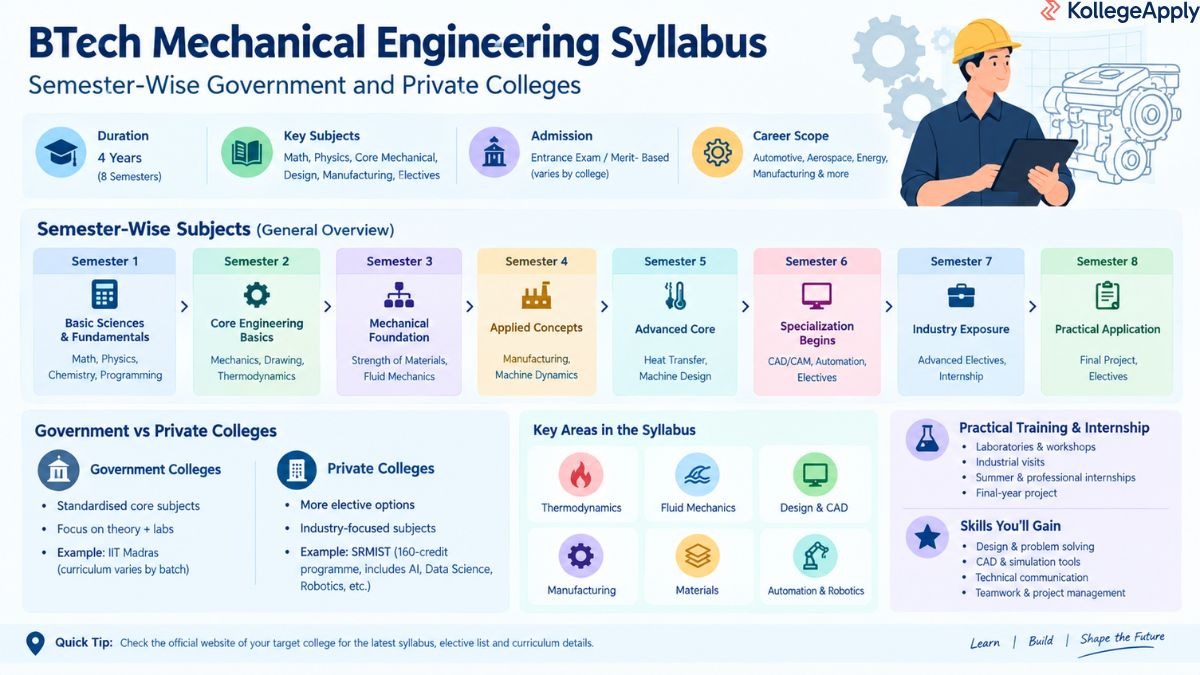
BTech Mechanical Engineering Syllabus Semester-Wise
The table given below gives a general idea for semester-wise summary of the subjects that are particularly focused in Btech Mechanical Engineering syllabus generally in all the colleges:
BTech Mechanical Engineering 1st Year Syllabus
The BTech Mechanical Engineering 1st year syllabus generally focuses on mathematics, science and basic engineering concepts. These subjects create the foundation required for studying mechanical engineering in later semesters. Common first-year BTech Mechanical Engineering subjects include:
- Engineering Mathematics
- Physics
- Chemistry
- Programming
- Engineering Mechanics
- Engineering Graphics/Drawing
- Basic Electrical and Electronics Engineering
- Workshop Practice
- Communication or Professional English
- Basic laboratory courses
The exact combination varies by university. For example, the 2026 SRMIST curriculum includes Calculus and Linear Algebra, Physics, Data Science and Artificial Intelligence, Electrical and Electronics Engineering, Engineering Graphics and Professional English in Semester I, followed by Chemistry, Biology, Advanced Calculus, Programming, Workshop Practice and Engineering Mechanics in Semester II.
BTech Mechanical Engineering Syllabus in Government Colleges
Government and public institutions do not necessarily follow one common BTech Mechanical Engineering syllabus. IITs, NITs, IIITs, state technical universities and autonomous institutions can have different curriculum structures.
For this reason, the syllabus of a government college should be checked against the university or institute's official curriculum. IIT Madras is a useful example because its Mechanical Engineering curriculum includes foundational sciences, mechanics, thermal engineering, manufacturing, design, electives, laboratory work and project components. To provide a clearer understanding, the semester-wise BTech Mechanical Engg syllabus at IIT Madras is outlined below:
BTech Mechanical Engineering Syllabus in Private Colleges
Private universities may have more flexibility in designing their BTech Mechanical Engineering syllabus. Along with traditional mechanical subjects, many current curricula include programming, Artificial Intelligence, Data Science, automation, robotics, Finite Element Analysis and industry-oriented electives.
BTech Mechanical Engineering Syllabus at SRM Institute of Science and Technology
The 2026 SRMIST curriculum specifies a 160-credit BTech Mechanical Engineering programme. Its professional core includes Materials Engineering, Mechanics of Solids, Engineering Thermodynamics, Manufacturing Processes, Kinematics and Dynamics of Machines, Fluid Mechanics and Machinery, Metrology and Quality Control, Mechanical Engineering Design, Finite Element Analysis, Thermal Engineering Systems, Heat and Mass Transfer, and Automation and Computer Integrated Manufacturing.
BTech Mechanical Engineering Elective Subjects
Elective Subjects allow students to develop expertise in a specific area of mechanical engineering. The available choices differ by college. The SRMIST curriculum also provides skill-oriented electives in areas such as Industrial Robotics, Smart Sensors, Mechatronics, Smart Mobility, Computational Fluid Dynamics, Automobile Engineering, Electric Vehicle Systems, Mechanical Vibrations, Computer-Aided Design, Additive Manufacturing, Digital Manufacturing and IoT, and Soft Robotics.
This shows why the BTech Mechanical Engineering subjects can differ considerably between colleges even though the core mechanical engineering concepts remain similar.
BTech Mechanical Engineering Subjects: Core Areas
The BTech Mechanical Engineering subjects cover the major areas required to understand, design, analyse, manufacture and maintain mechanical systems. While the subject names and their semester-wise placement may differ across universities, most B tech mechanical engineering syllabus structures cover a common set of core areas, including mechanics, thermal engineering, fluid mechanics, manufacturing, machine design, materials, automation and computational engineering. These subjects are supported by laboratory work, workshops, internships and project-based learning to help students connect theoretical concepts with practical engineering applications.
The table below highlights the major subject areas generally covered in the BTech Mechanical Engineering syllabus and the topics students may study under each area.
Practical Training / Internship in BTech Mechanical Engineering
Practical training is an important part of the BTech Mechanical Engineering curriculum because students need to apply theoretical concepts to real engineering problems. For example, the 2026 SRMIST curriculum includes a Summer Internship in Semester VII and provides for a Professional Internship in Semester VIII alongside the major project structure.
IIT Madras also highlights industrial training and undergraduate project work as important components of mechanical engineering education, although the exact structure can vary by curriculum and batch. Depending on the institution, students may complete:
- Manufacturing and workshop training
- Mechanical engineering laboratory work
- CAD/modelling assignments
- Industrial visits
- Summer internships
- Professional internships
- Design projects
- Final-year major projects
Skills Developed Through BTech Mechanical Engineering Syllabus
The syllabus is designed to develop both technical and professional skills required in mechanical engineering roles. Modern curricula are also increasingly introducing AI, data science, IoT, additive manufacturing, electric vehicle systems and advanced automation. The 2026 SRMIST curriculum, for example, includes Data Science and Artificial Intelligence, Finite Element Analysis, Industrial Robotics, Digital Manufacturing and IoT among its courses and electives. Students generally develop skills in:
- Mechanical design and engineering analysis
- Thermodynamics and thermal systems
- Manufacturing and production processes
- CAD and 3D modelling
- Problem-solving and numerical analysis
- Fluid and solid mechanics
- Machine design
- Automation and robotics
- Computer-based simulation
- Laboratory testing and experimentation
- Technical communication
- Project management and teamwork
BTech Mechanical Engineering Syllabus Books
Students can use standard engineering textbooks to strengthen their understanding of core BTech Mechanical Engineering subjects. The exact books recommended by colleges may differ. Some of the important books that can be useful for students are given in the table below:
BTech Mechanical Engineering Syllabus FAQs
What subjects are included in BTech Mechanical Engineering?
BTech Mechanical Engineering subjects include Thermodynamics, Fluid Mechanics, Strength of Materials, Manufacturing, Machine Design, Heat Transfer, CAD and Engineering Mathematics.
What is the BTech Mechanical Engineering syllabus of 1st year?
The first-year syllabus generally includes Mathematics, Physics, Chemistry, Programming, Engineering Mechanics, Graphics, Electrical Engineering and Workshop Practice.
What are the subjects in BTech Mechanical Engineering syllabus of IIT?
IIT Mechanical Engineering subjects include mechanics, thermodynamics, manufacturing, design, mathematics, programming, laboratories, electives and project-based learning.
Is Mathematics included in BTech Mechanical Engineering syllabus?
Yes. Mathematics supports subjects such as mechanics, thermodynamics, design, numerical analysis and engineering simulation.
Does BTech Mechanical Engineering include programming?
Yes. Many universities include programming, computational tools, data science or AI as part of their engineering curriculum.
Does BTech Mechanical Engineering include internship?
Yes. Many colleges include summer or professional internships to provide practical industry exposure.
Are BTech Mechanical Engineering subjects the same in all colleges?
No. Core subjects are similar, but semester structure, electives, labs and specialised courses vary by university.
Is a final-year project compulsory in BTech Mechanical Engineering?
Most BTech Mechanical Engineering programmes include a major project or equivalent practical work in the final year, subject to university rules.