DDVL Colleges in India offer postgraduate diploma-level training in Dermatology, Venereology and Leprosy to eligible MBBS graduates. DDVL is a two-year postgraduate medical diploma that focuses on the diagnosis and management of skin, hair and nail disorders, sexually transmitted infections and leprosy.
Admission to DDVL is generally linked to NEET-PG and the applicable counselling process, subject to the seat availability and admission rules of the relevant academic year. Candidates should verify the latest NMC course status and counselling seat matrix before choosing a college because DDVL seats can change between admission cycles.
The availability of DDVL seats is particularly important when comparing colleges. Historical NMC records show that several institutions previously offered DDVL, while some diploma seats were subsequently converted to degree seats or discontinued. Therefore, a college listed in an older source should not automatically be considered a DDVL option for 2026.
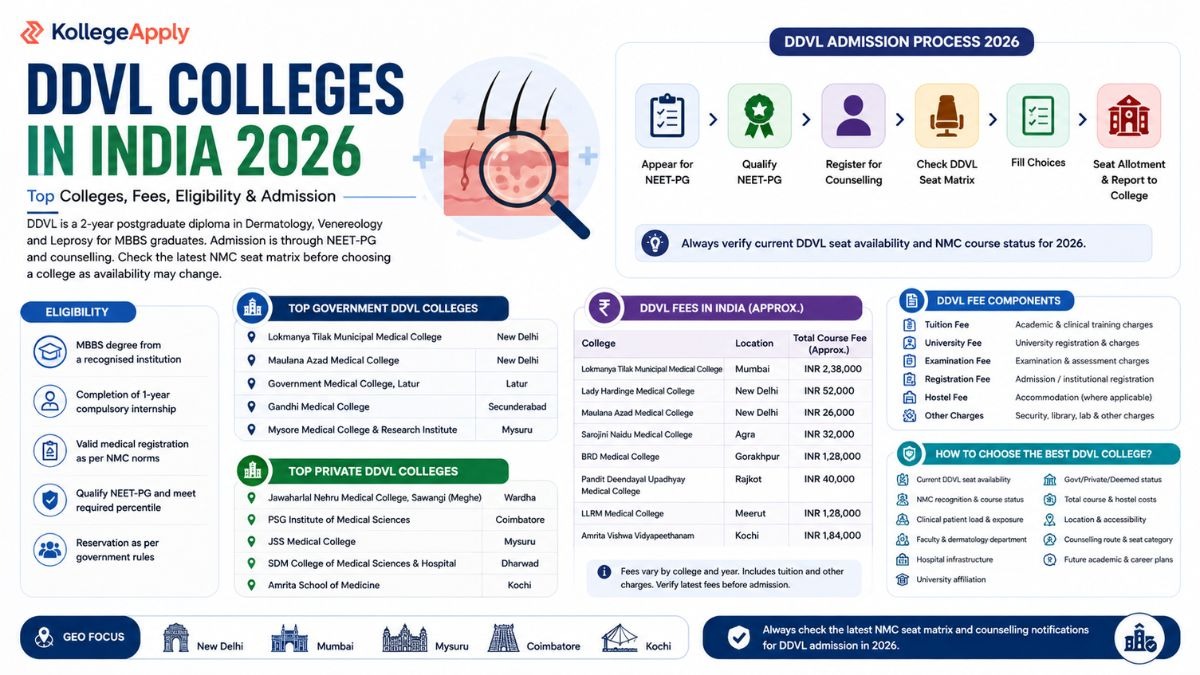
Table of Contents
Top Government and Private DDVL Colleges in India
DDVL colleges in India include medical institutions that have offered or may offer the Diploma in Dermatology, Venereology and Leprosy through recognised postgraduate medical training. However, the active DDVL seat matrix should be checked for the particular admission year rather than relying solely on historical lists.
The NMC maintains a College and Course Search facility that allows candidates to check the course, management type, state, university, college and annual intake. This is particularly useful because postgraduate diploma availability can change from one counselling cycle to another.
Government DDVL Colleges in India
Government medical colleges have historically accounted for several DDVL seats. However, the presence of a college in an older NMC record does not confirm an active DDVL seat in 2026.
Private DDVL Colleges in India
Private and deemed medical institutions may also appear in historical NMC records for DDVL. However, candidates should be especially careful while checking DDVL fees in private colleges, as fee structures and course availability can vary considerably.
What is the Eligibility Criteria for DDVL Colleges in India?
Candidates seeking admission to DDVL Colleges in India must generally have an MBBS qualification and fulfil the applicable internship, registration and postgraduate admission requirements. Since DDVL is a postgraduate medical programme, eligibility is different from that of undergraduate dermatology-related courses. The commonly applicable requirements include:
- Candidates must hold an MBBS degree from a recognised medical institution.
- Candidates must fulfil the applicable medical registration requirements.
- Completion of the one-year compulsory rotatory internship is required within the prescribed timeline.
- Candidates must qualify NEET-PG
- for applicable postgraduate admissions.
- Candidates must satisfy the qualifying percentile and other requirements prescribed for the relevant admission year.
- Foreign medical graduates must meet the applicable requirements for registration and postgraduate medical admission in India.
- Reservation benefits are applicable according to prevailing government and counselling regulations.
Candidates should always verify the eligibility requirements in the relevant NEET-PG information bulletin and counselling notification before applying.
DDVL Admission Process 2026
Admission to DDVL Colleges in India generally follows the postgraduate medical counselling route. Candidates first need to qualify for NEET-PG and then participate in the appropriate counselling process. The most important step for DDVL aspirants is to verify whether the preferred college actually has an active DDVL seat for the 2026 counselling cycle. The basic admission process includes:
- Appear for NEET-PG: Candidates must take the postgraduate medical entrance examination.
- Qualify NEET-PG: Candidates must meet the applicable qualifying requirements.
- Register for counselling: Eligible candidates register with the relevant counselling authority.
- Check available DDVL seats: Candidates should carefully review the current seat matrix.
- Fill choices: Eligible colleges and DDVL preferences can be entered during choice filling.
- Seat allotment: Seats are allotted according to merit, preferences, category and availability.
- Report to the allotted college: Candidates must complete document verification and admission formalities within the prescribed deadline.
DDVL Fees in India
DDVL fees in India vary significantly across medical colleges depending on the institution, location, university and applicable fee structure. The fee figures available for the colleges listed below range from approximately INR 26,000 to INR 2.38 lakh, with colleges such as Maulana Azad Medical College, New Delhi, Lady Hardinge Medical College, New Delhi, and Lokmanya Tilak Municipal Medical College, Mumbai showing different fee levels.
The table below provides an approximate comparison of total course fees reported for selected DDVL colleges, covering institutions across cities such as Mumbai, New Delhi, Agra, Gorakhpur, Rajkot, Meerut and Kochi. These figures can help aspirants get an initial idea of the cost difference between institutions before shortlisting colleges.
However, the actual DDVL fees may change by admission year and may include additional charges such as university registration, examination, hostel, security deposit and other institutional fees. Therefore, candidates should verify the latest fee structure with the respective college, university or counselling authority before taking admission. The fee figures below should be treated as approximate reference values and not as confirmed 2026 fees or confirmation of active DDVL seats.
What are the DDVL Fees components?
The DDVL fees may include more than the basic tuition fee. Depending on the institution, students may have to pay separate charges for university registration, examinations, admission, hostel facilities and other institutional services. Deemed and private medical colleges may follow different fee structures, so the total amount payable can vary from one college to another.
Before taking admission, candidates should check whether the quoted DDVL course fee covers only tuition or also includes other mandatory charges. Understanding these components can help students estimate the overall cost of pursuing DDVL and avoid unexpected expenses during the course.
How to Choose the Best DDVL College in India?
Choosing among DDVL Colleges in India requires more than comparing the listed course fee. Since DDVL is a clinical postgraduate qualification, the quality and extent of clinical exposure are particularly important. A college that appears in a historical DDVL list should not be selected without confirming that its DDVL seat is currently active. Candidates should consider the following factors:
- Current DDVL seat availability
- NMC recognition and course status
- Clinical patient load
- Dermatology department and faculty
- Practical and procedural exposure
- Hospital infrastructure
- University affiliation
- Government/private/deemed status
- Total course and hostel expenses
- Location and accessibility
- Counselling route and seat category
- Future academic and career plans
DDVL Placements and Career Opportunities After DDVL
DDVL placements are different from regular campus placements. Medical colleges generally do not guarantee jobs through campus placement after completing the Diploma in Dermatology, Venereology and Leprosy. Instead, career opportunities depend largely on clinical training, practical exposure, experience, additional skills and the healthcare sector or organisation you choose.
For DDVL aspirants, the clinical exposure and career support offered by a college can therefore be more important than a conventional placement package.
Does DDVL Have Placement Opportunities?
Yes, DDVL graduates can explore employment opportunities after completing the course, but a guaranteed placement or fixed salary package should not be assumed.
Medical colleges may provide career guidance, hospital-based clinical experience, research exposure and professional networking opportunities. For example, the official Dermatology Department at Lokmanya Tilak Municipal Medical College and General Hospital, Mumbai highlights postgraduate exposure to a wide range of dermatological conditions, research activities, academic presentations and conferences.
Similarly, JSS Academy of Higher Education & Research has a dedicated Placement Cell and career-advisory structure that supports students in planning careers through employment or further education.
What Do DDVL Colleges Offer for Career Development?
The quality of postgraduate training can have a major impact on a student's professional development. Candidates should look beyond fees and check what the college actually offers through its dermatology department and hospital.
For instance, the official Dermatology Department at Amrita School of Medicine highlights clinical, academic, research and surgical training. Its postgraduate training also includes exposure to allied specialties, paediatric dermatology, psychodermatology and dermatopathology. Key areas to check include:
- Clinical exposure: Exposure to a broad range of dermatological conditions
- Patient load: Opportunities for regular clinical practice
- Procedural training: Exposure to relevant dermatological procedures
- Research opportunities: Participation in research, presentations and conferences
- Faculty support: Guidance from experienced dermatology faculty
- Hospital facilities: Availability of specialised departments and clinical infrastructure
- Career guidance: Whether the institution has a placement or career-support cell
- Alumni network: Professional connections that may assist with career development
- Higher-study support: Opportunities and guidance for further education
FAQs on DDVL Colleges in India
What are DDVL Colleges in India?
DDVL Colleges in India offer a two-year postgraduate diploma in Dermatology, Venereology and Leprosy. Some listed colleges include MAMC, LHMC, BRD Medical College and LLRM Medical College.
Which entrance exam is required for DDVL admission?
Admission to applicable DDVL seats is generally based on NEET-PG followed by the relevant counselling process.
What is the DDVL fees in private colleges?
DDVL fees in private colleges vary by institution, university and seat category. Candidates should check the latest official fee structure.
What is the DDVL fees in India?
DDVL fees in India vary by college. Available fee figures in the article range from about INR 26,000 to INR 2.38 lakh.
Can I pursue DDVL after MBBS?
Yes, eligible MBBS graduates can pursue DDVL after meeting internship, registration, NEET-PG and counselling requirements.
Are there government DDVL Colleges in India?
Yes, some government institutions have historically offered DDVL. Candidates should verify current NMC seat availability before applying.
How long is the DDVL course?
DDVL is generally a two-year postgraduate medical diploma covering Dermatology, Venereology and Leprosy.
What should I check before choosing DDVL Colleges in India?
Check NMC recognition, active DDVL seats, clinical exposure, fees, affiliation, counselling route and hospital facilities before selecting a college.
What are the career options after DDVL?
DDVL graduates can explore eligible roles in hospitals, dermatology clinics, STI services, public health and other healthcare settings.
Does DDVL fees include hostel and other charges?
Not always, DDVL fees may exclude hostel, examination, registration, university and other institutional charges. Check the college's latest fee structure.