DDVL full form is Diploma in Dermatology, Venereology and Leprosy. It is a postgraduate medical diploma that generally has a duration of two years and focuses on the study of disorders affecting the skin and its appendages, including hair and nails, along with sexually transmitted infections (STIs) and leprosy. The course covers the identification of different skin conditions, their prevention and the appropriate medical and surgical approaches used for their management.
The DDVL after MBBS pathway combines academic study with clinical and practical training, helping medical graduates develop specialised skills in dermatological diagnosis and patient care. The curriculum may include areas such as clinical dermatology, dermatopathology, venereology, leprosy and dermatological procedures, with the exact subjects and practical exposure varying by institution.
Admission to DDVL is generally available to MBBS graduates through NEET-PG and the applicable counselling process, subject to the eligibility criteria and admission regulations in force for the academic year. After completing the diploma, graduates can explore opportunities in hospitals, clinics and dermatology practices or pursue further specialisation, depending on the applicable eligibility requirements.
- DDVL Full Form in Medical
- DDVL Course Highlights
- What is a DDVL Course?
- Why Study DDVL?
- Is DDVL a PG Diploma?
- DDVL Eligibility Criteria
- DDVL Entrance Examination
- DDVL Admission Process 2026
- DDVL Colleges in India
- Distance or Online DDVL: Is It Available?
- DDVL Fees in India 2026
- DDVL Syllabus
- DDVL Skills You Learn
- Is DDVL Worth It in 2026?
- DDVL vs MD Dermatology vs DNB Dermatology
- DDVL Career Scope
- DDVL Job Opportunities in India
- DDVL Salary in India
- What After DDVL?
- DDVL FAQs
DDVL Full Form in Medical
DDVL stands for Diploma in Dermatology, Venereology and Leprosy. It is a postgraduate medical diploma that focuses on the diagnosis and treatment of skin, hair and nail disorders, sexually transmitted diseases, and leprosy. The course is generally pursued by MBBS graduates.
DDVL Course Highlights
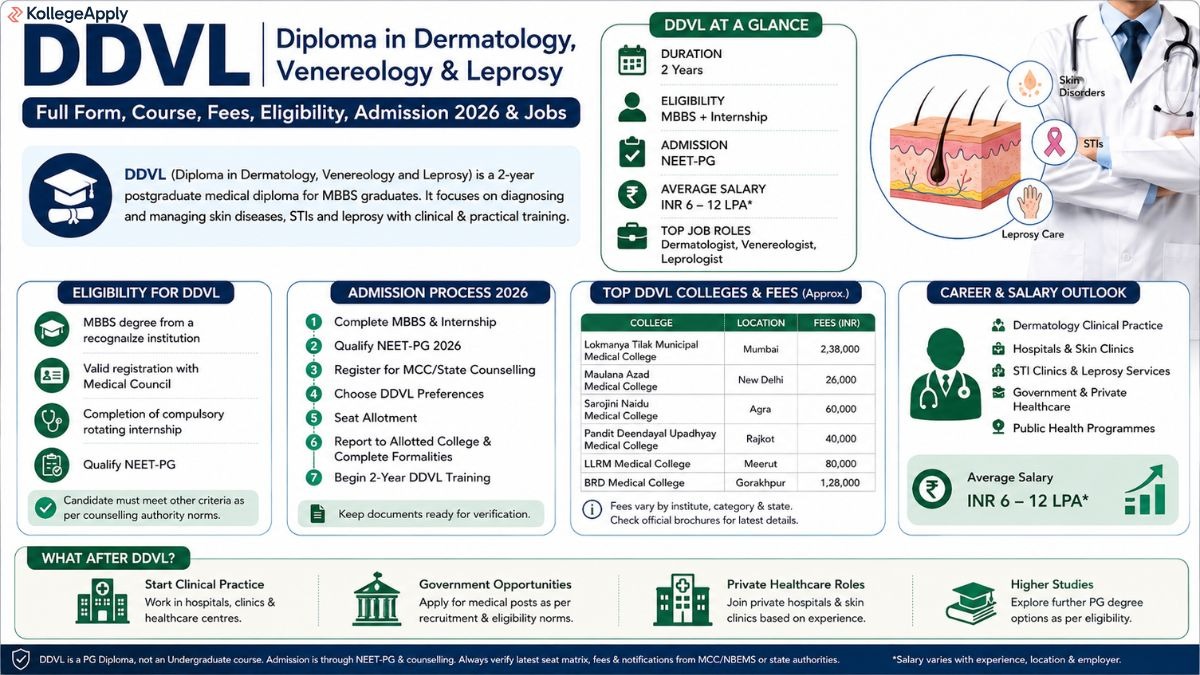
DDVL is a postgraduate medical diploma focused on the diagnosis, management and prevention of disorders involving the skin, hair and nails, along with venereology and leprosy. The recognised postgraduate training programme is designed around clinical knowledge, investigations, patient management and practical/procedural skills. The key DDVL course details below cover its duration, eligibility, admission route, fees, salary prospects and career opportunities.
What is a DDVL Course?
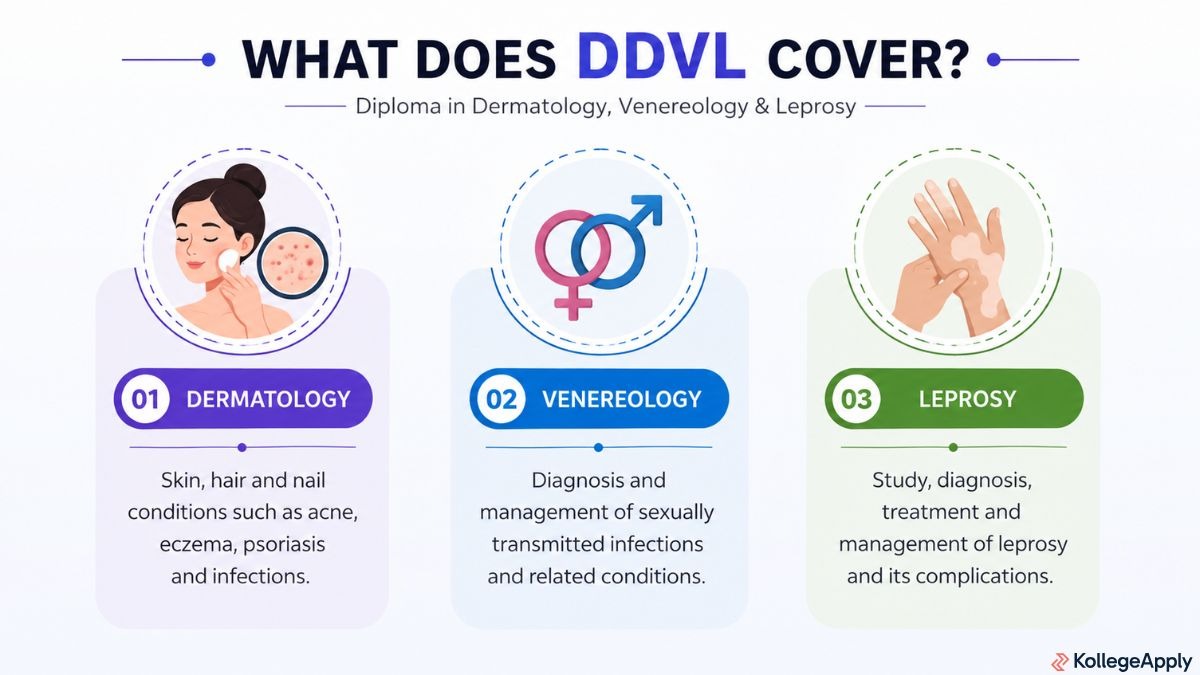
DDVL after MBBS is a postgraduate medical diploma in Dermatology, Venereology, and Leprosy that provides specialised training in the diagnosis and management of conditions affecting the skin, hair, nails and mucosal surfaces. The course also covers sexually transmitted infections (STIs) and leprosy, giving medical graduates a broader understanding of dermatological and venereal diseases.
The MBBS DDVL pathway combines theoretical knowledge with supervised clinical training. Students learn to examine patients, identify different dermatological conditions and understand appropriate treatment approaches for disorders such as acne, eczema, psoriasis, infections, pigmentation problems and hair and nail disorders. The programme also introduces students to the medical and procedural aspects of dermatology, including commonly used diagnostic and therapeutic techniques.
Key areas of study may include clinical dermatology, dermatopathology, dermatosurgery, venereology and leprosy. Depending on the institute, students may also receive exposure to procedures used in cosmetic and procedural dermatology, such as scar management, chemical peels, laser-based treatments and other skin procedures. The exact curriculum and clinical exposure can vary across institutions.
Why Study DDVL?
DDVL after MBBS can be a suitable option for medical graduates who want focused postgraduate training in dermatology, venereology and leprosy without immediately pursuing a longer postgraduate degree. The course combines academic learning with clinical exposure, helping students understand skin disorders, sexually transmitted infections and leprosy from diagnostic, therapeutic and preventive perspectives. Major reasons to pursue DDVL include:
- Specialised dermatology training: The programme provides focused training in the diagnosis and management of a wide range of dermatological conditions.
- Clinical exposure: Students gain experience in examining patients, interpreting investigations and managing dermatological cases under appropriate supervision.
- Study of venereology and leprosy: Unlike programmes focused only on general dermatology, DDVL also covers sexually transmitted infections and leprosy.
- Practical and procedural learning: The NMC curriculum includes bedside diagnostic and therapeutic procedures and expects students to develop relevant practical skills.
- Opportunities across healthcare: Depending on qualification, registration and job requirements, graduates may explore hospitals, healthcare organisations, public health services, research and other medical sectors.
- Foundation for further learning: Candidates interested in dermatology-related careers can explore higher qualifications and additional training where they meet the applicable eligibility requirements.
- Combination of clinical and preventive care: The curriculum also covers prevention, counselling and rehabilitation, making the programme relevant to both individual patient care and community health.
Is DDVL a PG Diploma?
Yes, DDVL is a postgraduate medical diploma pursued after MBBS. It should not be described as a postgraduate degree. The NMC's recognised postgraduate diploma list includes Dermatology, Venereology and Leprosy (D.D.V.L.). The distinction is important when comparing DDVL with other postgraduate pathways. DDVL generally involves two years of diploma training, while MD Dermatology is a three-year postgraduate degree programme. DNB Dermatology is a separate postgraduate qualification with its own training and examination framework.
DDVL Eligibility Criteria
Admission to the PG DDVL programme after MBBS depends on meeting the prescribed academic, registration, internship and entrance requirements. Candidates should fulfil the applicable criteria and admission conditions specified by the relevant medical authorities and counselling bodies. A common eligibility structure is maintained to provide a common training.
- The candidate must have completed an MBBS degree from a recognized medical college or university approved by the Medical Council of India (MCI) or National Medical Commission (NMC).
- It is mandatory that the applicant has successfully completed the one-year compulsory rotatory internship at the time of admission or by the date specified by the counselling authority.
- Admission to the course is strictly entrance-based, and candidates must appear for the NEET PG (National Eligibility cum Entrance Test for Postgraduates) conducted by the National Board of Examinations in Medical Sciences (NBEMS).
- Applicants must meet the minimum NEET PG cutoff percentile for their respective category as declared for the academic year.
- Foreign medical graduates applying for this course in India must have:
- Cleared the FMGE (Foreign Medical Graduate Examination),
- Obtained registration from MCI/NMC.
DDVL Entrance Examination
For candidates planning to pursue DDVL after MBBS, NEET-PG 2026 is the key entrance examination for admission to postgraduate medical diploma seats, including DDVL, wherever seats are offered through the applicable counselling system. NEET-PG is conducted by the National Board of Examinations in Medical Sciences (NBEMS). After qualifying, candidates must participate in the relevant MCC or state counselling process, depending on the institution and seat category.
Important: Candidates should check the latest NBEMS Information Bulletin and official notices for any changes to NEET-PG dates, fees, eligibility or counselling-related requirements.
DDVL Admission Process 2026
Candidates interested in pursuing DDVL at Maulana Azad Medical College (MAMC), New Delhi are required to secure admission through the applicable NEET-PG merit and counselling process. Candidates must participate in the relevant counselling rounds and select the college and course according to their eligibility and preferences. The key steps are as follows:
- Step 1: Qualify NEET-PG: Candidates must appear for NEET-PG and obtain a valid qualifying score or percentile as prescribed for the admission year.
- Step 2: Register for MCC Counselling: Eligible candidates must complete online registration on the Medical Counselling Committee (MCC) portal within the notified counselling schedule.
- Step 3: Complete the Registration Details: Candidates need to enter their personal and academic information, upload the required photograph and documents, and pay the prescribed counselling fee.
- Step 4: Select MAMC and DDVL: During the choice-filling window, candidates should select Maulana Azad Medical College and the applicable DDVL seat/course preference, subject to availability and eligibility.
- Step 5: Participate in Counselling: Candidates participate in the relevant MCC counselling rounds, where seat allotment is determined based on NEET-PG merit, category, candidate preferences and available seats.
- Step 6: Download the Allotment Letter: Candidates allotted a DDVL seat at MAMC can download the seat allotment letter from the MCC portal and follow the reporting instructions.
- Step 7: Report to MAMC: Candidates must report to Maulana Azad Medical College, New Delhi, within the stipulated deadline with the allotment letter and required original documents for verification and completion of admission formalities.
Documents Required for DDVL Admission
The exact document list may differ by college or counselling authority. Commonly required documents include:
DDVL Colleges in India
DDVL seat availability in India can change from one admission cycle to another because postgraduate diploma seats may be surrendered, converted to degree seats or otherwise revised. Therefore, candidates should not rely on historical DDVL college lists when applying in 2026. Check the latest NMC course/seat information and the applicable MCC or state counselling seat matrix before selecting a college.
Note: The institutions and fee figures below are historical or reported references and should not be interpreted as confirmation of active DDVL seats or 2026 fees. Candidates must verify the current course approval, seat matrix and fee structure before applying.
Distance or Online DDVL: Is It Available?
DDVL is primarily a clinical postgraduate medical qualification, so practical patient exposure, supervised clinical training and hands-on learning are important components of the programme. Candidates should therefore be cautious about courses advertised online or through distance-learning modes as equivalent to a conventional clinical DDVL.
Before enrolling, students should verify whether the programme is recognised for the intended professional purpose, whether it involves the required clinical training and whether it meets the current regulatory requirements. An online certificate in dermatology should not automatically be treated as equivalent to a recognised postgraduate medical diploma.
DDVL Fees in India 2026
DDVL fees vary substantially depending on the institution, state, university, seat category and applicable fee regulations. A single nationwide fee range should therefore not be treated as a fixed 2026 figure. Candidates should check the institution-specific fee structure for the relevant admission year. The total cost may include:
- Tuition fee
- University fee
- Examination fee
- Admission or registration charges
- Hostel and mess charges
- Security deposit, where applicable
- Other institution-specific charges
Private, government, deemed-university and other institutional fee structures can differ considerably. Candidates should rely on the latest official college prospectus, university notification or counselling authority information rather than older online fee tables.
DDVL Syllabus
The DDVL syllabus combines three primary areas: dermatology, venereology and leprosy. The exact curriculum and clinical postings may vary by university and institution. The syllabus for the Diploma in Dermatology, Venereology and Leprosy is overall the same in all institutes with small variations. This program provides systematic progression from basic sciences to clinical applications. The syllabus for Diploma in Dermatology, Venereology and Leprosy at LLRM Medical College is as follows:
DDVL Skills You Learn
DDVL training develops clinical competencies in dermatological assessment, diagnosis, treatment planning, patient counselling and supervised procedures, with emphasis on skin disorders, STIs and leprosy.
- Dermatological assessment: Taking relevant medical history and performing systematic skin, hair, nail and mucosal examinations.
- Clinical diagnosis: Identifying and differentiating common dermatological conditions based on clinical findings.
- Disease management: Developing treatment plans for common skin disorders under appropriate clinical supervision.
- Infectious skin diseases: Recognising and managing common infectious dermatological conditions.
- Venereology: Assessing, diagnosing and managing sexually transmitted infections (STIs) according to standard clinical protocols.
- Leprosy care: Recognising leprosy, assessing its clinical manifestations and understanding the management of associated complications.
- Investigations: Interpreting relevant basic laboratory and dermatological investigations to support clinical diagnosis.
- Pharmacological knowledge: Understanding the appropriate use of topical and systemic therapies commonly used in dermatological practice.
- Procedural skills: Observing, assisting with or performing relevant dermatological procedures as permitted by the training programme and under supervision.
- Patient counselling: Educating patients about treatment adherence, preventive measures, disease transmission, follow-up and long-term care.
Is DDVL Worth It in 2026?
DDVL can be a suitable postgraduate option for MBBS graduates who want focused clinical training in dermatology, venereology and leprosy. Its two-year duration offers specialised exposure within a shorter training period than the conventional three-year MD pathway. The programme can help candidates develop clinical competencies in evaluating and managing skin disorders, STIs and leprosy, depending on the institution's curriculum and clinical exposure.
However, the value of DDVL depends on seat availability, institution quality, clinical exposure, recognition and long-term career plans. Course availability can change between admission cycles, so candidates should verify the current seat matrix, course status, faculty, patient exposure, practical training and fee structure before applying. This is particularly important when relying on older college lists or fee information available online.
DDVL may suit doctors who specifically want a focused postgraduate qualification in dermatology-related clinical care without entering a three-year MD pathway. However, candidates considering academic progression, specialist training or specific long-term career opportunities should compare DDVL with MD/DNB pathways before making a decision. The shorter duration should be considered alongside the quality and scope of training.
DDVL vs MD Dermatology vs DNB Dermatology
DDVL, MD Dermatology and DNB Dermatology differ in qualification, duration, training structure and future academic pathways. Comparing these aspects can help MBBS graduates choose the postgraduate route that aligns with their clinical interests and long-term career goals.
DDVL Career Scope
A DDVL qualification can open opportunities across clinical practice, hospitals, STI services, leprosy programmes and public healthcare. The role and scope of practice depend on the candidate’s registration, experience, institutional requirements and applicable recruitment rules. The possible career areas include:
DDVL Job Opportunities in India
Aspiring PGDDVL graduates can pursue diverse clinical, academic, and public‐health roles. Each role offers distinct career paths, sectors, and remuneration levels. Below is a concise overview of key job profiles.
DDVL Salary in India
There is no single fixed salary for DDVL graduates. Earnings depend on experience, location, employer, clinical responsibilities and whether the doctor works in a hospital, clinic, government service or private practice.
As a broad market reference rather than a DDVL-specific salary promise, Indeed reported an average base salary of approximately INR 80,202 per month for dermatologists in India, based on reported salaries updated in February 2026. This figure should not be treated as a guaranteed DDVL fresher salary, because the dataset covers dermatologist roles generally and does not isolate DDVL-qualified doctors.
Candidates should therefore evaluate salary opportunities based on the specific job role, experience level, location and employer rather than relying on a fixed claim such as INR 5–12 LPA+ immediately after DDVL.
What After DDVL?
After completing DDVL, graduates can choose between clinical practice, hospital-based roles, government or private healthcare opportunities and further postgraduate training. The most suitable pathway depends on career goals, applicable eligibility criteria, registration requirements and the rules of the institution or recruiting authority.
- Start Clinical Practice: Graduates can pursue eligible clinical roles in hospitals, clinics and other healthcare settings, subject to applicable registration and employer requirements.
- Work in Government Healthcare: Candidates can apply for government medical positions where the DDVL qualification is accepted and they meet the prescribed recruitment and eligibility conditions.
- Work in Private Hospitals: Private hospitals and dermatology clinics may recruit DDVL-qualified doctors depending on the position, experience and employer requirements.
- Pursue Further Postgraduate Training: Candidates may explore further postgraduate degree or advanced training pathways where they meet the applicable eligibility conditions. The exact pathway depends on prevailing regulations and the admission rules of the concerned institution.
DDVL FAQs
What is the DDVL full form in medical?
DDVL full form in medical is Diploma in Dermatology, Venereology and Leprosy. It is a postgraduate medical diploma focused on dermatology, venereology and leprosy.
What does DDVL mean after MBBS?
DDVL after MBBS means pursuing the Diploma in Dermatology, Venereology and Leprosy after completing MBBS and meeting the applicable postgraduate admission requirements.
What is DDVL in Medical?
DDVL in medical terms refers to a postgraduate diploma that provides specialised clinical training in skin diseases, sexually transmitted infections and leprosy.
Is DDVL a PG diploma?
Yes, DDVL is a postgraduate medical diploma, not a postgraduate degree. The NMC lists Diploma in Dermatology, Venereology and Leprosy as a diploma qualification.
Is DDVL a degree?
No, DDVL is a postgraduate diploma. Although “DDVL degree” is a commonly searched phrase, the correct qualification name is Diploma in Dermatology, Venereology and Leprosy.
Can I do DDVL without MBBS?
No, DDVL is a postgraduate medical qualification, so candidates must have the required MBBS qualification and satisfy the applicable registration, internship and admission requirements.
What is the DDVL course duration?
The DDVL course duration is two years. The NMC competency-based curriculum specifies two years of diploma training.
What is the DDVL fee in India?
There is no single national DDVL fee. Fees depend on the institution, university, state, seat category and whether a currently available DDVL seat exists. Candidates should verify the latest official fee notification before applying.
What is the DDV full form in medical?
DDV may refer to Diploma in Dermatology and Venereology in some references. It should not automatically be treated as the same qualification as DDVL, whose full form is Diploma in Dermatology, Venereology and Leprosy.