DMRD Full Form: Quick Answer
DMRD stands for Diploma in Medical Radio Diagnosis. It is a postgraduate medical diploma in radiodiagnosis generally pursued after MBBS. The course provides training in diagnostic imaging, including X-ray, ultrasound, CT and MRI, along with clinical and practical exposure.
Key Details
- Full Form: Diploma in Medical Radio Diagnosis
- Duration: 2 Years
- Course Level: Postgraduate Diploma
- Eligibility: MBBS + applicable requirements
- Admission: NEET PG/counselling, depending on the institution
DMRD full form in medical is Diploma in Medical Radio Diagnosis. It is a 2-year postgraduate medical diploma in radiodiagnosis, generally pursued by eligible MBBS graduates after completing the required internship and admission requirements. The course focuses on imaging modalities such as X-ray, ultrasound, CT and MRI, helping doctors understand how imaging findings support disease diagnosis and treatment planning. Through classroom learning, clinical postings and supervised practical exposure, DMRD trainees develop knowledge of image acquisition, interpretation, radiological anatomy, pathology and radiation safety.
The DMRD course is primarily designed for MBBS graduates who want to build a career in radiodiagnosis. Eligibility generally includes an MBBS degree, completion of the compulsory rotating internship and fulfilment of the applicable registration and admission requirements. For seats covered under the postgraduate medical admission system, NEET PG and counselling are important parts of the selection process, although the exact admission route can differ by institution and seat category. The MCC conducts counselling for eligible postgraduate medical seats under its notified framework.
DMRD course fees vary considerably between government, private and other medical institutions. Similarly, the DMRD salary depends on experience, employer, location, responsibilities and additional qualifications. The course can lead to opportunities in hospital radiology departments, diagnostic centres, imaging services and other healthcare settings, subject to professional eligibility and prevailing regulations.
Table of Contents
- DMRD Course Highlights
- DMRD Full Form in Medical
- Why Choose DMRD After MBBS? Career Benefits & Limitations
- Is DMRD Worth It After MBBS in 2026?
- DMRD Eligibility
- DMRD Entrance Exam 2026
- DMRD NEET-PG Cutoff 2026: Expected Rank, Marks & College-wise Trends
- DMRD Vs MD Radiology, Which is better?
- Can I Complete DMRD After Completing MBBS?
- Are DMRD and DNB Radiology the Same?
- DMRD Colleges in India
- DMRD Admission Process 2026
- DMRD Syllabus
- What Can You Learn in DMRD? Skills & Clinical Training
- What Is the Scope of DMRD in India?
- DMRD Full Form in Hindi
- DMRD Vs DCP, Which Is Better?
- DMRD Colleges Comparison
- DMRD FAQs
DMRD Course Highlights
DMRD is a postgraduate diploma rather than an undergraduate radiography or paramedical programme. It is pursued after MBBS and provides focused training in medical imaging. The table below gives a quick answer to the most searched questions related to DMRD full form, duration, eligibility, fees, admission and career scope.
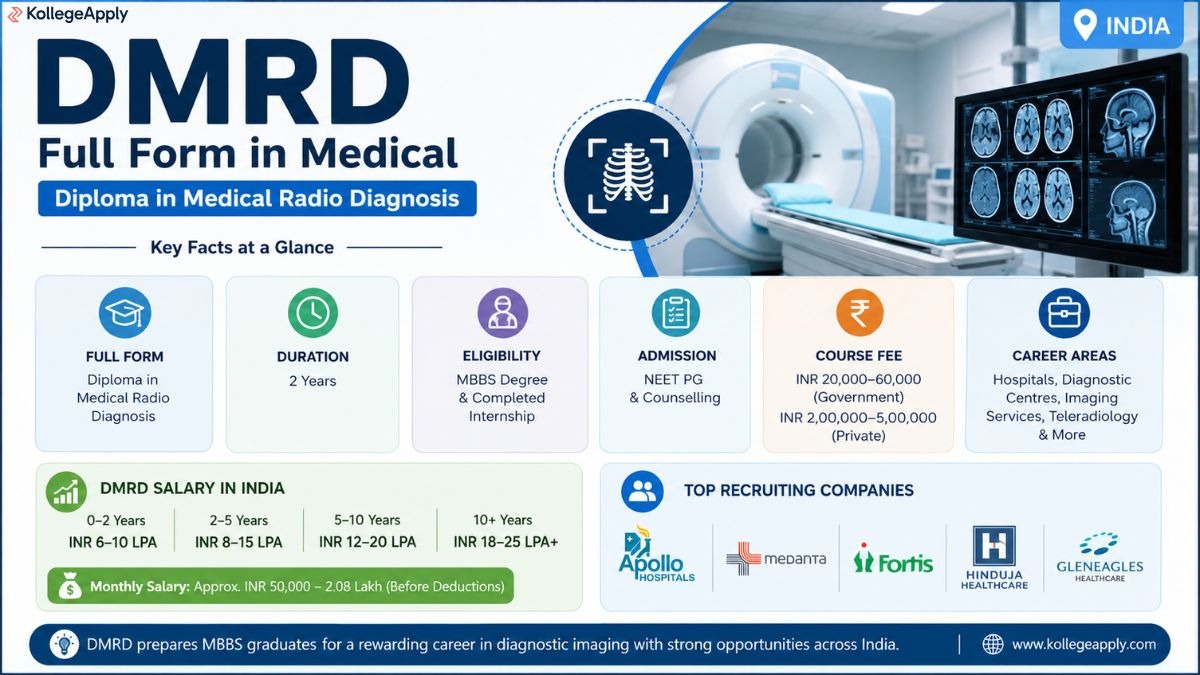
DMRD Full Form in Medical
The D.M.R.D full form is Diploma in Medical Radio Diagnosis. It is a postgraduate diploma in radiodiagnosis that provides medical graduates with specialized education and clinical exposure in diagnostic imaging. The course combines theoretical knowledge with practical training. Students study radiological anatomy, pathology, imaging physics, radiation protection and diagnostic interpretation while gaining supervised clinical exposure in hospital radiology departments.
DMRD can be suitable for MBBS graduates interested in diagnostic medicine, imaging technology and radiological sciences. Career opportunities, independent responsibilities and eligibility for specific roles, however, depend on the candidate's qualification, registration, training, institutional requirements and applicable regulations.
Why Choose DMRD After MBBS? Career Benefits & Limitations
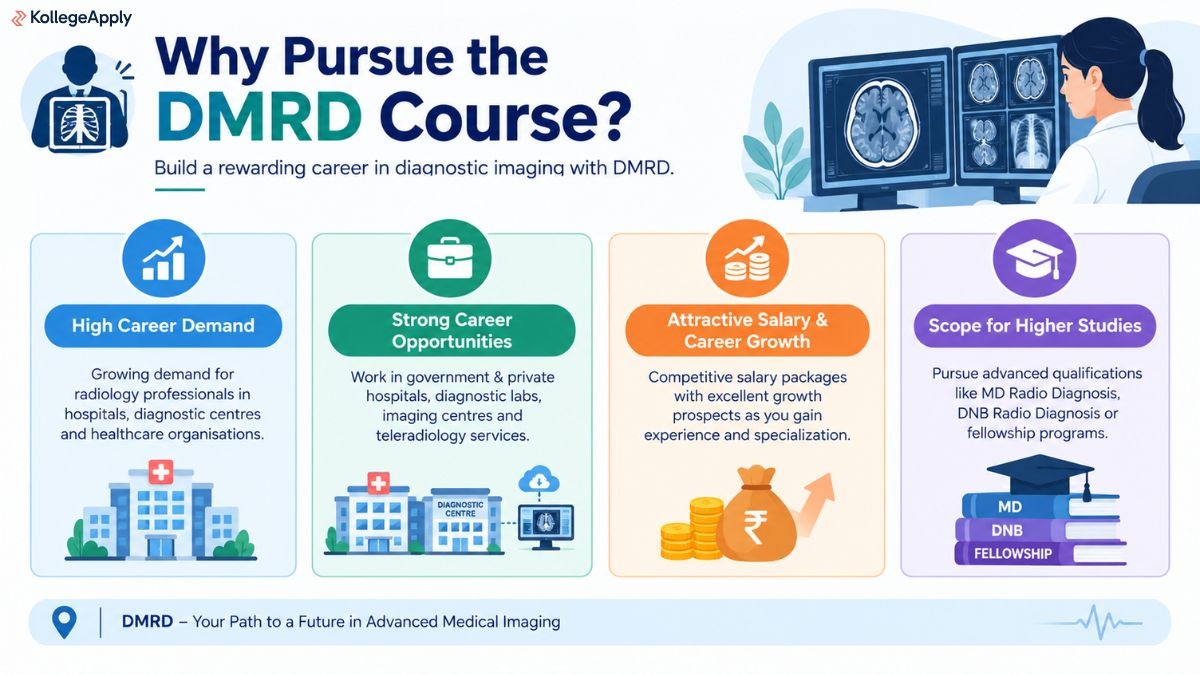
A Diploma in Medical Radio Diagnosis (DMRD) is an excellent choice for MBBS graduates who want to build a career in diagnostic imaging. The course provides in-depth knowledge of radiological techniques, imaging technologies, and disease diagnosis, preparing graduates for rewarding roles in hospitals, diagnostic centres, and healthcare institutions. Some of the key reasons to Pursue DMRD are:
- High Career Demand: Growing demand for radiology professionals in hospitals, diagnostic centres, and healthcare organizations due to increasing reliance on medical imaging.
- Strong Career Opportunities: Graduates can work in government and private hospitals, diagnostic laboratories, imaging centres, and teleradiology services.
- Attractive Salary & Career Growth: DMRD offers competitive salary packages with excellent growth prospects as professionals gain experience and specialization.
- Scope for Higher Studies: Candidates can pursue advanced qualifications such as MD Radio Diagnosis, DNB Radio Diagnosis, or fellowship programs in Interventional Radiology and other radiology subspecialties.
Is DMRD Worth It After MBBS in 2026?
For an MBBS graduate interested specifically in diagnostic imaging, DMRD or PG Diploma in Radio-Diagnosis can remain a relevant postgraduate option in 2026. Healthcare increasingly relies on imaging for screening, diagnosis, treatment planning and follow-up, which keeps radiological expertise important across hospitals and diagnostic facilities.
The field is also evolving through technologies such as digital radiology, PACS, advanced CT and MRI systems and AI-assisted imaging tools. These developments increase the importance of professionals who understand both clinical medicine and modern imaging workflows.
However, whether DMRD is the right choice depends on individual career goals. Candidates interested in broader specialist training, academics or long-term sub-specialisation should compare the diploma with MD Radio Diagnosis, DNB and other available postgraduate pathways before making a decision.
DMRD Eligibility
DMRD is a postgraduate diploma pursued after MBBS. Candidates must meet the eligibility and registration requirements prescribed by the relevant medical authority and institution. Candidates seeking admission to the DMRD course must fulfill the eligibility requirements prescribed by the respective medical college or university. While specific criteria may vary slightly across institutions, the general eligibility conditions are as follows:
- Candidates must hold an MBBS degree from a recognized medical institution and meet the registration and eligibility requirements prescribed by the relevant authority.
- They should have obtained the minimum qualifying marks required by the respective institute or admission authority.
- Completion of the compulsory rotating medical internship on or before the prescribed cutoff date is mandatory.
- Candidates are generally required to qualify NEET PG, depending on the admission process followed by the institution.
- Some colleges may also require candidates to submit a medical fitness certificate at the time of admission.
DMRD Entrance Exam 2026
For postgraduate diploma seats filled through the national or state postgraduate medical admission route, NEET PG is the key examination candidates should track. The examination schedule, registration window, application fee and counselling dates can change through official notifications. Therefore, candidates should verify the latest information before applying rather than relying solely on previously published dates.
After qualifying the applicable examination, candidates may need to participate in MCC or state-level PG counselling, depending on the type of seat and institution. MCC is responsible for counselling within its notified jurisdiction, including 50% All India Quota postgraduate seats and other participating categories.
Important: Always check the latest official NBEMS and counselling notification for the final exam date, application deadline, eligibility and fee.
DMRD NEET-PG Cutoff 2026: Expected Rank, Marks & College-wise Trends
The DMRD NEET-PG Cutoff 2026 will determine the rank range at which candidates may secure admission to Diploma in Medical Radio Diagnosis seats through the applicable postgraduate medical counselling process. The actual cutoff varies by college, category, quota, seat availability and counselling round. Since NEET-PG 2026 is scheduled for August 30, 2026, the final DMRD admission cutoff will be available only after the result and counselling process.
Candidates should distinguish between the NEET-PG qualifying cutoff and the actual DMRD admission cutoff. The qualifying cutoff determines whether a candidate is eligible to participate in counselling, whereas the admission cutoff refers to the closing rank at which a DMRD seat is allotted at a particular college. Previous-year closing ranks can therefore be useful for estimating admission chances, but they should not be treated as a fixed prediction for 2026.
For candidates planning DMRD admission, factors such as NEET-PG rank, category, college preference, seat type and counselling round can significantly affect the final outcome. DMRD closing ranks may also change between Round 1, Round 2, Round 3 and subsequent rounds as candidates upgrade or vacate seats.
To check the latest DMRD NEET-PG 2026 expected cutoff, previous-year closing ranks, category-wise cutoff, college-wise trends, marks vs rank analysis and counselling details, read the detailed DMRD NEET-PG Cutoff 2026 guide.
DMRD Vs MD Radiology, Which is better?
DMRD is a 2-year postgraduate diploma, while MD Radio Diagnosis is a 3-year postgraduate degree. DMRD may appeal to MBBS graduates seeking a shorter radiology-focused qualification, whereas MD Radio Diagnosis offers broader specialist training and stronger scope for advanced academic and career pathways. Want to compare fees, duration, career scope and salary? See the detailed DMRD vs MD comparison guide.
Can I Complete DMRD After Completing MBBS?
Yes, DMRD can be pursued after completing MBBS, subject to the eligibility and admission requirements of the respective medical college or authority. The course is a 2-year postgraduate diploma in radiodiagnosis and is generally designed for eligible MBBS graduates.
Candidates generally need to complete their compulsory rotating medical internship and fulfil the applicable medical registration and admission requirements. For DMRD seats covered under the postgraduate medical admission system, candidates are generally required to qualify NEET PG followed by the applicable counselling process.
After completing DMRD, graduates receive focused training in diagnostic imaging, including areas such as X-ray, ultrasound, CT and MRI, along with clinical and practical exposure in radiodiagnosis.
Are DMRD and DNB Radiology the Same?
No, DMRD and DNB Radiology are not the same. DMRD is a 2-year postgraduate diploma in radiodiagnosis, whereas DNB Radiodiagnosis is a 3-year postgraduate programme. Both are related to radiology, but they differ in course duration, qualification structure and training pathway.
DMRD Colleges in India
Several government and private medical colleges in India offer the Diploma in Medical Radio Diagnosis (DMRD) through entrance-based admissions. Admission is primarily based on NEET PG scores, followed by centralized or institute-level counselling, although a few institutions may have their own selection process. College choice matters because DMRD training is highly dependent on clinical exposure, imaging infrastructure, patient volume and faculty supervision. Compare the following colleges on fees, location and admission route before filling your choices.
DMRD fees in private medical college and government and their seat availability can change by academic year. The following institutions have documented DMRD offerings, but candidates should verify the current 2026 seat matrix and admission notification before applying:
Also check out the detailed DMRD fees guide.
DMRD Admission Process 2026
Admission to DMRD is generally based on the applicable postgraduate medical entrance and counselling process. For seats offered through the national postgraduate medical admission system, NEET PG is the relevant entrance examination. The exact admission route can vary by institute and seat type.
Step 1: Register and appear for NEET PG by completing the online application form and paying the prescribed application fee.
Step 2: Qualify the entrance examination and participate in the counselling process conducted by the Medical Counselling Committee (MCC) or the respective state counselling authority.
Step 3: Fill in and lock your preferred colleges and DMRD specialization during the choice-filling process.
Step 4: If allotted a seat, report to the allotted institute for document verification and submission of the required certificates.
Step 5: Pay the admission fee within the specified deadline to confirm your seat. After successful verification and fee payment, the institute issues the final admission confirmation.
Documents Required
DMRD Syllabus
The DMRD syllabus is designed to combine theoretical learning with practical clinical exposure. The exact syllabus and examination pattern can vary by university, but students generally study radiological sciences, imaging techniques and system-based diagnostic applications. The table below provides an overview of the major subjects covered in the DMRD curriculum.
Note: The exact semester distribution may vary across universities. Students should refer to the syllabus prescribed by their admitting institution.
Practical Training
Practical training is an integral part of the DMRD curriculum, enabling students to apply theoretical concepts in real clinical settings. During the course, candidates receive hands-on experience in operating imaging equipment, interpreting diagnostic images, following radiation safety protocols, and assisting in various radiological procedures under the supervision of experienced faculty and radiologists.
What Can You Learn in DMRD? Skills & Clinical Training
A successful career in Medical Radio Diagnosis requires a combination of technical expertise, clinical knowledge, and interpersonal skills. Along with interpreting medical images accurately, DMRD professionals must communicate effectively with healthcare teams and make informed clinical decisions to support patient care.
What Is the Scope of DMRD in India?
The scope of DMRD in India extends across hospitals, diagnostic centres, imaging services and teleradiology. The course provides training in X-ray, ultrasound, CT and MRI, allowing eligible graduates to explore radiology-related roles. The DMRD salary in India can range from around INR 6–25 LPA, depending on experience, employer, location, clinical responsibilities and additional qualifications.
| Career Area | Scope After DMRD |
| Government Hospitals | Radiology and diagnostic imaging services |
| Private Hospitals | Hospital radiology departments and imaging services |
| Diagnostic Centres | Diagnostic imaging and related clinical services |
| Teleradiology | Remote image interpretation where permitted |
| Medical Colleges | Academic and teaching roles, subject to eligibility |
| Research Organisations | Medical imaging and clinical research |
| Higher Studies | MD, DNB or fellowship pathways, subject to eligibility |
DMRD Salary Based on Experience
| Experience | Indicative Salary |
| 0–2 Years | INR 6–10 LPA |
| 2–5 Years | INR 8–15 LPA |
| 5–10 Years | INR 12–20 LPA |
| 10+ Years | INR 18–25 LPA+ |
These salary figures are indicative and can vary based on the role, employer, location, responsibilities and additional qualifications.
Read the detailed DMRD Salary guide →DMRD Salary in India.
DMRD Full Form in Hindi
DMRD का फुल फॉर्म Diploma in Medical Radio Diagnosis है। यह MBBS के बाद किया जाने वाला postgraduate medical diploma है, जो radiodiagnosis और diagnostic imaging से संबंधित है.
DMRD Vs DCP, Which Is Better?
DMRD and DCP are both 2-year postgraduate medical diplomas generally pursued after MBBS, but they focus on different areas of diagnosis. DMRD focuses on radiology and medical imaging, while DCP focuses on pathology and laboratory medicine. The choice depends on whether a candidate is more interested in imaging-based diagnosis or laboratory-based clinical work.
| Particulars | DMRD | DCP |
| Full Form | Diploma in Medical Radio Diagnosis | Diploma in Clinical Pathology |
| Course Duration | 2 Years | 2 Years |
| Primary Focus | Radiology and diagnostic imaging | Pathology and laboratory medicine |
| Key Areas | X-ray, Ultrasound, CT, MRI, radiological diagnosis | Histopathology, Cytopathology, Haematology, Microbiology, Biochemistry |
| Eligibility | MBBS + internship + applicable registration requirements | MBBS + internship + applicable registration requirements |
| Admission | NEET PG + counselling, where applicable | NEET PG + counselling, where applicable |
| Career Areas | Hospitals, diagnostic centres, imaging services, teleradiology | Pathology departments, diagnostic laboratories, blood banks, hospitals |
| Indicative Salary Range | INR 6–25 LPA | INR 2–12+ LPA |
| Further Study Options | MD Radio Diagnosis, DNB and fellowships, subject to eligibility | MD Pathology and other higher qualifications, subject to eligibility |
| Best Suited For | Students interested in medical imaging and radiology | Students interested in pathology, laboratory diagnosis and clinical specimens |
The key difference is the area of specialisation: DMRD is imaging-focused, while DCP is laboratory-focused. Candidates should compare the training, career roles, salary expectations and higher-study options with their long-term interests before choosing a programme.
DMRD Colleges Comparison
Students must consider several factors before finalising a college for DMRD, including fees, admission process, course duration, clinical exposure, infrastructure and institutional reputation. Comparing these parameters can help students understand the differences between institutions and select a college according to their academic requirements, budget and career plans. Let us compare Christian Medical College, Vellore and Amrita School of Medicine, Kochi on these key parameters.
DMRD FAQs
What is the DMRD full form in medical?
DMRD stands for Diploma in Medical Radio Diagnosis, a postgraduate medical diploma focused on radiodiagnosis and diagnostic imaging.
What does DMRD mean?
DMRD means Diploma in Medical Radio Diagnosis. It is generally pursued by eligible MBBS graduates as postgraduate medical training.
Is DMRD a degree or diploma?
DMRD is a postgraduate diploma. MD Radio Diagnosis is a separate postgraduate degree with a longer training structure.
What is the DMRD course?
DMRD is a postgraduate radiodiagnosis course that combines theoretical study, clinical postings and practical exposure in diagnostic imaging.
What is DMRD course eligibility?
DMRD eligibility generally includes MBBS, internship completion and applicable registration and admission requirements.
What are DMRD course fees?
DMRD fees vary by college, state and seat type. Government colleges generally cost less than private institutions.
What is the DMRD admission process?
DMRD admission generally involves NEET PG, counselling, seat allotment, document verification and fee payment, where applicable.
Can a DMRD doctor do MRI?
DMRD training can include MRI, but specific duties depend on training, registration, institutional rules and applicable regulations.
Is DMRD equivalent to MD Radio Diagnosis?
No. DMRD is a postgraduate diploma, while MD Radio Diagnosis is a postgraduate medical degree with broader specialist training.
What is the salary after DMRD?
DMRD salary varies by experience, role, employer and location, with higher earning potential generally linked to experience and advanced qualifications.