DMRD vs MD Radiology is an important comparison for MBBS graduates planning a career in diagnostic imaging. DMRD (Diploma in Medical Radio Diagnosis) is a postgraduate medical diploma generally completed in two years, while MD Radiology/MD Radiodiagnosis is a three-year postgraduate degree. Both provide training in diagnostic imaging, but they differ in qualification level, training duration, academic scope and long-term career opportunities.
For candidates considering radiology after MBBS, the choice also involves DMRD vs DNB vs MD, because DNB Radiodiagnosis is another three-year postgraduate pathway. DNB and MD are recognised as equivalent qualifications subject to applicable regulatory provisions, while DMRD remains a postgraduate diploma and is not equivalent to MD Radiology.
The comparison is particularly important in 2026 because the National Medical Commission has announced that 2026–27 will be the last academic year for admission to postgraduate diploma courses, including the transition of PG Diploma seats towards MD/MS broad-speciality degree seats from 2027–28. Candidates should therefore check the latest seat matrix and admission notification before considering DMRD.
- DMRD vs MD Radiology: Quick Comparison
- What is DMRD?
- What is MD Radiology?
- Is DMRD Equivalent to MD Radiology?
- DMRD vs DNB vs MD: Which is Better?
- DMRD vs MD Radiology: Career Scope
- DMRD vs MD Radiology Salary in India
- DMRD vs MD Radiology: Course Fees
- Can I Complete DMRD After Completing MBBS?
- DMRD vs MD Radiology: Which Should You Choose?
- DMRD vs MD FAQs
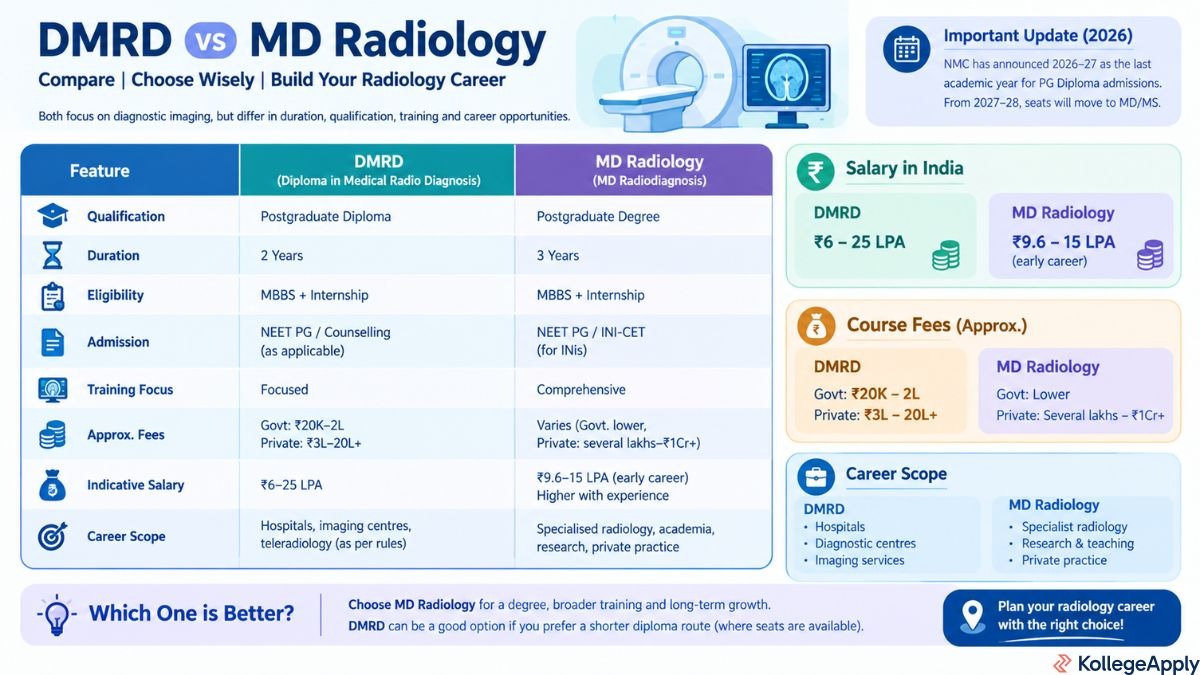
DMRD vs MD Radiology: Quick Comparison
DMRD and MD Radiology both focus on diagnostic imaging, but they represent different postgraduate qualifications. The following comparison covers the most important factors, including duration, eligibility, admission, training, fees, salary, career scope and opportunities for further academic progression.
Note: Fee and salary figures are indicative and vary by institution, location, experience, employer and practice model.
What is DMRD?
DMRD stands for Diploma in Medical Radio Diagnosis. It is a postgraduate medical diploma focused on diagnostic radiology and imaging. The course is generally two years long and is designed for eligible MBBS graduates who want specialised training in medical imaging and radiodiagnosis.
The curriculum can include X-ray, ultrasound, CT, MRI, radiological anatomy, radiological pathology, imaging physics, radiation protection and supervised image interpretation. The exact training structure depends on the institution and applicable curriculum.
DMRD Eligibility
DMRD eligibility can vary according to the institution and seat category, so candidates should verify the current admission notification before applying. Candidates applying for DMRD generally need to fulfil the medical postgraduate eligibility requirements prescribed by the relevant authority and institution. The common requirements include:
- MBBS degree from a recognised medical institution.
- Completion of the compulsory rotating internship within the prescribed deadline.
- Appropriate medical registration as required.
- Qualification in the applicable postgraduate medical admission process, generally including NEET PG where applicable.
- Fulfilment of institution-specific counselling, documentation and admission requirements.
DMRD Course Duration
The standard DMRD duration is two years. It is shorter than the three-year MD Radiology programme and provides focused postgraduate training in diagnostic imaging. However, candidates considering DMRD in 2026 should also account for the NMC's decision to phase out postgraduate diploma admissions after the 2026–27 academic year.
What is MD Radiology?
MD Radiology, commonly referred to as MD Radiodiagnosis or MD Radio-Diagnosis, is a three-year postgraduate medical degree after MBBS. It provides comprehensive training in diagnostic imaging, image interpretation, clinical decision-making, research and selected image-guided procedures.
During the programme, residents receive training in modalities such as conventional radiography, ultrasound, CT and MRI, along with system-based radiology, radiological anatomy, pathology, radiation safety and clinical case management.
MD Radiology Eligibility
Candidates generally need an MBBS degree from a recognised medical institution and must complete the required internship and registration requirements. Admission to participating institutions is primarily through NEET PG, while eligible Institutes of National Importance use INI-CET for postgraduate admissions. The exact eligibility and internship cut-off should be checked in the relevant year's counselling prospectus.
MD Radiology Course Duration
The MD Radiology course duration is three years after MBBS. Unlike a diploma route, the programme provides longer residency-based clinical training along with academic teaching, case discussions, seminars, research and thesis work. This additional training period is one of the major differences when comparing DMRD vs MD for candidates planning a long-term career in radiology.
Is DMRD Equivalent to MD Radiology?
No, DMRD is not equivalent to MD Radiology. DMRD is a recognised postgraduate diploma in Radiodiagnosis, whereas MD Radiology is a postgraduate medical degree. The two qualifications differ in duration, training structure, academic exposure and qualification level.
The NMC's recognised postgraduate diploma list includes Radiodiagnosis (D.M.R.D.), while MD Radiology is a three-year broad-speciality postgraduate degree. Therefore, candidates should not treat DMRD and MD Radiology as interchangeable qualifications.
Candidates should also distinguish between DMRD and DNB Radiology. DNB Radiodiagnosis is a three-year postgraduate qualification and is recognised as equivalent to MD/MS subject to the applicable regulatory framework.
DMRD vs DNB vs MD: Which is Better?
DMRD, DNB Radiology and MD Radiology are not identical pathways. DMRD is a postgraduate diploma, while DNB and MD are postgraduate degree-level qualifications. For a candidate choosing a long-term radiology career, comparing training, recognition, institute quality, fees and future academic opportunities is more useful than looking only at course duration.
The quality of the training institution matters considerably in both MD and DNB. Candidates should compare patient load, imaging infrastructure, faculty, reporting exposure, procedural training, academic activities and fees before making a decision.
DMRD vs MD Radiology: Career Scope
Both qualifications provide training related to diagnostic imaging, but their long-term career scope differs because MD Radiology is a postgraduate degree with broader training and academic opportunities. Actual professional responsibilities depend on registration, qualification, institutional requirements and applicable medical regulations.
Career Options After DMRD
DMRD training covers diagnostic imaging and can provide exposure to X-ray, ultrasound, CT, MRI and related radiological areas. However, specific roles should always be assessed against current professional and institutional requirements. DMRD graduates may explore eligible opportunities in:
- Hospital radiology departments
- Diagnostic and imaging centres
- Medical imaging services
- Teleradiology, where qualification and regulations permit
- Medical institutions and teaching-related roles where eligible
- Research and healthcare organisations
- Further medical education, subject to applicable eligibility
Career Options After MD Radiology
Advanced subspecialty practice may require additional focused training or qualifications depending on the area of practice and applicable regulations. MD Radiology graduates can pursue a wider range of specialist roles, including:
- Radiologist
- Consultant Radiologist
- Diagnostic Radiologist
- Interventional Radiology pathways
- Emergency Radiology
- Neuroradiology
- Body imaging
- Breast imaging
- Academic and teaching roles
- Clinical research
- Teleradiology
- Private practice
- Diagnostic-centre practice or ownership
DMRD vs MD Radiology Salary in India
The DMRD vs MD radiology salary comparison shows a difference in typical earning potential, but salary is not determined by qualification alone. Experience, location, employer, reporting workload, clinical responsibilities, subspecialty expertise and private-practice opportunities can substantially influence earnings.
Current KollegeApply salary estimates place DMRD-related earnings broadly around INR 6–25 LPA, while early-career MD Radiology salaries are around INR 9.6–15 LPA, with experienced radiologists potentially earning considerably more.
Note: These figures are indicative market ranges rather than fixed salary scales. Actual earnings depend on employer, location, experience, workload, specialisation and practice model.
DMRD vs MD Radiology Salary Per Month
Monthly earnings can provide a clearer picture for candidates comparing immediate career prospects. DMRD-related roles may begin around INR 50,000–83,000 per month based on the annual ranges above, while early-career MD Radiology roles can start around INR 80,000–1.25 lakh per month.
Salary varies considerably by city, hospital, reporting volume, experience and employment model. Private practice and diagnostic-centre ownership can produce income substantially different from salaried employment.
DMRD vs MD Radiology: Course Fees
Fees are another major factor when comparing DMRD vs MD. Government medical colleges generally offer substantially lower fees, while private and deemed medical institutions can charge much higher tuition. MD Radiology fees can range from relatively low government-institution fees to several lakhs or more at private/deemed institutions.
For DMRD, current KollegeApply estimates place government fees around INR 20,000–2 lakh and private fees around INR 3–20 lakh or more, although some published private-college figures are historical and should be verified against the latest prospectus.
Candidates should compare the complete cost, including tuition, examination charges, registration, hostel, deposits and other institutional expenses rather than relying only on advertised tuition fees.
For detailed course-specific information, candidates can refer to theDMRD Course guide,DMRD Fees guide andMD Radiology course guide.
Can I Complete DMRD After Completing MBBS?
Yes, DMRD is designed as a postgraduate medical diploma for eligible MBBS graduates. Candidates generally need to complete the required internship, meet registration requirements and qualify through the applicable postgraduate medical admission route.
However, candidates planning DMRD admission in 2026 should carefully check the latest counselling notification because the NMC has announced that AY 2026–27 is the last academic year for PG Diploma admissions.
DMRD vs MD Radiology: Which Should You Choose?
The better option depends on the candidate's long-term career objective, NEET PG rank, available seats, budget and preferred training environment. MD Radiology is generally preferable for candidates seeking a postgraduate degree and wider academic and specialist opportunities, while DMRD may suit candidates considering a diploma route where seats remain available.
For candidates entering postgraduate counselling in 2026, the decision should also account for the NMC's announced transition away from PG Diploma admissions from 2027–28.
DMRD vs MD FAQs
Can I complete DMRD after completing MBBS?
Yes, Eligible MBBS graduates can pursue DMRD after internship and required admission formalities, subject to seat availability and current regulations.
Is DMRD equivalent to MD Radiology?
No, DMRD is a postgraduate diploma, while MD Radiology is a postgraduate degree with longer and broader specialist training.
Which is better, DMRD or MD Radiology?
MD Radiology is generally stronger for long-term academic and specialist careers. DMRD may suit candidates seeking focused diploma training where available.
Which is better, MD Radiology or DNB Radiology?
Both are recognised postgraduate qualifications. Compare institute quality, clinical exposure, fees, workload and career goals rather than choosing by title alone.
Is secondary DNB equivalent to MD?
DNB equivalence depends on the qualification, specialty and applicable NMC rules. Candidates should verify the current equivalence provisions for their specific DNB.
Is a diploma in radiology good?
DMRD can provide focused radiology training, but its future availability is changing. NMC has announced 2026–27 as the final PG Diploma admission year.
What is the DMRD vs MD radiology salary difference?
DMRD salaries broadly range around INR 6–25 LPA, while MD Radiology earnings can rise substantially higher with experience and specialisation.
Is DMRD a degree or diploma?
DMRD is a postgraduate medical diploma. It is different from MD Radiology, which is a postgraduate medical degree.
How long is DMRD after MBBS?
DMRD is generally a two-year postgraduate diploma after MBBS, including the required clinical and academic training.
Can DMRD lead to a radiology career?
Yes, DMRD provides postgraduate training in diagnostic imaging. Specific job responsibilities depend on registration, training and applicable institutional regulations.