PhD in Radiology Colleges in India include government universities, medical institutions and private universities offering doctoral research in radiodiagnosis, radio-imaging technology and medical imaging. Institutions such as Banaras Hindu University (BHU), Adesh University, SRM Institute of Science and Technology (SRMIST), SGT University and Integral University are relevant options for candidates exploring research in these fields. However, the exact doctoral programme title and eligibility criteria vary by institution.
A PhD generally requires a minimum of three years, including coursework, research and thesis preparation, although the permitted duration varies by university. Admission may involve a university-level entrance examination, a national eligibility qualification where applicable, a research proposal and an interview. Eligibility depends on the programme's subject-specific requirements, so candidates should distinguish between doctoral research in radiology and clinical postgraduate qualifications such as MD Radiodiagnosis.
For students comparing PhD in Radiology colleges in India in 2026, the key factors are programme availability, accepted postgraduate qualifications, entrance requirements, research specialisation and tuition fees. Published fees also differ by billing period: some institutions specify annual charges, while others publish semester-wise or programme-specific fees. Candidates should compare these amounts carefully before applying.
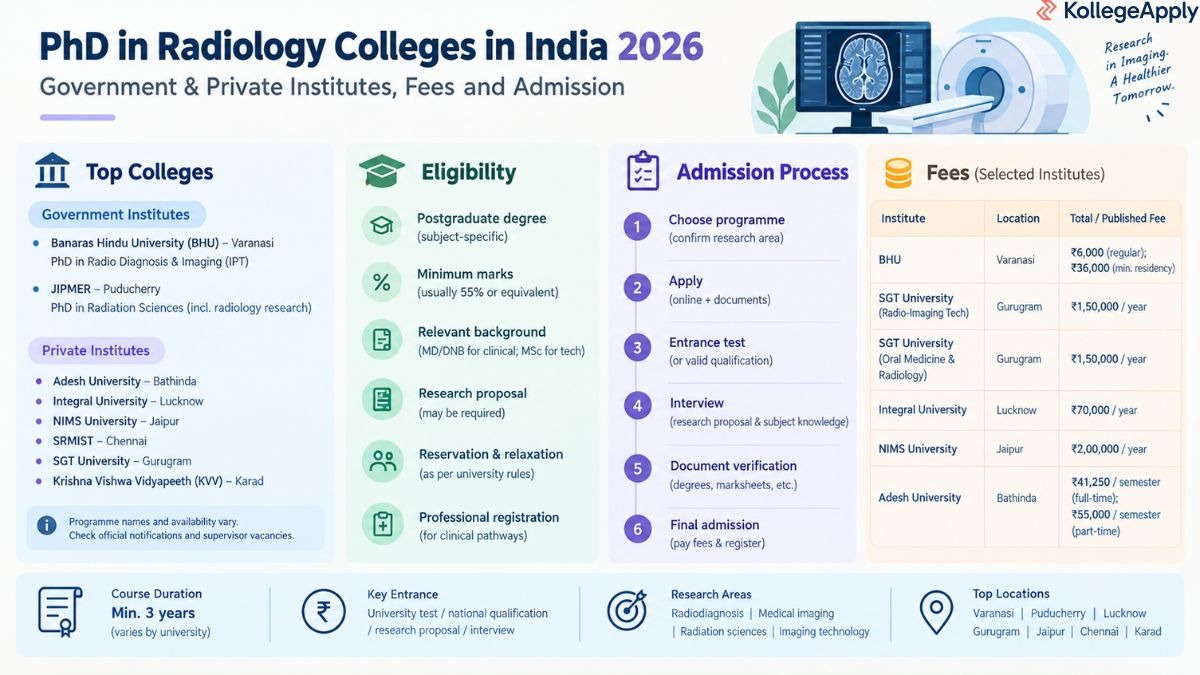
Top Government and Private PhD in Radiology Colleges in India
PhD in Radiology colleges differ in their research focus, eligibility requirements and institutional structure. Some offer doctoral research in a medical department, while others focus on imaging technology or radiation sciences. The lists below include institutions with official evidence of a relevant doctoral programme. Programme titles are retained as published by the institutions so that students can distinguish medical radiodiagnosis from allied health and dental research. Admission availability can vary by academic session and supervisor vacancies.
Government PhD in Radiology Colleges
Government universities and medical institutions may offer doctoral research through departments of radiodiagnosis, medical imaging or radiation sciences. Their admission rules, eligibility requirements and fee structures are institution-specific. For clinical radiology research, applicants should check whether the department requires an MD, MS, DNB or another recognised postgraduate qualification. For technology-focused research, the qualifying degree may instead be in medical imaging, biomedical engineering or a related discipline.
Private PhD in Radiology Colleges
Private and deemed-to-be universities provide additional doctoral options in radiodiagnosis, medical imaging technology and related disciplines. These programmes may suit applicants interested in clinical research, imaging equipment, image processing, technology development or academic careers. However, the programme title matters: a PhD in Medical Imaging Technology is not automatically equivalent to a PhD in clinical Radiodiagnosis. Applicants should match the programme's eligibility rules with their previous qualification and intended research topic.
Important: The inclusion of an institution does not mean that every programme is accepting applications in the current session. Check the latest official PhD notification, available supervisors and approved research areas before applying.
PhD in Radiology Eligibility Criteria
Eligibility for PhD in Radiology colleges depends on whether the research is clinically oriented, technology-focused or related to dental radiology. Most universities require a relevant postgraduate qualification, but the accepted degree can differ substantially between departments. Medical radiodiagnosis programmes may require a recognised postgraduate medical degree, whereas medical imaging technology programmes may accept candidates with a relevant master's qualification. The official admission notification takes precedence over general eligibility guidance. The usual requirements include:
- Educational qualification: A relevant master's or recognised postgraduate degree in the subject specified by the university.
- Minimum marks: Commonly at least 55% or an equivalent grade, subject to programme rules and applicable relaxations.
- Relevant background: MD/DNB in Radiodiagnosis or another specified medical qualification for certain clinical research programmes; a relevant MSc or equivalent qualification for technology-focused programmes.
- Research proposal: Some departments require a proposed research topic, statement of purpose or discussion of research interests.
- Reservation and relaxation: Relaxation in qualifying marks may apply to eligible categories under university rules and applicable regulations.
- Professional registration: Candidates applying through a clinical medical pathway may need to meet the relevant professional and qualification-recognition requirements.
PhD in Radiology Admission Process
Admission normally involves identifying an eligible programme, submitting an application and meeting the institution's selection criteria. Depending on the university, candidates may need to qualify for a PhD entrance test or be considered for an exemption based on an eligible national examination or fellowship. Shortlisted candidates may then undergo an interview or research proposal assessment. Final selection depends on eligibility, research suitability, available supervisors and the university's admission rules.
PhD in Radiology Fees in India
PhD in Radiology fees vary according to the university, research discipline, study mode and fee components. Government universities may have lower published academic fees, while private institutions can charge higher annual or semester-wise tuition. Applicants should also distinguish tuition from registration, admission, coursework, examination and thesis-submission charges.
BHU's official programme information lists a regular fee of INR 6,000 for PhD in Radio Diagnosis & Imaging (IPT). SGT University lists INR 1,50,000 per year for its Radio-Imaging Technology programme and separately lists the same annual fee for PhD in Oral Medicine and Radiology. The table below includes published fee figures available from official institutional sources:
FAQs on PhD in Radiology Colleges in India
Which are the best PhD in Radiology Colleges in India?
BHU, Adesh University, SRMIST, SGT University and Integral University list relevant doctoral programmes. The best choice depends on eligibility and research specialisation.
Which government colleges offer PhD in Radiology in India?
BHU offers PhD in Radio Diagnosis & Imaging. JIPMER is relevant for radiation sciences research, subject to current programme availability.
What are the PhD in Radiology Colleges in India fees?
Published fees vary by institute, from BHU's listed regular fee to annual or semester-wise charges at private universities.
Can you get a PhD in Radiology in India?
Yes, Eligible candidates can pursue doctoral research in Radiodiagnosis, Medical Imaging Technology or related fields at institutions offering these programmes.
How long does a PhD in Radiology take?
The minimum duration is generally three years. SRMIST lists three years full-time and four years part-time for Medical Imaging Technology.
Can I join a PhD in Radiology colleges without an entrance exam?
Some universities allow exemptions under specific rules. Check whether the institution requires an entrance test, an accepted fellowship or an interview.
Is MD Radiodiagnosis required for PhD in Radiology?
Not for every programme. Clinical research may require MD/DNB, while Medical Imaging Technology programmes may accept relevant master's degrees.
Which private universities offer PhD in Radiology-related fields?
Adesh University, SGT University, SRMIST, NIMS University Rajasthan and Integral University list relevant doctoral programmes.
Is PhD in Radiology the same as PhD in Medical Imaging Technology?
No. Radiodiagnosis generally focuses on clinical imaging research, while Medical Imaging Technology emphasises imaging methods, equipment and related technologies.
How should I choose PhD in Radiology Colleges in India?
Compare the official programme title, eligibility, research supervisors, admission process, duration and verified fees before shortlisting a college.