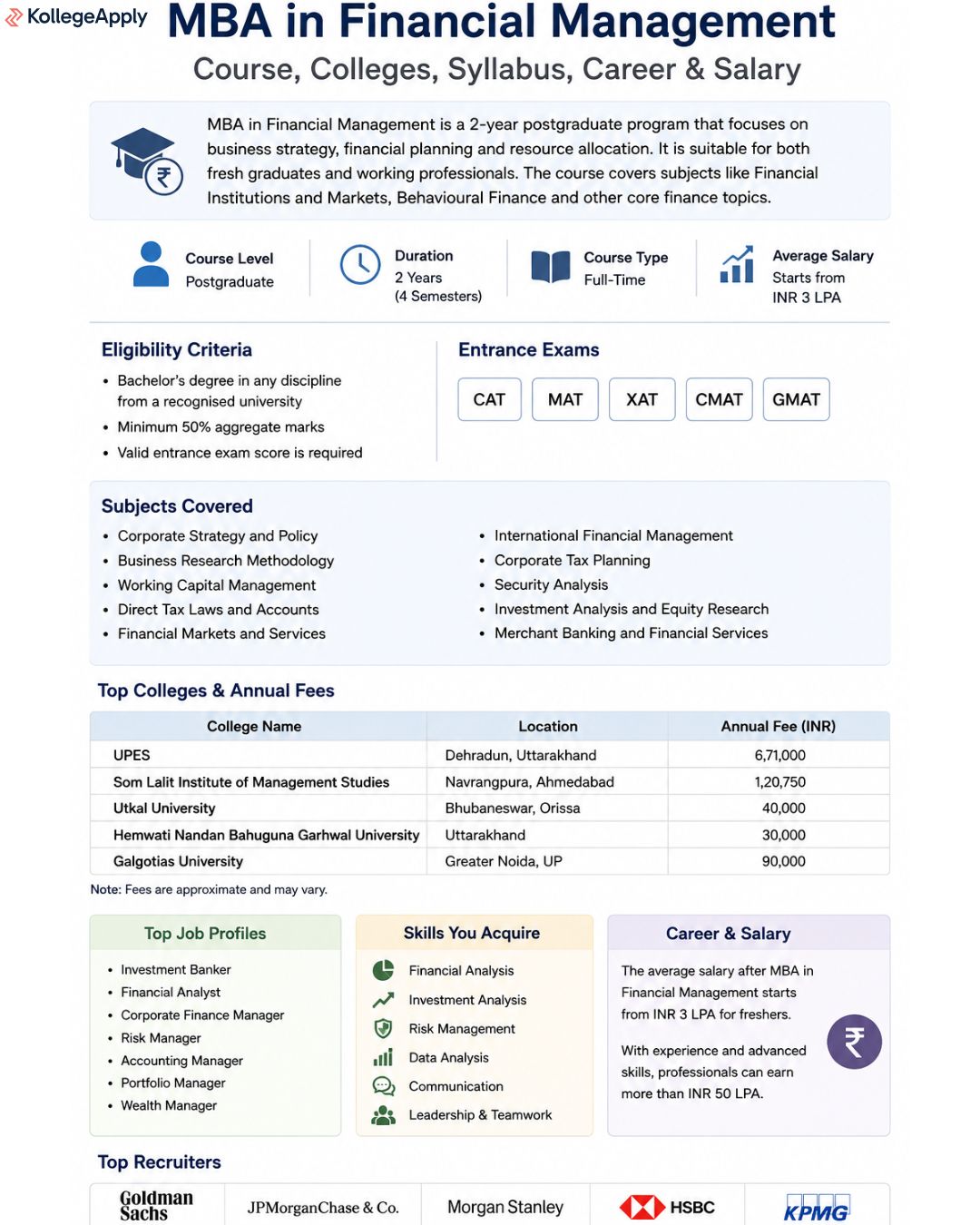
Students aiming to study MBA Finance and Management as a combined discipline that focuses on business strategy, financial planning, and resource allocation can pursue an MBA in Financial Management. This two-year postgraduate program is suitable for fresh graduates as well as working professionals. The curriculum covers industry-relevant subjects such as Financial Institutions and Markets, Behavioural Finance, and other core finance concepts.
It is necessary for students to meet the specified Financial Management MBA course eligibility criteria in order to move to the next round of the admission process. Students are required to hold a bachelor’s degree in any discipline from a recognised university. Obtaining a minimum aggregate of 50% marks or above is also crucial for students to be considered for the program by colleges. Appearing for entrance exams such as CAT, XAT, MAT, CMAT, etc., and presenting a valid scorecard during the admission process is also an important part of the process.
Students graduating from MBA Finance colleges can find several job opportunities across different career fields such as blockchain, fintech, and many more. Fresh graduates of the MBA in Financial Management course can secure job roles such as Investment Banker, Financial Analyst, Corporate Finance Manager, Risk Manager, Accounting Manager, Portfolio Manager, and Wealth Manager. Some of the top recruiters for graduates include Goldman Sachs, JP Morgan, Morgan Stanley, HSBC, and KPMG.
- MBA in Financial Management Key Highlights
- What is an MBA in Financial Management?
- Why pursue an MBA in Financial Management?
- Who Should Study MBA in Financial Management?
- Is MBA in Financial Management Worth It in 2026?
- What is the Eligibility Criteria of MBA in Financial Management?
- MBA in Financial Management Entrance Exams
- MBA in Financial Management Colleges
- MBA in Financial Management Admission Process 2026
- What is the syllabus of MBA in Financial Management?
- What Skills Do You Acquire in an MBA in Financial Management?
- MBA in Financial Management Career
- MBA in Financial Management Vs MBA Marketing
- MBA in Financial Management FAQs
MBA in Financial Management Key Highlights
Candidates aiming for admission into colleges offering an Financial Management MBA course must be familiar with all the relevant information associated with the program. There are several key factors, such as the duration of the program, eligibility criteria, required entrance exams, course fee structure, MBA Finance and Management subjects, and many more. To learn more about the key highlights of MBA Financial Management, students can refer to the table below:
What is an MBA in Financial Management?
MBA provides a specialised course to students called Financial Management, which focuses on the study of finance, auditing, accounting, risk management, and many other finance-related topics. MBA in Financial Management is a two-year program offered to students across four semesters. This program emphasises helping students develop analytical, proactive decision-making, and logical analysis skills.
The MBA Financial Management syllabus covers a wide range of topics such as Corporate Strategy and Policy, Working Capital Management, Management of Financial Institutions, and many more. Students who successfully complete an MBA in Financial Management can find job opportunities in areas such as the stock market, auditing agencies, taxation firms, and more. Investment Banker, Financial Analyst, and Corporate Finance Manager are some of the job roles that students can pursue after studying the Financial Management program.
Why pursue an MBA in Financial Management?
MBA in Financial Management helps students build strong financial, analytical, and decision-making skills required to manage business finances effectively. MBA in FM opens career opportunities in banking, investment, fintech, corporate finance, auditing, and many other finance related sectors. Check out the following pointers to understand more about the significance of the course:
- Financial Management helps in developing strong knowledge of finance, accounting, auditing, and risk management for handling business financial operations effectively.
- The program creates a pathway to career opportunities in banking, fintech, investment firms, taxation, auditing agencies, and corporate finance sectors.
- Helps students improve analytical, logical, and proactive decision-making skills required in finance-related job roles.
- Provides industry-relevant knowledge through subjects like financial institutions, markets, corporate strategy, and working capital management.
Who Should Study MBA in Financial Management?
Candidates interested in the field of finance, business strategies, and investment related fields can pursue MBA in Financial Management. The program is suitable for individuals aiming to build a career in banking, corporate finance, fintech, auditing, and other finance-related industries. Check out the table given below to learn more about MBA in Financial Management suitability:
- Students interested in finance, investment, banking, and business management can pursue MBA in Financial Management.
- Working professionals seeking career growth in corporate finance, auditing, or financial planning can benefit from the program.
- Candidates aiming to develop analytical, logical, and financial decision-making skills should consider this specialization.
- Individuals interested in stock markets, wealth management, and investment strategies can pursue this course for career opportunities.
- Students looking for high-growth careers in fintech, taxation, risk management, and corporate finance can choose this program.
Is MBA in Financial Management Worth It in 2026?
An MBA in Financial Management is worth pursuing in 2026 due to the growing demand for professionals who can combine financial expertise with strategic business decision-making. As industries continue to embrace digital transformation, organisations seek graduates with skills in financial planning, investment analysis, risk management, and business analytics. An MBA Finance and Management program equips students with these competencies, preparing them for leadership roles across banking, corporate finance, consulting, and financial services.
The future scope of MBA Finance is further strengthened by emerging trends such as AI-powered financial analysis, blockchain-based financial services, ESG investing, digital banking, and fintech innovation. These advancements are creating opportunities in industries including banking, insurance, consulting, investment firms, NBFCs, and multinational corporations. Graduates can explore roles such as Investment Banker, Financial Analyst, Risk Manager, Wealth Manager, FinTech Specialist, and Portfolio Manager while benefiting from the sector's strong long-term growth potential.
What is the Eligibility Criteria of MBA in Financial Management?
Colleges across India offering the MBA in Financial Management course require students to fulfil specific eligibility criteria for admission. Students need to perform well academically and submit the required documents during the admission process to move forward. These entry requirements help colleges assess a student’s capability and suitability for pursuing the program. Check out the pointers given below to learn more about the eligibility criteria:
- A bachelor's degree in any discipline from a recognized university is important.
- Achieving a minimum aggregate marks of 50% or above is important to be eligible for the Financial management program.
- Students are supposed to appear for entrance exams such as CAT, XAT, MAT, GMAT, etc and present a valid scorecard at the time of admission.
- Many universities also require candidates to participate in a group discussion or personal interview as part of the selection process.
MBA in Financial Management Entrance Exams
It is important for students to present a valid entrance exam score from exams such as MAT, XAT, CAT, GMAT, CMAT, etc., for admission into MBA in Financial Management programs. These exams are generally competitive, and colleges offer limited seats for admission. Students need to understand these factors and study hard in order to secure admission into their desired colleges. Check out the table given below to learn more about entrance exam-related information:
MBA in Financial Management Colleges
Several colleges across India offer the MBA in Financial Management program through both public and private institutions. The annual course fee varies significantly depending on the college, generally ranging from around INR 30,000 at public universities such as Hemvati Nandan Bahuguna Garhwal University to approximately INR 6,71,000 at private institutions like UPES. Students are required to fulfil the prescribed eligibility criteria and present a valid entrance exam scorecard to secure admission. The table below highlights some of the popular MBA in Financial Management colleges along with their locations and annual course fees.
MBA in Financial Management Admission Process 2026
MBA in Financial Management colleges require students to thoroughly understand the admission steps beforehand. The admission process generally includes steps such as meeting the eligibility criteria, paying the application fee, presenting the entrance exam scorecard, and more. Students must ensure that they fulfil each step in order to confirm their seat. Aspirants interested in learning more about the admission process can refer to the steps followed at Indira University:
Step 1: Students are required to meet the eligibility criteria set by Indira University in order to gain admission.
Step 2: Visiting the official university website is the next step in the process. Students must fill out the application form and pay the required application fee to complete the submission process.
Step 3: Applicants must appear for qualifying entrance examinations such as CAT, XAT, GMAT, CMAT, MAT, and CUET, and submit a valid scorecard during the admission process.
Step 4: Aspirants will be shortlisted on the basis of their entrance exam scores.
Step 5: Shortlisted candidates are required to attend the Personal Interview (PI) round and Group Discussion (GD), where their communication and interpersonal skills are evaluated.
Step 6: Final admission is granted on the basis of the candidate’s overall performance, seat availability, and interview results. Selected students must complete document verification and pay the required course fee to confirm their seat in the program.
Documents Required
What is the syllabus of MBA in Financial Management?
The MBA in Financial Management syllabus is divided into four semesters, covering both theoretical and practical aspects of finance and business management. The curriculum includes several industry-relevant subjects that help students develop the knowledge and skills required for diverse career opportunities in the finance sector. Some of the key topics covered include Accounting for Managerial Decisions, Economic Analysis for Decision Making, Investment Analysis and Equity Research, Business Regulatory Framework, Merchant Banking and Financial Services, Marketing of Financial Services, and many more. To learn more, students can refer to the MBA in Financial Management syllabus followed at Utkal University:
What Skills Do You Acquire in an MBA in Financial Management?
An MBA in Financial Management equips students with a combination of technical finance knowledge and managerial skills required to succeed in today's competitive business environment. Throughout the program, students develop expertise in financial planning, investment analysis, budgeting, risk management, financial modelling, capital allocation, and corporate finance. They also strengthen their analytical thinking, problem-solving, and strategic decision-making abilities, enabling them to evaluate business performance and make informed financial decisions.
In addition to financial expertise, an MBA Finance and Management program helps students build essential professional skills such as leadership, communication, data analysis, teamwork, and business strategy. Exposure to case studies, industry projects, and practical applications prepares graduates to work across sectors including banking, investment firms, consulting, fintech, insurance, and corporate finance. These industry-relevant skills enhance employability and prepare students for managerial and leadership roles in the finance domain.
MBA in Financial Management Career
Students can pursue several job opportunities after successfully completing an MBA in Financial Management degree. Generally, the skills required to secure high-paying roles in the financial management field include forecasting and strategic planning, capital allocation, financial modelling, and data analysis. Some of the popular job roles include Investment Banker, with an average annual salary ranging from INR 7.9 LPA to INR 14.2 LPA. Overall, graduates can expect starting salaries from around INR 3 LPA, while experienced professionals with advanced skills and industry expertise can earn over INR 50 LPA. Students can refer to the table given below to learn more about the career scope and average salary after an MBA:
MBA in Financial Management Vs MBA Marketing
There are numerous colleges in India offering MBA programs in different kinds of specialisations. Students must choose the course that perfectly aligns with their long-term career goals. MBA Marketing is one such discipline, and students should thoroughly study the program before confirming their decision. To better understand the suitability of the program, a comparison table between MBA Financial Management and MBA Marketing is provided below:
MBA in Financial Management FAQs
What is MBA in Financial Management?
MBA in Financial Management is a postgraduate program offered for a period of two years. It focuses on finance, accounting, auditing, investment, taxation, and risk management related concepts.
What is the eligibility criteria for MBA in Financial Management?
MBA aspirants must hold a bachelor’s degree from a recognised university with a minimum marks of 50% or above for MBA in Financial Management admission.
What are the entrance exams required for MBA in Financial Management?
Popular entrance exams for MBA in Financial Management include CAT, XAT, MAT, CMAT, GMAT, and many others national, state or university level exams accepted by colleges.
What is the MBA in Financial Management syllabus?
MBA in Financial Management syllabus includes subjects such as Financial Markets, Corporate Finance, Tax Planning, Investment Analysis, Risk Management, and Financial Institutions.
What is the duration of MBA in Financial Management?
MBA in Financial Management is generally offered as a two-year postgraduate program divided into four semesters.
What are the job opportunities after MBA in Financial Management?
Students can pursue job roles such as Investment Banker, Financial Analyst, Risk Manager, Corporate Finance Manager, and Wealth Manager after MBA in Financial Management.
What is the salary after MBA in Financial Management?
The salary after an MBA in Financial Management generally starts from INR 3 LPA. With experience, advanced skills, and senior-level roles, professionals can earn more than INR 50 LPA.
Which are the top colleges offering MBA in Financial Management?
Some popular colleges offering MBA in Financial Management include UPES, Galgotias University, Utkal University, and Som Lalit Institute of Management Studies.
Who should pursue MBA in Financial Management?
Students interested in finance, investment, banking, auditing, taxation, and business financial strategies can pursue MBA in Financial Management.