Supply Chain Management Jobs are becoming increasingly popular among MBA graduates, due to the rapid expansion of manufacturing, e-commerce, retail, logistics, and global trade industries. Nowadays, companies require professionals who can efficiently manage procurement, inventory, transportation, warehousing, and distribution networks. An MBA in Supply Chain Management equips students with managerial expertise and analytical skills needed to optimize business operations and improve organizational efficiency.
The demand for SCM jobs has grown significantly with the rise of digital supply chains, automation, artificial intelligence, and international trade operations. Graduates can explore opportunities in logistics companies, multinational corporations, e-commerce firms, FMCG organizations, shipping companies, and consulting firms. With attractive salary packages, global exposure, and strong career growth, MBA supply chain jobs offer long-term stability and leadership opportunities across industries.
- Why Choose Supply Chain Management Jobs?
- Factors Influencing Supply Chain Management Jobs
- Supply Chain Management Jobs in India
- Industry-Wise Supply Chain Management Jobs Opportunities
- Top Recruiters for Supply Chain Management Jobs
- Skills Required for MBA Supply Chain Jobs
- Supply Chain Management Jobs Salary
- Future Scope of Supply Chain Management Jobs
- Certifications that Improve Supply Chain Management Jobs
- Supply Chain Management Jobs FAQs
Why Choose Supply Chain Management Jobs?
MBA in Supply Chain Management offers a combination of business management knowledge and logistics expertise. The program helps students understand sourcing, procurement, inventory management, demand forecasting, operations planning, and transportation systems. These skills are highly valuable in industries that depend on efficient product movement and operational management. Some of the major reasons students prefer logistics MBA jobs include:
- Growing demand across industries
- High career stability
- Attractive salary packages
- International career opportunities
- Leadership and managerial roles
- Expanding e-commerce sector
- Opportunities in manufacturing and retail
- Increasing adoption of digital supply chain technologies
Factors Influencing Supply Chain Management Jobs
There are several factors affecting the MBA logistics and supply chain management job opportunities, career growth, and salary packages in India. Understanding these factors helps students make informed career decisions and improve employability in the logistics and operations sector. Some of the major factors are explained below:
1. Educational Institution
The reputation of the MBA college significantly impacts placement opportunities. Graduates from reputed business schools generally receive higher salary packages and better job roles in top companies.
2. Specialization Skills
Students with expertise in logistics analytics, procurement, inventory control, ERP software, and operations management often receive better opportunities in MBA supply chain jobs.
3. Industry Experience
Candidates with prior work experience in logistics, manufacturing, retail, or operations management usually receive higher compensation and leadership positions.
4. Technical Knowledge
Knowledge of technologies like SAP, Oracle ERP, warehouse automation systems, data analytics, and AI-based supply chain tools improves employability.
5. Location of Employment
Metropolitan cities and industrial hubs such as Bengaluru, Mumbai, Pune, Hyderabad, Chennai, and Gurgaon offer better logistics MBA jobs due to the presence of manufacturing units and corporate headquarters.
6. Economic and Industry Growth
Industries like e-commerce, retail, pharmaceuticals, automobile, and FMCG continuously create demand for supply chain professionals, positively influencing job growth.
Supply Chain Management Jobs in India
MBA supply chain management jobs in India provide opportunities in multiple operational and managerial domains. Professionals can work in logistics planning, procurement, transportation management, inventory optimization, and warehouse operations.
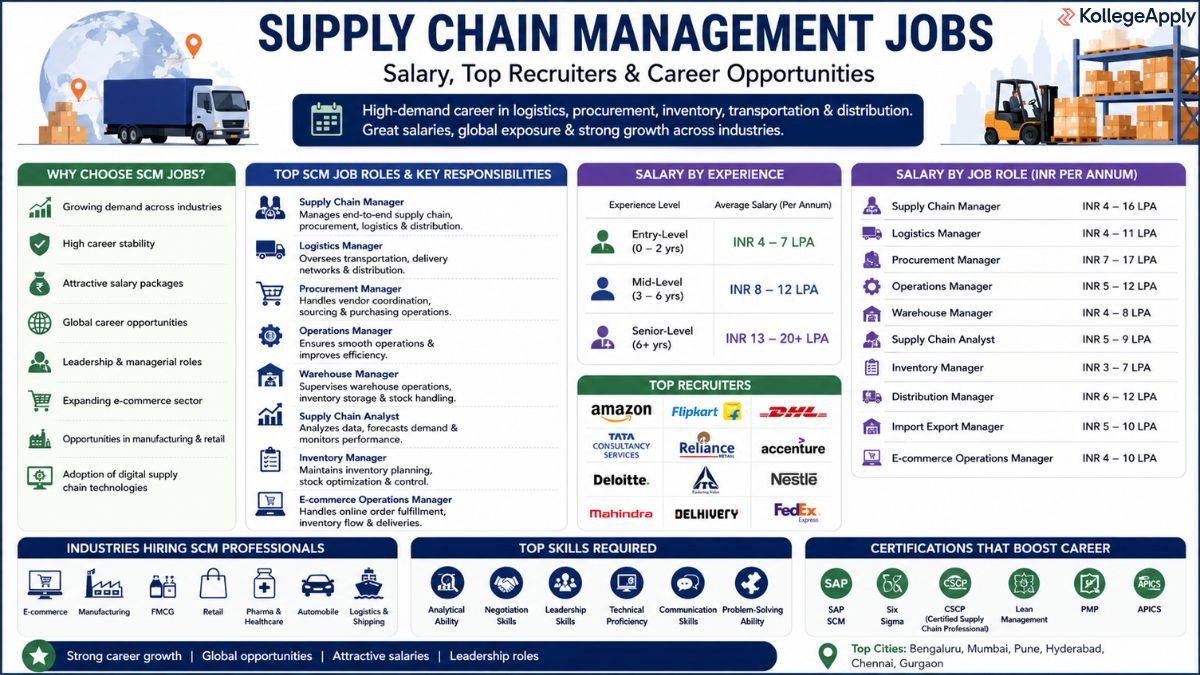
Before exploring salary details and responsibilities, it is important to understand that supply chain management roles differ based on industry requirements, organizational size, and operational complexity. Some roles focus on procurement and vendor coordination, while others involve inventory management, logistics planning, or strategic operations. The following table highlights the major MBA in Supply Chain Management jobs along with explaining the key responsibilities based on the job roles:
Industry-Wise Supply Chain Management Jobs Opportunities
MBA in logistics jobs are available across several industries because supply chain operations are essential for product delivery and customer satisfaction. Different industries offer unique operational challenges and career growth opportunities. The table below highlights the major industries and the supply chain management roles offered within them.
Top Recruiters for Supply Chain Management Jobs
Supply Chain Management professionals are hired across multiple industries including retail, e-commerce, manufacturing, FMCG, healthcare, automobile, and shipping sectors. Large organizations require skilled managers to improve operational efficiency and reduce logistics costs. Some of the top recruiting companies offering MBA logistics and supply chain management jobs include:
Skills Required for MBA Supply Chain Jobs
To pursue top MBA Supply Chain Management jobs, freshers need a combination of managerial, analytical and technical skills. Strong communication and problem-solving abilities play a crucial role in managing supply chain operations effectively.
Before entering the logistics and supply chain industry, students should focus on developing practical and technical competencies that align with modern supply chain systems. Companies now prefer candidates who can handle data-driven decision-making, vendor coordination, and operational planning efficiently. The following skills are highly valuable for long-term success in MBA in logistics jobs and supply chain management careers. Some of the important skills included are:
Analytical Ability
Supply chain professionals must analyze operational data, forecast demand, and identify process improvements. Strong analytical skills help companies improve efficiency and reduce operational costs.
Negotiation Skills
Negotiation skills are important for building strong relationships with suppliers and vendors. Effective negotiation helps organizations secure better pricing, improve contracts, and maintain smooth procurement operations.
Leadership Skills
Leadership abilities help professionals manage teams, coordinate operations, and handle workplace challenges efficiently. Strong leadership also supports career growth into managerial and senior-level positions.
Technical Proficiency
Knowledge of ERP software, SAP systems, and digital logistics platforms is highly valuable in modern supply chain management. Technical expertise helps professionals manage inventory, procurement, and logistics operations effectively.
Communication Skills
Communication skills are essential for coordinating with suppliers, warehouse teams, clients, and management departments. Effective communication improves teamwork and operational accuracy.
Problem-Solving Ability
Supply chain professionals frequently face operational disruptions, delivery delays, and inventory issues. Problem-solving skills help in finding quick and effective solutions to maintain smooth operations.
Global Logistics Knowledge
Understanding international trade laws, shipping regulations, and customs procedures is important for global supply chain operations. This knowledge helps professionals manage import-export activities efficiently.
Inventory Management Skills
Inventory management skills help maintain optimal stock levels and reduce unnecessary storage costs. Efficient inventory control improves warehouse productivity and customer satisfaction.
Supply Chain Management Jobs Salary
Supply Chain Management offers rewarding career opportunities with competitive salaries across industries such as manufacturing, logistics, retail, e-commerce, pharmaceuticals, and consulting. Salary packages vary depending on factors like experience, job role, location, company size, educational qualifications, and technical expertise. Professionals with strong analytical, operational, and leadership skills often enjoy steady salary growth and excellent career advancement. The sections below provide a detailed breakdown of Supply Chain Management Jobs Salary based on experience and job role.
Salary Based on Experience
The salary of supply chain professionals generally increases with experience as they take on greater operational and managerial responsibilities. Entry-level professionals focus on inventory, logistics, and procurement support, while experienced managers oversee end-to-end supply chain operations, vendor management, and strategic planning. The table below shows the average salary range based on experience.
Salary Based on Job Role
Supply Chain Management professionals can explore diverse career opportunities across logistics, procurement, operations, warehousing, and e-commerce. Each job role comes with different responsibilities and salary prospects based on experience, industry, and organization. Professionals with an MBA in Supply Chain Management and certifications such as CSCP, CPIM, SAP, or Lean Six Sigma often receive higher salary packages. The table below highlights the average annual salaries for some of the most popular job roles in supply chain management.
Future Scope of Supply Chain Management Jobs
The future of MBA supply chain jobs is highly promising due to increasing globalization and technological advancements. Companies are continuously improving logistics networks and operational efficiency to reduce costs and improve customer satisfaction. The following developments are expected to generate strong demand for skilled supply chain professionals in India and abroad. Some emerging trends in supply chain management include:
- AI-driven supply chain systems
- Automation and robotics
- Sustainable logistics
- Blockchain in supply chain operations
- Real-time inventory tracking
- Predictive analytics
- Smart warehouse systems
- Global supply chain expansion
Certifications that Improve Supply Chain Management Jobs
Additional certifications help professionals improve technical knowledge and increase employability in logistics MBA jobs. Certifications also enhance salary potential and career growth opportunities. Some of the popular certifications that Supply Chain Management graduates can pursue include:
- SAP SCM Certification
- Six Sigma Certification
- Certified Supply Chain Professional (CSCP)
- Lean Management Certification
- Logistics and Transportation Certification
- PMP Certification
- APICS Certification
Supply Chain Management Jobs FAQs
What jobs can I get with an MBA in Supply Chain Management?
Supply Chain Management Jobs include roles such as Supply Chain Manager, Logistics & Procurement Manager, Operations Manager, and Supply Chain Analyst across retail, e-commerce, and manufacturing industries.
Is MBA in Supply Chain Management a good career?
Yes, Supply Chain Management Jobs offer strong career growth, global opportunities, competitive salaries, and managerial positions in industries like logistics, e-commerce, and manufacturing.
What is the average salary after MBA in Supply Chain Management?
Entry-level professionals generally earn INR 4–7 LPA, mid-level professionals earn INR 8–12 LPA, while senior supply chain managers can earn INR 13–20+ LPA, depending on experience, industry, and organization.
Which companies hire MBA SCM graduates?
Top recruiters for Supply Chain Management Jobs include Amazon, Flipkart, DHL, Blue Dart, Reliance Retail, Infosys, Accenture, FedEx, and other logistics and e-commerce companies.
What skills are required for logistics MBA jobs?
Important skills for Supply Chain Management Jobs include analytical ability, ERP and SAP knowledge, leadership, communication, negotiation, inventory management, and problem-solving skills.
Which city offers the highest salary for supply chain professionals?
Mumbai and Bengaluru offer some of the highest salary packages due to the presence of multinational corporations, manufacturing companies, and large logistics networks.
Can MBA SCM graduates work abroad?
Yes, Supply Chain Management Jobs offer international career opportunities in logistics, shipping, procurement, and global trade operations across multinational companies worldwide.
What are MBA supply chain management fresher jobs in India?
Freshers can apply for Supply Chain Management Jobs such as Logistics Executive, Inventory Analyst, Procurement Associate, Warehouse Executive, and Operations Coordinator roles.
Is SCM a high-paying job?
Yes. Supply Chain Management is considered a high-paying career, especially for experienced professionals working in multinational companies, manufacturing, e-commerce, and consulting sectors.
Are certifications useful for MBA SCM jobs?
Certifications like SAP SCM, Six Sigma, CSCP, and APICS improve technical expertise and increase employability, salary growth, and promotion opportunities in Supply Chain Management Jobs.
What is the future scope of MBA supply chain jobs?
The future of Supply Chain Management Jobs is highly promising due to AI-driven logistics, automation, blockchain technology, predictive analytics, and expanding global supply chains.
What are the top roles after MBA in Supply Chain Management?
Popular Supply Chain Management Jobs include Supply Chain Manager, Procurement Manager, Logistics Manager, Distribution Manager, and E-commerce Operations Manager.
Can supply chain professionals earn well abroad?
Yes, Countries such as the USA, UK, UAE, Canada, and Australia offer significantly higher salary packages because of strong demand for skilled supply chain and logistics professionals.