
• Updated on 27 Aug, 2026 by Tiyasa Khanra
What's new?
CBSE Class 12 Exam Latest news and articles
CBSE Class 12 Board Exam Preparation 2027 must begin with a clear understanding of the syllabus, question paper pattern, NCERT textbooks, and the time available before the exam. Rather than rote memorization, regular revision, solving previous years' question papers, practising sample papers, and maintaining a subject-wise timetable can significantly improve preparation. For subjects such as Mathematics, Physics, and Chemistry, students must practise numericals consistently, while for English, they must give equal attention to comprehension, literature, and writing skills to attain 90%+ scores.
- CBSE Class 12 Board Exam Preparation Tips 2027
- CBSE Class 12 Maths Preparation Tips 2027
- CBSE Class 12 Physics Preparation Tips 2027
- Chemistry CBSE Class 12 Preparation Tips 2027
- CBSE Class 12 English Preparation Tips 2027
- CBSE Class 12 Biology Preparation Tips 2027
- CBSE Class 12 Exam 2027 Preparation Timetable for 6 Months
- Best Books for CBSE Board Preparation Class 12 for 2027
- CBSE 12 Board Exam 2027 Preparation Tips FAQs
CBSE Class 12 Board Exam Preparation Tips 2027
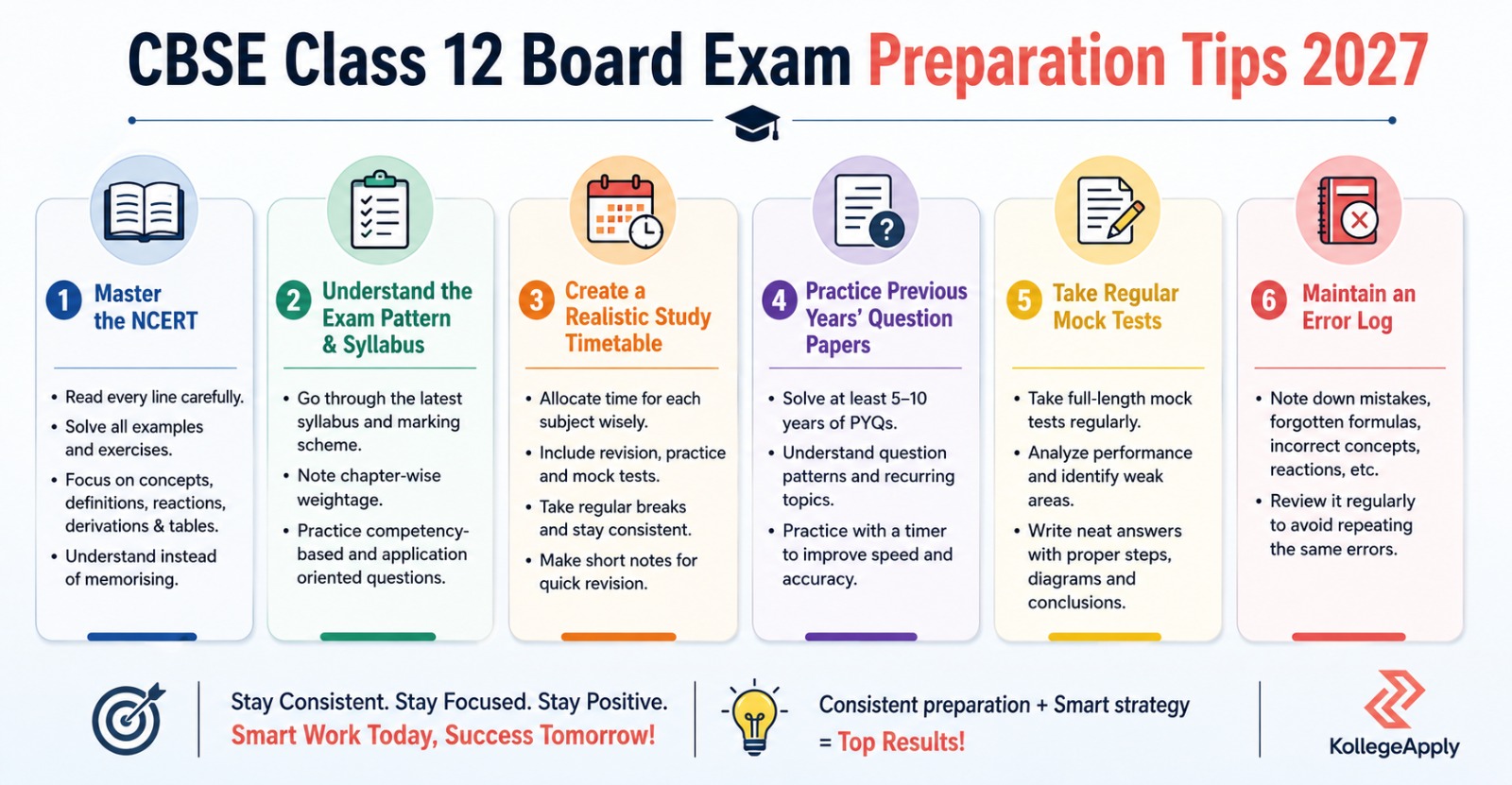
Before starting the CBSE Class 12 Board Exam preparation, students must go through the CBSE 12 Syllabus 2027 and the latest exam pattern properly to know all the subject-wise topics and chapters to be covered in the exam. Knowing the exam pattern will help students understand the marking scheme, question types, weightages, marks, and more. Success in the CBSE Class 12 Board Exam 2027 begins with a solid foundation and a well-structured plan. Here are the key strategies to follow:
- Master the NCERT: The NCERT textbooks must be regarded as the bible for the CBSE Class 12 Board Exam, as a significant proportion of board questions are directly or indirectly based on NCERT content. Students must read every line of the NCERT textbooks, solve every example, and practice all exercises, particularly for Mathematics, Physics, Chemistry, and English. In Chemistry, students should study definitions, reactions, mechanisms, examples, and tables. In Physics, they must understand derivations and concepts instead of memorising formulas without understanding them.
- Understand the Exam Pattern and Syllabus: Before diving into preparation, thoroughly review the CBSE Class 12 Syllabus 2027 and marking scheme. Note down all topics, their respective weightage, and the overall structure of the paper, as knowing the weightage of each chapter helps prioritize the topics with maximum weightage. Students must focus on competency-based education and application of knowledge by practising questions that require interpretation, analysis, and application instead of preparing only direct theory-based questions. For example, for Physics, students must practise a maximum number of questions across remembering, understanding, applying, analysing, evaluating, and creating.
- Create a Realistic Study Timetable: Curate a balanced, well-organised and realistic timetable that allocates specific time slots for each subject, considering its difficulty and strengths/weaknesses, revision, numerical practice, and mock tests. Include breaks to avoid burnout and maintain focus and consistency. Learn the concept first, practise questions, create concise notes for quick revision, especially for formulas, derivations, reactions, and important definitions, and revise these notes regularly.
- Practice Previous Years' Question Papers: Solving at least 5–10 years of PYQs helps you understand the question pattern, difficulty level, and recurring topics. It also improves time management during the actual exam. Practice solving questions within the allotted time to enhance the speed and accuracy of answering. Try to use a timer during practice sessions to simulate exam conditions.
- Take Regular Mock Tests: Simulate exam conditions by taking full-length mock tests. Analyze your performance to identify weak areas and work on them systematically. Practise writing answers using appropriate headings, steps, diagrams, formulas, and conclusions wherever required. Write answers neatly, label diagrams properly, and show all steps in numerical problems to secure step-wise marking.
- Maintain an Error Log: Maintain a separate error notebook to note down frequently forgotten formulas, incorrect numerical solutions, important reactions, Grammar mistakes, incorrect concepts, and questions that are repeatedly answered incorrectly.
CBSE Class 12 Maths Preparation Tips 2027
Mathematics is a high-scoring subject and requires continuous practice. Many board questions are directly picked from NCERT. Begin with NCERT solved examples and exercises, then move to solving problems from sample papers independently, and gradually increase the speed once the basic concepts are clear. Students can ace CBSE Class 12 Maths preparation by following the tips mentioned below:
- Conceptual Understanding: Understand the fundamental concepts of each chapter, including Relations and Functions, Algebra, Calculus, Vectors and Three-Dimensional Geometry, Linear Programming, and Probability, and focus on important topics like equivalence relations, composition of functions, matrices and determinants, continuity and differentiability, applications of derivatives, definite and indefinite integration, area under curves, differential equations, properties of vectors, 3D geometry (lines and planes), linear programming problems, and probability (conditional probability, Bayes' theorem). Solve every example and exercise in the NCERT textbook to clear the concepts.
- Make a Formula Notebook: Create a formula sheet by compiling all formulas, theorems, and properties. For topics like trigonometric functions, practice writing their domain, range, and graphs. Understand the logic behind each derivation instead of memorizing. Practice writing them step-by-step without looking at notes. Revise this notebook daily.
- Solve Numerical Problems Daily: Dedicate at least 1–2 hours daily to solving numerical problems. Focus on chapters like Calculus, Algebra, and Probability, which have high weightage. Practise case-based and application-oriented questions. Write solutions clearly step-by-step, showing all calculations and reasoning, which will help in securing partial marks even if the final answer is incorrect. Reattempt questions answered incorrectly after a gap of several days.
- Revise Weekly: Instead of chapter-wise revision, revise formulas and important problems weekly to retain them better.
- Solve Question Banks and Sample Papers: Supplement NCERT with credible question banks (e.g., Oswaal, RD Sharma) and solve CBSE sample papers under timed conditions.
CBSE Class 12 Physics Preparation Tips 2027
CBSE Class 12 Physics Preparation requires conceptual understanding, numerical practice, derivations and diagrams, with a major focus on applying, analysing, evaluating and creating. Follow the tips mentioned below to excel in the CBSE Class 12 Physics section:
- Conceptual Understanding: Read NCERT thoroughly to master the concepts of Coulomb's Law, Gauss' Law, Kirchhoff's Laws, Ampere's Circuital Law, Faraday's Laws of Induction, LCR circuits, Ray Optics and Wave Optics (Huygens' Principle, Young's Double Slit Experiment), Photoelectric Effect, Bohr's Model, and p-n junction diodes. Most board questions, especially derivations and numericals, are based on NCERT content.
- Master Derivations: Focus on high-weightage derivations from chapters like Current Electricity, Electromagnetic Induction, and Optics. Do not simply memorise derivations; rather, understand the derivations of important formulas and equations and the sequence of steps, and practise deriving formulas step-by-step without looking at the solution. Be proficient in interpreting and drawing various graphs (e.g., V-I characteristics, energy graphs).
- Draw Diagrams Neatly: Ray diagrams, circuit diagrams, and electromagnetic wave diagrams are asked frequently. Practice drawing them neatly with proper labels.
- Practice Numericals: Practise a wide variety of numerical problems and pay close attention to units, significant figures, formulas, substitution of values, and proper notation. Solve as many sample papers and previous years' questions as possible to improve speed and accuracy.
- Make a Formula Sheet: Compile all formulas, units, and dimensions in one place for quick revision. Write formulas along with the meaning and SI unit of each variable.
- Solve PYQs and Sample Papers: Practise previous years' papers and CBSE sample papers to understand the question pattern and improve speed.
For every Physics chapter, follow this sequence:
Concept → Formula → Derivation → NCERT Questions → Additional Questions → Chapter Test
Chemistry CBSE Class 12 Preparation Tips 2027
CBSE Class 12 Chemistry is divided into Physical, Organic, and Inorganic Chemistry. Each requires a different approach, as mentioned below.
- Focus on Numericals: For Physical Chemistry, focus on chapters like Electrochemistry, Chemical Kinetics, and Solutions, which have high-weightage numericals. Practice a diverse range of numerical problems from NCERTs and sample papers related to stoichiometry, mole concept, solutions, electrochemistry, chemical kinetics, and chemical equations.
- Understand Formulas: Derive formulas where possible and practice applying them to different problems.
- Create Reaction Charts: For Organic Chemistry, Prepare important reactions systematically by creating charts containing Reactant, Reagent, Conditions, Product, and important exceptions. Create flowcharts for conversions and reactions to visualize relationships between compounds. Practise writing named reactions, mechanisms, and conversion reactions step-by-step. Pay attention to the differentiating tests for different functional groups in organic chemistry.
- Read NCERTs Thoroughly: For Inorganic Chemistry, focus on group properties, reactions, trends, and exceptions, and memorize tables and trends from NCERT.
- Regular Revision: Inorganic Chemistry requires frequent revision to retain facts. Use flashcards or short notes for quick revision. Practice previous years' papers to identify recurring questions and patterns.
CBSE Class 12 English Preparation Tips 2027
English preparation should cover Reading, Writing and Literature systematically, practising questions regularly and understanding the marking scheme:
- Reading Section: Practice diverse unseen passages (factual, descriptive, literary) to improve comprehension, inference, and vocabulary with a timer. Focus on identifying the main idea, supporting details, and the author's tone and purpose. Focus on answering precisely and avoid writing essays for 1-mark questions.
- Writing Skills: Practice various writing formats like notices, letters (job applications, letters to the editor), reports, and articles. Pay attention to word limits and presentation. Improve vocabulary through consistent reading. Pay close attention to format, grammar, punctuation, sentence structure, and coherence.
- Literature: Read all chapters and poems thoroughly. Understand main themes, characters, literary devices, and the historical/cultural context of the works. Practice writing answers with proper introduction, body, and conclusion. Pay extra attention to poetry, as questions can often be trickier. Practice questions on literary analysis to understand different question types.
- Grammar: Practise grammar exercises from NCERT and supplementary books. Focus on tenses, clauses, and reported speech. Revise grammar rules, especially those related to gap filling, re-ordering sentences, and transformation of sentences, as these are common question types. Practice CBSE sample papers to improve speed and accuracy.
CBSE Class 12 Biology Preparation Tips 2027
CBSE Class 12 Biology requires a combination of conceptual understanding, NCERT-based learning, diagrams, terminology, and regular revision. Students must focus on high-weightage topics like sexual reproduction in flowering plants, human reproduction, reproductive health, Mendelian inheritance, genetic disorders, DNA structure, evolution, human health and diseases, microbes in human welfare, biotechnology, organisms and populations, and ecosystems.
- Study NCERTs Thoroughly: Since many questions are directly or indirectly based on NCERT concepts, students should read the textbook thoroughly rather than relying only on reference books, understand every concept, and solve the in-text and end-of-chapter questions. Rather than memorizing long paragraphs, understand the sequence of events in processes such as reproduction, genetic inheritance, transcription, translation, biotechnology and ecological cycles.
- Prepare Chapter-wise Short Notes: Create concise notes for final revision on important topics such as important biological processes, definitions and terminology, scientific names, examples and applications, important experiments, differences between related concepts, diagrams and labelling, and important sequences and cycles. Use flowcharts and visual aids to represent complex biological processes.
- Focus on Genetics and Biotechnology: Practise numerical and conceptual questions from Genetics, and understand processes, terminology, applications and diagrams for Biotechnology. Try to understand the relationships between different chapters; for example, connect genetics with evolution.
- Practise Important Diagrams: To understand and remember complex biological processes, students must practise drawing and correctly labelling important NCERT diagrams regularly. This includes cell structures, reproductive systems, life cycles, and biotechnological processes.
- Solve PYQs and Revise Regularly: Regularly revise key terms, scientific names, and definitions. Solve CBSE Previous Year Question Papers, especially those that involve reasoning and application of concepts. Practise answer writing by starting with a direct introduction, dividing the answer into logical points, using headings wherever appropriate, and drawing relevant labelled diagrams.
CBSE Class 12 Exam 2027 Preparation Timetable for 6 Months
A six-month preparation plan should gradually move from syllabus completion to revision and full-length examination practice. Students must complete 60–70% of the syllabus in the first 2 months. Months 3–4 must be allotted to completing the syllabus and starting mock tests. Month 5 must involve intensive revision and 3–4 mock tests per week. In Month 6, candidates must take full-length mocks daily and do final revision. The following plan can be adjusted according to the student's stream, school schedule, and current level of preparation.
Best Books for CBSE Board Preparation Class 12 for 2027
While NCERT textbooks are the foundational and most important resources for the CBSE Class 12 exams, referring to a few good reference books can provide additional practice, deeper insights, and alternative explanations. These books often contain a wider variety of practice problems and more detailed theoretical explanations. It's recommended to complete the NCERT textbooks first before moving into the additional resources. Here are some of the best reference books recommended for CBSE Class 12 Exam 2027 preparation:
Subject | Book | Author Name(s) / Publisher |
Mathematics | NCERT Textbook (Mandatory) | NCERT |
RD Sharma (Volumes 1 & 2) | R.D. Sharma | |
Exemplar Problems (for MCQs and higher-order questions) | NCERT | |
Physics | NCERT Textbook (Mandatory) | NCERT |
Concepts of Physics (Volumes 1 & 2) | H.C. Verma | |
S.L. Arora (Comprehensive Physics) | S.L. Arora | |
Chemistry | NCERT Textbook (Mandatory) | NCERT |
Pradeep's New Course Chemistry (Volumes I & II) |
S.C. Kheterpal, S.N. Dhawan, P.N. Kapil |
|
|
O.P. Tandon (Physical, Inorganic, Organic) |
O.P. Tandon |
|
|
Biology |
NCERT Textbook (Mandatory) |
NCERT |
|
Trueman's Elementary Biology (Volumes 1 & 2) | K.N. Bhatia, M.P. Tyagi | |
S. Chand's Biology for Class 12 |
P.S. Verma, B.P. Pandey |
|
|
English |
NCERT (Flamingo & Vistas) (Mandatory) |
NCERT |
|
Together With English Core (Guide Book) |
Rachna Sagar |
|
|
All in One English (Guide Book) |
Arihant Experts |
CBSE 12 Board Exam 2027 Preparation Tips FAQs
What is the latest exam pattern for CBSE Class 12 Board Exam 2027?
The CBSE 12 Board Exam 2027 will have 50% competency-based questions (including MCQs and case-based), 20% MCQs, and 30% descriptive short/long answer questions. This new pattern emphasises the application of concepts over rote learning.
How important is the NCERT textbook for CBSE Class 12 Board Exam 2027 preparation?
The NCERT textbook is extremely important and forms the core of your CBSE 12 Board Exam 2027 preparation. Most board questions are directly or indirectly based on NCERT content, making it essential for conceptual clarity and fundamental understanding.
How many hours should I study daily for the CBSE Class 12 Board Exam 2027?
The ideal study duration for CBSE 12 Board Exam 2027 depends on individual learning pace, but quality over quantity is key. Aim for 6-7 hours of focused self-study daily, ensuring you cover all subjects and engage in active learning.
What is the role of sample papers and previous year questions in CBSE 12 Board Exam 2027 preparation?
Solving sample papers and previous year questions is crucial for CBSE 12 Board Exam 2027 preparation as it familiarises you with the exam pattern and question types. This practice also helps improve time management and identify your weak areas for targeted revision.
How can I create an effective study schedule for CBSE Class 12 Board Exam 2027?
To create an effective study schedule for CBSE 12 Board Exam 2027, identify your strongest and weakest subjects and allocate time accordingly. Ensure consistency, incorporate short breaks, and balance all subjects to cover the syllabus systematically.
What are some key time management tips for the CBSE Class 12 Board Exam 2027?
Key time management tips for CBSE 12 Board Exam 2027 include prioritising topics based on weightage, using a timer during practice, and sticking to a realistic daily schedule. This helps improve speed and accuracy under exam conditions.
How can I deal with stress during CBSE Class 12 Board Exam 2027 preparation?
To deal with stress during CBSE 12 Board Exam 2027 preparation, maintain a healthy lifestyle with adequate sleep, nutritious meals, and regular physical activity. Practice relaxation techniques like deep breathing or meditation to stay calm and focused.
Are there any specific changes in the marking scheme for CBSE 12 Board Exam 2027?
For CBSE 12 Board Exam 2027, 50% of the theory paper will be competency-based questions, 20% will be MCQs, and 30% will be constructed response (short/long answer) questions. Practical exams will continue to hold significant weightage.
Should I refer to extra books besides NCERT for CBSE Class 12 Board Exam 2027?
While NCERT is fundamental for CBSE 12 Board Exam 2027, referring to additional books like RD Sharma for Maths or HC Verma for Physics can provide more practice problems and deeper conceptual understanding. Always prioritise mastering NCERT first.
What is the importance of regular revision in CBSE Class 12 Board Exam 2027 preparation?
Regular revision is vital for retaining information and reinforcing understanding for CBSE 12 Board Exam 2027. Dedicate specific time slots to review previously studied topics, formulas, and concepts to solidify your knowledge and improve long-term retention.
Question Papers
Browse previous year papers by subject