
• Updated on 4 Nov, 2026 by Himanshu Singh
What's new?
GATE Latest news and articles
GATE Biotechnology Syllabus 2027, released by IIT Madras, covers six major sections, including Engineering Mathematics, General Biology, Genetics, Cellular and Molecular Biology, Fundamentals of Biological Engineering, Plant, Animal and Microbial Biotechnology, and Recombinant DNA Technology. Candidates should go through the revised syllabus to understand the topics prescribed for the BT paper.
The syllabus covers a wide range of concepts, from biochemistry, microbiology and immunology to genetic engineering, bioprocessing and bioinformatics. Candidates can refer to the detailed section-wise GATE BT syllabus 2027 below to identify the topics they need to prepare, along with the examination pattern.
Table of Contents
GATE Biotechnology Section-Wise Topics
The GATE 2027 Biotechnology syllabus is divided into six sections. Each section covers multiple subjects and topics related to biotechnology and biological sciences. Candidates can check the detailed GATE BT syllabus below.
Section 1: Engineering Mathematics
Engineering Mathematics is an important part of the GATE Biotechnology syllabus. It covers five major topics: Linear Algebra, Calculus, Differential Equations, Probability and Statistics, and Numerical Methods.
Candidates should understand the fundamental concepts and practise numerical problems from each topic.
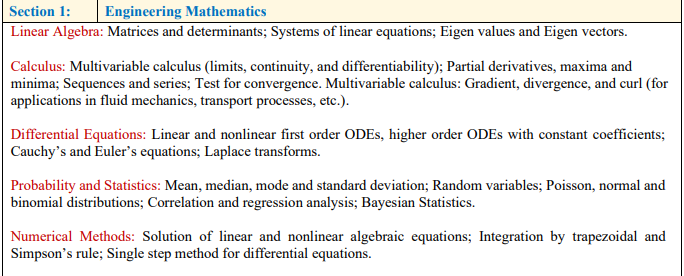
Source: The image has been sourced from the official GATE Biotechnology syllabus.
Section 2: General Biology
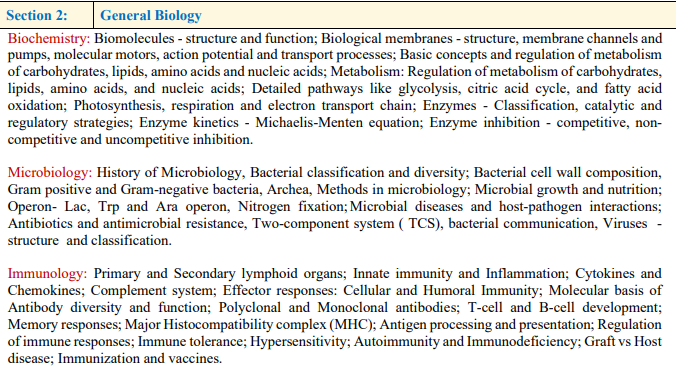
The General Biology section of the GATE Biotechnology syllabus includes three major subjects: Biochemistry, Microbiology and Immunology. These subjects cover biological molecules, metabolic processes, microorganisms, immune responses and related concepts. The detailed topics are provided below:
Biochemistry
Biochemistry covers the structure and function of biomolecules, biological membranes, metabolism and enzyme activity. Candidates should prepare the following topics:
Microbiology
The Microbiology syllabus includes the history and classification of microorganisms, microbial growth, bacterial genetics, microbial diseases and viruses. The detailed topics are:
Immunology
Immunology focuses on the immune system, immune responses, antibodies, immune cells and related disorders. Candidates should cover the following topics:
Section 3: Genetics, Cellular and Molecular Biology
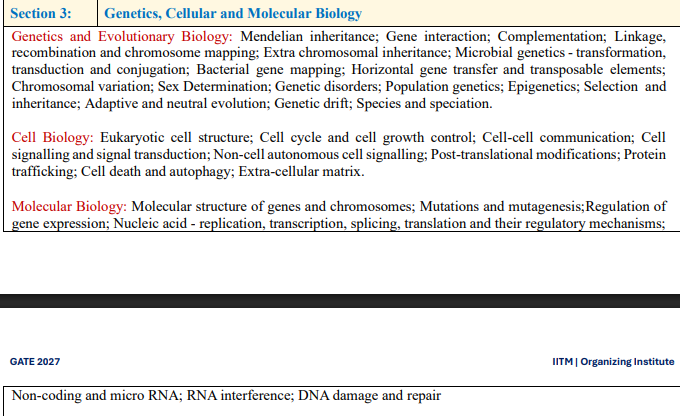
This section covers three subjects: Genetics and Evolutionary Biology, Cell Biology, and Molecular Biology. It focuses on inheritance, genetic variation, cell structure, cellular processes and the regulation of gene expression.
Genetics and Evolutionary Biology
The Genetics and Evolutionary Biology syllabus includes Mendelian inheritance, gene interactions, genetic mapping, population genetics and evolutionary processes.
Cell Biology
Cell Biology deals with eukaryotic cell structure, cell growth, communication and other cellular processes. The topics include:
Molecular Biology
The Molecular Biology section covers the molecular structure of genes and chromosomes, DNA and RNA processes, gene expression and DNA repair mechanisms.
Section 4: Fundamentals of Biological Engineering
The Fundamentals of Biological Engineering section includes Bioreaction Engineering and Upstream and Downstream Processing. These topics cover biological reaction systems, reactor design, process optimisation, separation techniques and process control.
Bioreaction Engineering
Bioreaction Engineering focuses on reaction kinetics, reactor systems, enzyme immobilisation, microbial growth and scale-up processes.
Upstream and Downstream Processing
This subsection covers the preparation, processing, separation and purification of biological products. It also includes process control and measurement systems.
Section 5: Plant, Animal and Microbial Biotechnology
The Plant, Animal and Microbial Biotechnology section covers applications of biotechnology in plant systems, animal cell culture and microbial production. It includes tissue culture, transgenic organisms, cell preservation and the industrial production of biological products.
Plant Biotechnology
The Plant Biotechnology syllabus includes plant tissue culture, plant regeneration, genetic transformation and the production of industrially important plant products.
Animal Biotechnology
Animal Biotechnology covers animal cell culture, preservation techniques, stem cell technology, hybridoma technology and genetic modification of animals.
Microbial Biotechnology
Microbial Biotechnology focuses on the industrial use of microorganisms and the production of commercially important biological products.
Section 6: Recombinant DNA Technology and Other Tools in Biotechnology
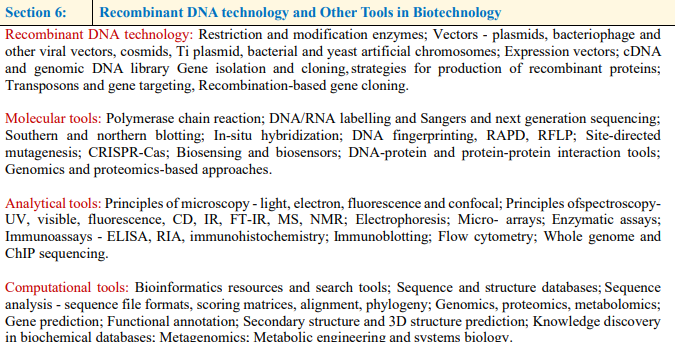
The sixth section of the GATE Biotechnology syllabus covers Recombinant DNA Technology, Molecular Tools, Analytical Tools and Computational Tools. It focuses on genetic engineering techniques, laboratory methods, biological data analysis and bioinformatics.
Recombinant DNA Technology
This subsection covers enzymes, vectors, cloning strategies and the production of recombinant proteins.
Molecular Tools
The Molecular Tools subsection includes techniques used for DNA and RNA analysis, gene editing, sequencing and molecular interactions.
Analytical Tools
The Analytical Tools section covers microscopy, spectroscopy, electrophoresis, immunoassays and other laboratory techniques used to analyse biological samples.
Computational Tools
Computational Tools focus on bioinformatics, sequence analysis, biological databases, genomics and computational approaches used in biotechnology.
GATE Biotechnology Exam Pattern
Candidates preparing for GATE 2027 should understand the exam pattern along with the syllabus. The GATE Biotechnology question paper carries 100 marks and is conducted in Computer-Based Test (CBT) mode. The examination duration is three hours.
The paper includes General Aptitude, Engineering Mathematics and subject-specific questions. Candidates can check the marks distribution below.
GATE Biotechnology Marking Scheme
The GATE BT examination includes both one-mark and two-mark questions. Negative marking applies to incorrect answers in MCQs.
Candidates should practise MCQ, MSQ and NAT questions to become familiar with the different question formats. They should also refer to the official GATE 2027 information brochure for examination instructions and the complete marking scheme.
GATE Biotechnology Syllabus 2027 FAQs
How many sections are there in the GATE Biotechnology syllabus 2027?
The GATE Biotechnology syllabus 2027 has six major sections, covering Engineering Mathematics, General Biology, Genetics, Biological Engineering and other biotechnology subjects.
Who released the GATE BT syllabus 2027?
IIT Madras, the organising institute for GATE 2027, has released the Biotechnology syllabus on its official website.
What are the main topics in the GATE Biotechnology syllabus?
The syllabus covers Engineering Mathematics, Biochemistry, Microbiology, Immunology, Genetics, Cell Biology, Biological Engineering and Biotechnology.
Is Engineering Mathematics included in the GATE Biotechnology syllabus?
Yes, Engineering Mathematics is included in the GATE BT syllabus. It covers Linear Algebra, Calculus, Differential Equations, Probability and Statistics, and Numerical Methods.
How many marks are allotted to Engineering Mathematics in GATE BT 2027?
Engineering Mathematics carries 13 marks in the GATE Biotechnology examination.
How many marks does General Aptitude carry in GATE Biotechnology 2027?
General Aptitude carries 15 marks in the GATE Biotechnology examination and is common to all GATE papers.
What is the total marks of the GATE Biotechnology exam?
The GATE Biotechnology examination carries 100 marks, including General Aptitude, Engineering Mathematics and core subject questions.
What is the duration of the GATE BT 2027 examination?
The GATE Biotechnology examination is conducted for three hours in Computer-Based Test mode.
What are the question types in the GATE Biotechnology exam?
The GATE BT question paper includes Multiple Choice Questions (MCQ), Multiple Select Questions (MSQ) and Numerical Answer Type (NAT) questions.
Is there negative marking in the GATE Biotechnology examination?
Yes, negative marking applies to incorrect MCQ responses. There is no negative marking for MSQ and NAT questions.
What topics are included in the GATE Biotechnology Microbiology syllabus?
Microbiology covers bacterial classification, microbial growth, operons, nitrogen fixation, microbial diseases, antimicrobial resistance, bacterial communication and viruses.
Does the GATE BT syllabus include Recombinant DNA Technology?
Yes, it includes restriction enzymes, vectors, DNA libraries, gene cloning, recombinant protein production and other molecular tools.
Where can I download the GATE Biotechnology syllabus PDF?
Candidates can download the official GATE Biotechnology syllabus PDF from the IIT Madras website at gate2027.iitm.ac.in.
Exam Calendar
Explore exam calendars tailored to your interest
Question Papers
Browse previous year papers by subject