
• Updated on 4 Nov, 2026 by Himanshu Singh
What's new?
GATE Latest news and articles
Students interested in pursuing Electronics and Communication Engineering can appear for the GATE 2027 examination, which will be conducted by IIT Madras in February 2027. The GATE ECE Syllabus covers important concepts from Engineering Mathematics, Network Theory, Signals and Systems, Electronic Devices, Analog and Digital Circuits, Control Systems, Communications and Electromagnetics.
Understanding these topics will help candidates identify the subjects they need to prepare for the ECE paper. Candidates can check the detailed section-wise syllabus below, along with the expected subject-wise weightage and GATE 2027 exam pattern, to plan their preparation effectively.
GATE ECE Section-Wise Topics
The GATE syllabus for Electronics and Communication Engineering is divided into eight sections, each covering different concepts related to electronics and communication engineering. Candidates can check the complete section-wise syllabus and important topics in the tables below.
Section 1: Engineering Mathematics
Engineering Mathematics is an important part of the GATE EC syllabus. It covers Linear Algebra, Calculus, Differential Equations, Vector Analysis, Complex Analysis, Probability and Statistics.
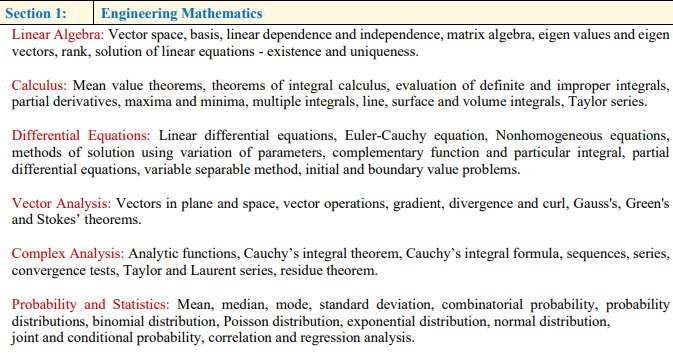
Source: The image has been sourced from GATE ECE Syllabus.
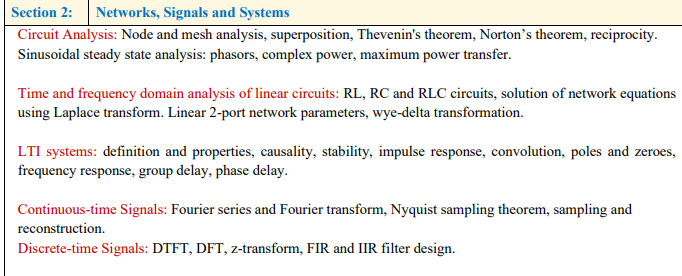
Section 2: Networks, Signals and Systems
The Networks, Signals and Systems section covers circuit analysis, linear time-invariant systems, continuous-time signals and discrete-time signals. Candidates should understand the fundamental principles of electrical networks and signal processing.
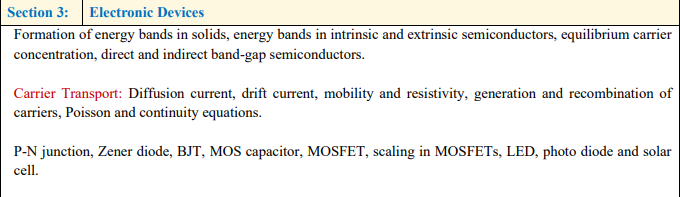
Section 3: Electronic Devices
The Electronic Devices section focuses on semiconductor physics, carrier transport and the working principles of different electronic devices. The important topics include:
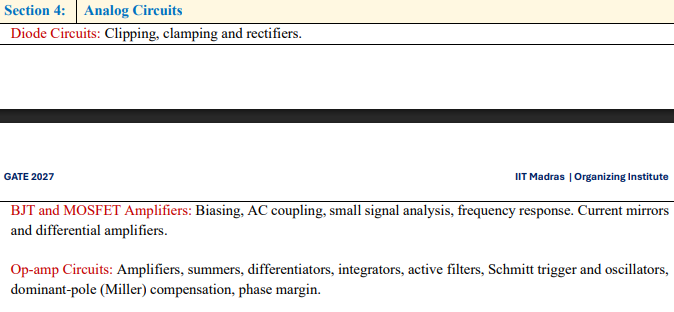
Section 4: Analog Circuits
The Analog Circuits section covers diode circuits, BJT and MOSFET amplifiers, and operational amplifier circuits. Candidates should prepare the following topics:
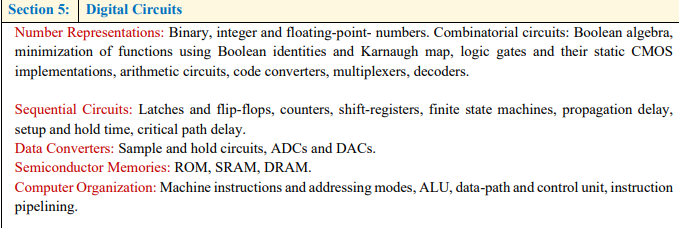
Section 5: Digital Circuits
The Digital Circuits section covers number representations, combinational and sequential circuits, data converters, semiconductor memories and computer organisation.
Section 6: Control Systems
The Control Systems section evaluates candidates' understanding of feedback systems, system stability, transfer functions and controller design. The complete syllabus includes:

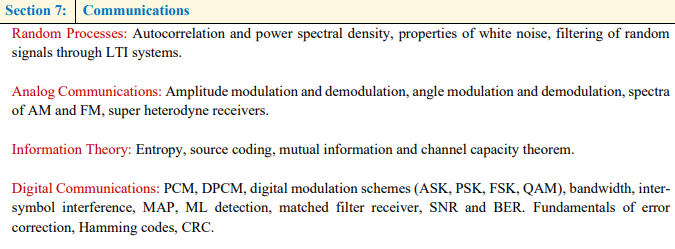
Section 7: Communications
The Communications section covers random processes, analog communications, information theory and digital communications. It includes modulation techniques, signal detection, channel capacity and error correction.
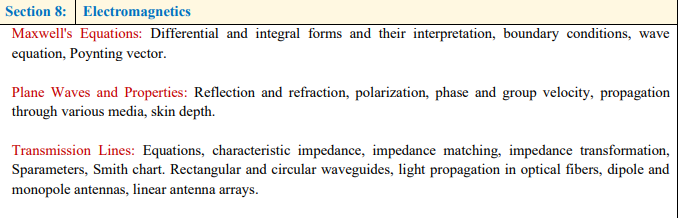
Section 8: Electromagnetics
The Electromagnetics section includes Maxwell's equations, plane waves, transmission lines, waveguides and antennas. Candidates should prepare the following topics:
GATE ECE Subject-Wise Weightage
Understanding the expected subject-wise weightage can help candidates prioritise topics while preparing for the GATE ECE examination. The paper carries 100 marks, divided into General Aptitude, Engineering Mathematics and core Electronics and Communication Engineering subjects.
The overall marks distribution is as follows:
GATE ECE Exam Pattern
Candidates should understand the GATE exam pattern along with the ECE syllabus. The examination is conducted in Computer-Based Test (CBT) mode for three hours. The question paper includes 65 questions carrying a total of 100 marks.
GATE ECE Syllabus 2027 FAQs
How many sections are there in the GATE ECE syllabus 2027?
The GATE ECE syllabus includes eight sections: Engineering Mathematics, Networks, Signals and Systems, Electronic Devices, Analog Circuits, Digital Circuits, Control Systems, Communications and Electromagnetics.
What is the paper code for GATE Electronics and Communication Engineering?
The paper code for Electronics and Communication Engineering in GATE 2027 is EC.
Who released the GATE ECE syllabus 2027?
IIT Madras, the organising institute for GATE 2027, has released the ECE syllabus on its official website.
What are the main subjects in the GATE ECE syllabus?
The main subjects include Engineering Mathematics, Network Theory, Signals and Systems, Electronic Devices, Analog Circuits, Digital Circuits, Control Systems, Communications and Electromagnetics.
How many marks are allotted to Engineering Mathematics in GATE ECE?
Engineering Mathematics carries 13 marks in the GATE ECE examination.
How many marks does General Aptitude carry in GATE ECE 2027?
General Aptitude carries 15 marks out of the total 100 marks in the GATE ECE examination.
What is the total marks of the GATE ECE examination?
The GATE ECE question paper carries 100 marks and consists of 65 questions.
What is the duration of the GATE Electronics and Communication exam?
The GATE Electronics and Communication examination is conducted for three hours in Computer-Based Test mode.
What are the question types included in the GATE ECE paper?
The GATE ECE paper includes Multiple Choice Questions (MCQ), Multiple Select Questions (MSQ) and Numerical Answer Type (NAT) questions.
Is there negative marking in the GATE ECE examination?
Yes, negative marking applies to incorrect MCQ responses. There is no negative marking for MSQ and NAT questions.
Which subjects carry the highest expected weightage in GATE ECE?
Communications, Electronic Devices and Circuits, and Analog Circuits are among the subjects with higher expected weightage.
Is the GATE ECE syllabus the same as the Electronics and Telecommunication syllabus?
The GATE EC paper is officially titled Electronics and Communication Engineering. Candidates should follow the official EC syllabus for preparation.
Where can I download the GATE ECE syllabus PDF?
Candidates can download the official GATE ECE syllabus PDF from the IIT Madras website: gate2027.iitm.ac.in.
Exam Calendar
Explore exam calendars tailored to your interest
Question Papers
Browse previous year papers by subject