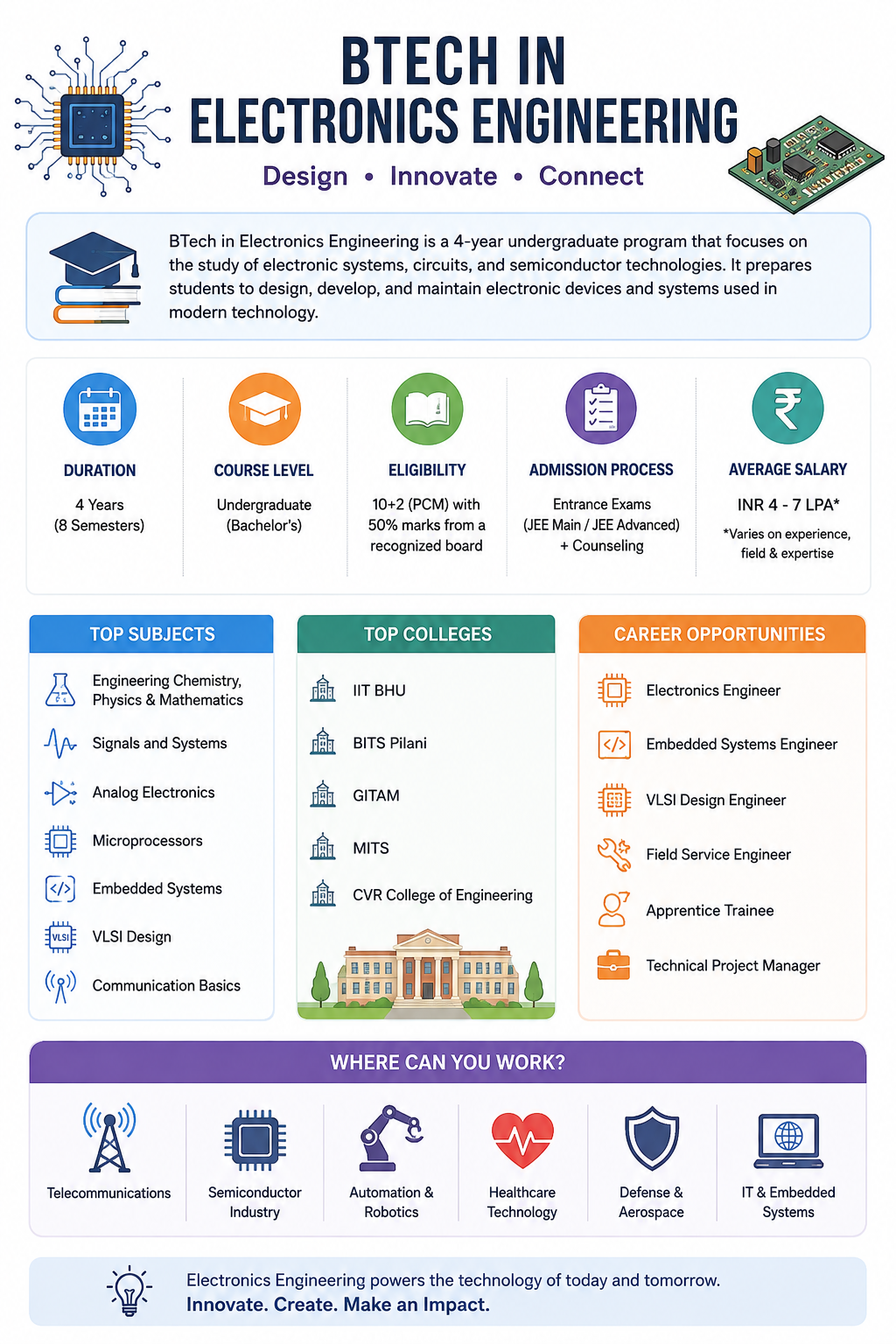
BTech in Electronics Engineering is a four-year UG engineering program that aims on the study of electronic systems, circuits, or semiconductor technologies. BTech Electronics prepares students to work on the design, development, and maintenance of electronic systems and devices. The subjects that are generally included in Electronics BTech are Analog Electronics, Digital Electronics, Signals and Systems, Microprocessors, Embedded Systems, VLSI Design and Communication Basics.
To be eligible for the BTech in Electronics Engineering course, applicants must have completed Class 12 or equivalent in the science stream (PCM) with 50% marks from a recognized board. Along with this, applicants are also required to qualify in national/state/university level entrance examinations such as JEE Main, JEE Advanced and others.
The course fee for studying BTech in Electronics Engineering in India ranges between INR 30,000 to 3,00,000 (or above) depending on whether the college is government or private affiliated. Some of the top colleges for BTech in Electronics Engineering in India are IIT BHU, BITS Pilani, CVR College of Engineering, MITS, and others.
BTech in Electronics Engineering graduates can get job opportunities in the electronics sector or related industries. The average starting BTech Electronics Engineering salary is up to INR 4-7 LPA (vary on experience, field and expertise), some of the common job roles are Electronics Engineer, Embedded Systems Engineer, VLSI Design Engineer, Field Service Engineer, Apprentice Trainee, Senior Electronics Engineer, Technical Project Manager, and many others. The top recruiters for BTech in Electronics Engineering graduates areComputronics, Applus Idiada, Neo Guide, Coexin Technologies, Emplay Inc, and others.
Table of Contents
- BTech in Electronics Engineering Key Highlights
- What is BTech in Electronics Engineering?
- Why Study a BTech in Electronics Engineering?
- Who should study BTech in Electronics Engineering?
- BTech in Electronics Engineering Eligibility Criteria
- BTech in Electronics Engineering Entrance Exams 2026
- BTech in Electronics Engineering Colleges in India
- BTech in Electronics Engineering Admission Process 2026
- BTech in Electronics Engineering Syllabus
- What is the scope of BTech in Electronics Engineering?
- BTech in Electronics Engineering FAQs
BTech in Electronics Engineering Key Highlights
The table given below summarizes the key details about BTech in Electronics Engineering program including admission process, eligibility, entrance exam, fees, colleges and other necessary informations:
What is BTech in Electronics Engineering?
The BTech in Electronics Engineering is a four year long undergraduate program. It involves the study of designing, developing, and analyzing electronic circuits and systems used in modern technology. It provides students with a solid base in mathematics, physics, and fundamental courses in electronics engineering, including analog and digital electronics, signal processing, communication systems, and embedded systems.
BTech Electronics Engineering also provides students with hands-on training in circuit designing, microcontrollers, and telecommunication technologies. It helps students to acquire knowledge and skills in the field of electronics engineering, and they can seek employment in various fields like telecommunication, electronics industry, information technology, health technology, and defense technology.
Why Study a BTech in Electronics Engineering?
BTech in Electronics Engineering is a highly demanding field because the world is becoming more connected and technology-driven. Some of the reason why one should pursue this program is listed below:
- Growing Industry Demand: Electronics engineers are needed in sectors like telecommunications, consumer electronics, automation, healthcare technology, and defense. Their skills are essential for developing and improving modern electronic systems.
- Foundation for Modern Technologies: The program teaches key areas such as circuit design, microcontrollers, embedded systems, and communication technologies, which are fundamental to many modern devices and digital systems.
- Wide Career Options: Graduates can work in areas such as electronics design, telecommunications, semiconductor manufacturing, robotics, and embedded systems, or pursue higher studies and research.
- Government Job opportunities: Graduates can work in organizations like Indian Space Research Organisation and Defence Research and Development Organisation.
Who should study BTech in Electronics Engineering?
BTech in Electronics Engineering equips students with skills to design and control electronic systems that power modern devices, from smartphones to robots. It blends theory with practical applications, enabling innovation in areas like automation, communication, and smart technologies. The students that are suitable to pursue BTech Electronics Engineering are:
- Perfect for students who have a passion for technology and innovation.
- Students who enjoy tackling technical challenges, designing solutions for complex circuits or systems, and improving existing technologies can thrive in this program.
- Students who want to work with emerging technologies such as the Internet of Things, robotics, AI, or renewable energy systems will benefit from the strong technical foundation this course provides.
- Students who are passionate about designing new electronic products, creating smart devices, or contributing to innovative tech solutions in healthcare, communication, and automation industries will find ample opportunities to apply their skills.
BTech in Electronics Engineering Eligibility Criteria
For pursuing BTech in Electronics Engineering, applicants are required to meet some eligibility criteria. The BTech Electronics engineering program eligibility criteria are as follows:
- Passed class 10+2 or equivalent in science stream with physics, chemistry, and mathematics as core subjects from a recognized board.
- Scored a minimum aggregate score of 50% or equivalent CGPA in the 10+2 boards examination
- Qualify in entrance examinations like JEE Main/JEE Advanced and others as per university requirements.
- Students who have completed a 3-year Diploma degree in Electronics Engineering or related domains are eligible to get lateral entry directly into the 2nd year.
BTech in Electronics Engineering Entrance Exams 2026
To get admission to the BTech Electronics course in India, candidates are generally required to qualify for national, state, or university-level entrance examinations. The most popular entrance exams include JEE Main, JEE Advanced, BITSAT, and TS EAPCET, depending on the college or university they wish to join. These examinations assess candidates' knowledge of Physics, Chemistry, and Mathematics and are conducted on different dates throughout the admission cycle. The table below provides an overview of the major BTech Electronics Engineering entrance exams, along with their tentative exam dates and application fees for the 2027 admission session:
BTech in Electronics Engineering Colleges in India
India is home to several reputed institutions offering BTech in Electronics Engineering, including IITs, private universities, and state government colleges. Admission to these colleges is primarily based on national, state, or university-level entrance examinations such as JEE Main, JEE Advanced, BITSAT, MET, TS EAPCET, and GAT, depending on the institution's admission criteria. The table below lists some of the top BTech in Electronics Engineering colleges in India, along with their locations, annual tuition fees, and accepted entrance exams for admission:
BTech in Electronics Engineering Admission Process 2026
The admission process for enrolling in BTech in Electronics Engineering program is almost similar in all colleges. For a clear understanding, the admission process at IIT BHU for pursuing BTech in Electronics Engineering is given below:
Step 1: Go to the official website of JEE Main and fill in the registration form providing personal, educational, and contact information. Additionally, upload documents (photo, signature) and pay the requisite application fee.
Step 2: Appear for the JEE Main examination as per the scheduled date and attempt to obtain the maximum number of marks.
Step 3: The result of JEE Main is released online. View your All India Rank (AIR).
Step 4: After qualifying in JEE Main, similarly register for JEE Advanced and appear in the exam. After results for JEE Advanced are released, check for rank.
Step 5: Following the JEE Advanced results, enroll on the JoSAA (Joint Seat Allocation Authority) website for the counseling procedure. Enter your choices of institutes and courses (such as IIT BHU and BTech in Electronics Engineering).
Step 6: Seats are assigned according to JEE Advanced AIR and your choices. Confirm the assigned seat online and deposit the initial admission amount.
Step 7: Report to the institute allotted (IIT BHU) for physical document verification.
Step 8: Pay the balance of fees as indicated by the institute's timetable to secure your seat in the chosen course. Upon confirmation of payment, the admission process is completed.
Documents Required:
The list of documents required at the time of counseling and during admission are as follows:
BTech in Electronics Engineering Syllabus
The syllabus for BTech in Electronics Engineering may vary from institution to institution depending upon the course curriculum followed by them, however, the core subjects remain the same. The syllabus for BTech Electronics Engineering at Harcourt Butler Technical University (HBTU) is given below:
Program Elective Course (PEC I-V)
List of Open Electives
What is the scope of BTech in Electronics Engineering?
After completing BTech in Electronics Engineering degree, graduates can get jobs in multiple fields related to technology, electronics, automobile, and other industries. Electronics engineer, embedded system engineer, etc are some of the offered roles. Freshers can earn an average salary of INR 4 - 7 LPA. Few of the common job roles for graduates of BTech in Electronics Engineering in India are given below:
BTech in Electronics Engineering Vs BTech in Electrical Engineering
Choosing between BTech in Electronics Engineering and BTech in Electrical Engineering can be challenging, as both branches share a common engineering foundation but differ significantly in their areas of specialization and career opportunities. While BTech in Electrical Engineering primarily focuses on power generation, transmission, electrical machines, and high-voltage systems, BTech in Electronics Engineering deals with electronic circuits, embedded systems, semiconductors, communication technologies, and consumer electronics. The table below highlights the key differences between BTech in Electronics Engineering and BTech in Electrical Engineering:
BTech in Electronics Engineering FAQs
What is the scope of BTech Electronics Engineering course?
BTech in Electronics Engineering offers careers in electronics design, telecom, robotics, embedded systems, IoT, and semiconductor industries. Graduates can work in private firms, government sectors, research, or startups.
What are the subjects in BTech in Electronics Engineering?
Some common subjects include Mathematics, Physics, Analog and Digital Electronics, Microprocessors, Communication Systems, Control Systems, Signal Processing, Embedded Systems, and electronics labs.
Is BTech Electronics good?
Yes, BTech in Electronics Engineering is a good course for students interested in technology and hardware. It offers strong career opportunities in electronics, research, & emerging tech fields.
What is the BTech Electronics Engineering eligibility?
Students must complete 10+2 with Physics, Chemistry, and Mathematics. Most colleges require 50–60% marks and entrance exams like JEE Main/JEE Advance scorecard for admission.
What is the BTech in Electronics Engineering Salary?
The BTech Electronics Engineering salary depends on the skill set, job roles and on the company. The fresh graduates usually earn around INR 4–7 LPA on average for entry-level roles in IT companies.
What are the practical skills and hands-on training that BTech in Electronic Engineering program provides?
Students gain skills in circuit design, PCB development, microcontroller programming, embedded systems, electronics testing, simulation tools, and building real-world electronic projects.
Is there a provision for internships or industry projects during the BTech in Electronic Engineering program?
Yes, most programs include summer internships, industrial training, and final-year projects with companies or research labs to provide practical industry experience.
How does the BTech in Electronic Engineering program foster innovation and entrepreneurship?
The program encourages innovation through project work, hackathons, incubation centers, and startup support, helping students develop new products and entrepreneurial skills.
What are the recent technologies and trends included in BTech in Electronic Engineering?
The recent technologies and trends include IoT, robotics, embedded systems, artificial intelligence, 5G communication, VLSI design, automation, and renewable energy electronics.
What higher studies options are available after BTech Electronics Engineering?
There are various degrees students can pursue MTech in Electronics, VLSI, Embedded Systems, MBA, or specialized certifications in AI, IoT, robotics, and communication technologies.