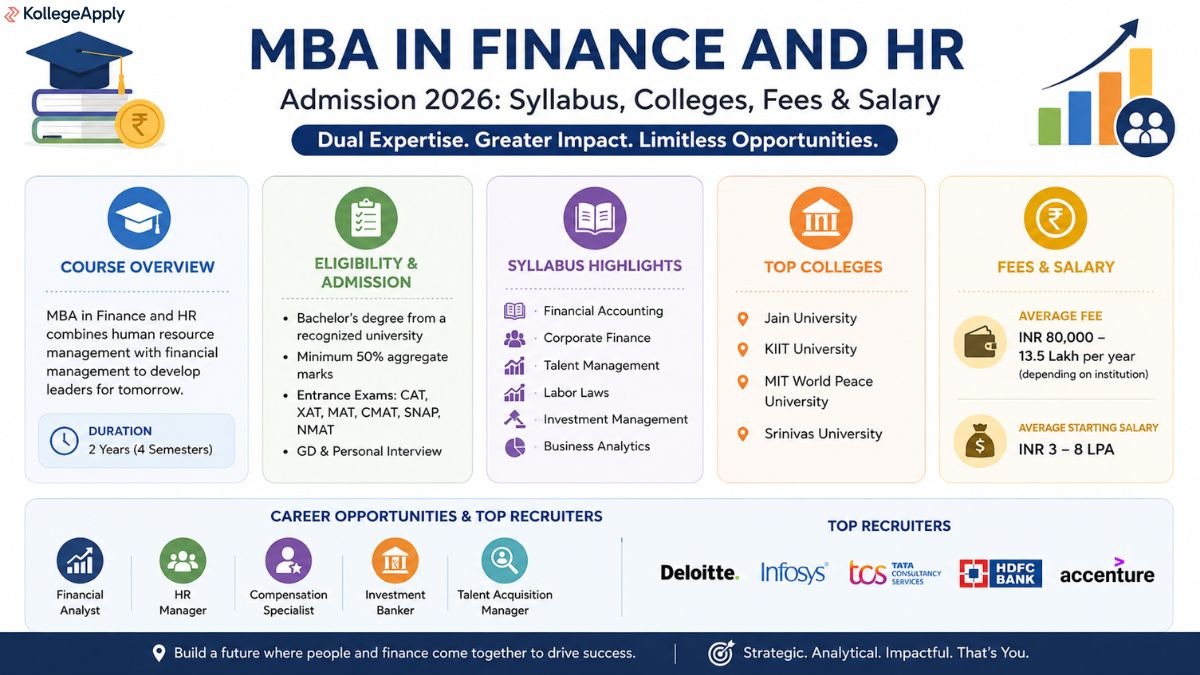
MBA in Finance and HR is a specialized postgraduate management program that combines human resource management with financial management principles. The course is designed for students who want to develop expertise in workforce management, organizational behavior, financial planning, compensation management, and strategic business decision-making.
Candidates seeking admission to MBA HR and Finance must generally hold a bachelor’s degree from a recognized university with at least 50% aggregate marks. Admission is usually based on entrance exams such as CAT, XAT, MAT, CMAT, SNAP, and NMAT, followed by Group Discussion and Personal Interview rounds.
The MBA graduates in the finance & HR field can explore diverse career options in the IT, consulting, or banking sectors. Some job roles that these graduates can pursue include Finance Manager, HR Manager, Compensation Analyst, Talent Acquisition Specialist, and Financial Analyst. The average starting package ranges between INR 3 - INR 10 LPA.
- MBA in Finance and HR Course Highlights
- What is MBA in Finance and HR?
- Why Study MBA in Finance and HR?
- Is MBA in Finance and HR Worth It in 2026?
- What is the MBA in Finance and HR Eligibility?
- MBA in Finance and HR Entrance Exam
- MBA in Finance and HR Colleges in India
- MBA in Finance and HR Fees
- MBA in Finance and HR Admission Process
- MBA in Finance and HR Syllabus
- What skills are required for an MBA in Finance and HR?
- MBA in Finance and HR Career Scope
- What is the salary after MBA in Finance and HR?
- Top Recruiters for MBA in Finance and HR
- MBA in Finance and HR Vs MBA Marketing
- MBA in Finance and HR Future Prospects
- Higher Studies After MBA Finance and HR
- MBA in Finance and HR FAQs
MBA in Finance and HR Course Highlights
An MBA in Finance and HR provides students with managerial expertise in both employee management and financial operations. The course develops leadership qualities along with analytical and strategic business skills required in modern organizations. The table below shows the Master of Business Management in Finance and HR course details:
What is MBA in Finance and HR?
An MBA in Finance and HR is a dual-specialization management course that blends human resource management with financial management. The program focuses on developing professionals who can efficiently manage organizational talent while also understanding financial operations and business profitability.
The MBA in Finance and HR syllabus includes subjects such as Financial Accounting, Corporate Finance, Talent Management, Human Resource Planning, Organizational Development, Investment Management, Labor Laws, Performance Management, and Business Analytics. The combination can be useful for students interested in cross-functional management roles. However, it should not be assumed that every institution offers the same curriculum or gives equal depth to both specialisations. Some universities offer a formally named Finance and HR dual specialisation, while others allow students to select Finance and HR within a broader MBA structure.
The course provides strong industry exposure through internships, live projects, business simulations, seminars, and corporate training sessions. Students learn practical business applications and develop problem-solving abilities that are highly valued across industries.
Also read about MBA Finance
Why Study MBA in Finance and HR?
Pursuing an MBA in Finance and HR offers strong career opportunities across various industries by combining expertise in people management and financial decision-making. This dual specialization helps students develop leadership, analytical, and strategic management skills that are highly valued in the corporate sector. Some of the major reasons to pursue this course are listed below:
- High Career Demand: Companies prefer professionals who can manage both employee-related tasks and financial planning, helping businesses operate more efficiently.
- Growing Industry Opportunities: As businesses expand globally, the need for experts in HR and Finance continues to rise, creating stable job opportunities.
- Balanced Skill Development: This course helps students build strong communication and people-management skills along with financial and analytical abilities.
- Better Salary Potential: Knowledge of both HR and Finance increases career value and can lead to higher salary packages.
- Strong Leadership Opportunities: Graduates can move toward senior roles such as HR Head, Finance Manager, CFO, or CHRO because of their broad business understanding.
- Support for Entrepreneurship: The program provides knowledge of finance, legal compliance, and team management, which is useful for starting and managing a business.
Is MBA in Finance and HR Worth It in 2026?
Yes, an MBA in Finance and HR is worth considering in 2026 for students who want stable career growth, diverse job opportunities, and long-term managerial exposure. The specialization is becoming increasingly relevant as companies adopt data-driven HR practices, financial automation, and integrated business management systems.
In 2026, organizations are not only hiring specialists but also professionals who understand how workforce strategies affect overall business performance and profitability. This makes the dual specialization valuable for industries that require both operational efficiency and employee management.
- Relevant in the AI and Automation Era: Companies are using AI-based recruitment systems, HR analytics, automated payroll software, and fintech tools, increasing demand for professionals familiar with modern business technologies.
- Useful Across Multiple Industries: The degree remains valuable in sectors such as banking, consulting, IT, healthcare, retail, e-commerce, manufacturing, and corporate services.
- Good Career Stability: HR and finance are essential functions in every organization, which provides consistent job opportunities even during changing market conditions.
- Opportunity to Work in Strategic Roles: Graduates can contribute to budgeting, employee planning, organizational development, compensation strategy, and business operations management.
- Helpful for Career Switching: The dual specialization allows professionals to move between HR-focused and finance-focused roles depending on industry demand and personal interests.
- Valuable for Future Leadership Roles: Understanding both employee management and financial performance helps professionals prepare for senior-level managerial positions in the future.
- Industry-Oriented Skill Development: The course supports practical learning through case studies, internships, analytics tools, and business strategy projects that improve employability in 2026.
What is the MBA in Finance and HR Eligibility?
Candidates seeking admission to an Finance and HR MBA must meet the eligibility criteria prescribed by universities and business schools. These requirements generally include educational qualifications, minimum marks, and valid entrance exam scores for the admission process. The eligibility criteria are as follows:
- Minimum Qualification: Candidates must hold a bachelor's degree in any discipline (such as BBA, B.Com, B.Tech, or BA) from a recognized university or educational board.
- Required Marks: A minimum of 50% aggregate marks or equivalent CGPA is mandatory at the graduation level for general category applicants.
- Relaxation Criteria: A relaxation of 5% is granted to candidates belonging to reserved categories (SC/ST/PwD), bringing their minimum requirement to 45%.
- Entrance Exams: Applicants must clear national, state, or university-level management entrance examinations with valid percentile scores to qualify for subsequent evaluation rounds.
- Age Limit: There is no official upper age restriction enforced for pursuing a full-time, regular dual specialization MBA program.
Note: Candidates should not assume that a 50% graduation requirement or a particular entrance exam applies to every Finance and HR MBA. The official admission notification of the institution should be treated as the final eligibility source.
MBA in Finance and HR Entrance Exam
Admission to MBA in Finance and Human Resource Management programs is generally based on national, state, or university-level entrance exams. For the 2026 admission cycle, XAT 2027 registration opened on July 15, 2026 and is scheduled to close on December 6, 2026, with the examination scheduled for January 3, 2027. AIMA's September 2026 MAT cycle has a September 13 PBT test and September 20 CBT test. Dates can change, so candidates should verify the official examination portal before applying. The table below highlights the major entrance exams accepted by universities and business schools across India for MBA admissions:
MBA in Finance and HR Colleges in India
Students looking for an MBA in Finance and Human Resource Management can choose from universities and management institutes that offer programmes combining financial management, accounting, investment analysis, human resource management and organisational behaviour. The MBA Finance and HR fees vary significantly by institution, with total tuition costs ranging from budget-friendly options to more than INR 10 lakh at private universities. The table below lists colleges that offer relevant MBA programmes or specialisations, along with their approximate total course fees for comparison.
Note: Fees are approximate and may vary depending on the programme structure, specialisation, admission year, campus and additional charges. Students should verify the latest fee structure and the exact Finance-HR programme title on the respective university's official website before applying.
MBA in Finance and HR Fees
The total cost of an MBA Finance and HR depends heavily on the university, campus, mode of study and whether additional certification or examination charges apply. Instead of presenting one broad figure as a universal fee, aspirants should compare tuition, registration, examination, hostel and other institutional charges separately.
As a broad editorial reference, MBA Finance and HR programmes can range from lower-cost university programmes to INR 8 lakh or more, while premium private institutions and specialised programmes may charge considerably more. Online programmes may have a different fee structure from regular campus MBAs.
For example, JAIN Online currently lists its online MBA in Human Resource Management and Finance at INR 1.75 lakh for the programme, whereas its campus/regular dual-specialisation programme has a separate institutional fee structure. This demonstrates why regular and online programmes should not be combined into one fee figure.
MBA in Finance and HR Admission Process
Admission to MBA in Finance and Human Resource Management programs is conducted through either merit-based or entrance-based selection processes. The general admission process followed by colleges through entrance exams is outlined below:
- Step 1: Entrance Exam Registration - Candidates must sign up and appear for relevant national tests like CAT, XAT, or SNAP by filling out forms on their respective official websites.
- Step 2: Application Form Filling - After entrance test results are announced, applicants must fill out individual admission forms for their preferred business schools, listing their dual specialization preferences.
- Step 3: Shortlisting - Business schools screen profiles based on entrance exam cut-off scores, academic records, and relevant work experience.
- Step 4: GD/PI Rounds - Shortlisted candidates are invited to participate in Group Discussions (GD), Written Ability Tests (WAT), and rigorous Personal Interviews (PI).
- Step 5: Merit List - Cumulative scores from entrance exams, GD/PI performance, academic history, and diversity factors are calculated to generate the final selection list.
- Step 6: Document Verification - Selected students must present original academic certificates, identity proofs, and experience letters for thorough verification.
- Step 7: Fee Submission - Upon verification, candidates pay the initial semester admission fees to confirm and secure their seat in the program.
Documents Required for MBA Finance and HR Admission
The exact document list varies by institution, but applicants should keep academic, identity and entrance-related documents ready before beginning the admission process. Students applying under reserved categories or special quotas may need additional certificates according to the institution's rules.
MBA in Finance and HR Syllabus
The MBA HR and Finance syllabus is designed to provide students with knowledge of financial management, employee relations, organizational behaviour, business strategy, and corporate operations. The curriculum includes subjects related to accounting, financial planning, recruitment, compensation management, labour laws, marketing, and leadership development. Along with theoretical learning, students also gain practical exposure through internships, case studies, presentations, and industry projects. The semester-wise syllabus followed at Jain University, Kochi is mentioned below:
What skills are required for an MBA in Finance and HR?
Students pursuing an MBA HR and Finance should possess a combination of communication, analytical, managerial, and problem-solving skills to perform effectively in corporate environments. These skills help students understand employee management, financial planning, organizational behaviour, and business operations more efficiently.
- Communication Skills: Strong verbal and written communication skills are important for professional interactions, presentations, and employee coordination.
- Leadership Skills: The ability to lead teams, manage responsibilities, and make effective decisions is essential in HR and finance roles.
- Analytical Thinking: Students should be able to analyze financial reports, business data, and organizational performance for better decision-making.
- Problem-Solving Skills: Identifying and resolving workplace, operational, and financial challenges is an important requirement in management roles.
- Team Management Skills: Managing employees, handling teamwork, and maintaining coordination within departments are crucial for organizational success.
- Financial Understanding: Basic knowledge of accounting, budgeting, financial planning, and investment concepts is beneficial for finance-related responsibilities.
- Strategic Thinking: Students should have the ability to plan long-term business strategies and contribute to organizational growth.
- Time Management Skills: Managing deadlines, multitasking, and maintaining productivity are important for handling corporate responsibilities efficiently.
- Negotiation Skills: HR and finance professionals often require negotiation abilities for conflict management, employee discussions, and business dealings.
- Technical Skills: Familiarity with HR software, payroll systems, spreadsheets, analytics tools, and financial technologies can provide an added advantage.
MBA in Finance and HR Career Scope
After completing the Master of Business Administration in Finance and HRM, graduates can explore a variety of job prospects such as Talent Acquisition Specialist, Credit Risk Manager, Financial Analyst, and much more. Some of the job roles, along with the job description, are mentioned below:
What is the salary after MBA in Finance and HR?
An MBA in Finance and HR offers strong salary prospects across industries such as banking, consulting, IT, healthcare, manufacturing, retail, and corporate services. Salary packages generally depend on factors such as job role, industry, experience level, skills, and the reputation of the business school.
Graduates entering the HR domain can expect competitive salary packages in roles related to recruitment, employee relations, compensation management, and organizational development. Similarly, finance professionals often receive attractive salaries in areas such as financial analysis, investment banking, risk management, and corporate finance.
With industry experience and advanced managerial skills, professionals in both HR and finance can move into senior leadership positions with significantly higher compensation packages. The table below provides a comparative overview of MBA in HR and MBA in Finance salary trends in India:
Note: These figures are indicative market ranges rather than guaranteed salaries. A student entering a financial analyst role at a strong business school may have a different compensation from a graduate entering HR operations at a smaller organisation.
Top Recruiters for MBA in Finance and HR
Leading companies across sectors such as banking, consulting, IT, manufacturing, healthcare, retail, and e-commerce actively recruit MBA HR Finance graduates for managerial, analytical, and leadership roles. These organizations value professionals who can effectively handle workforce management, financial planning, business operations, and strategic decision-making.
MBA in Finance and HR Vs MBA Marketing
Choosing between these programmes depends on whether a student wants specialised depth or broader exposure. MBA Finance is generally better suited to candidates interested in financial analysis and investment-related careers, while MBA HR is more suitable for students focused on people management and organisational development. Here is the comparison between the two Master of Business Administration courses, i.e, MBA in Finance & HR and MBA in Marketing. The table below highlights the difference between these two courses:
MBA in Finance and HR Future Prospects
The Master of Business Administration graduate can work as an Investment Banker, Credit Risk Manager, Talent Acquisition Specialist, etc. The other options available for an MBA Finance & HRM graduate are mentioned below:
- Entrepreneurship: Students with a Finance and HR MBA can start their consultancy firm by offering financial advisory or HR services.
- Higher Education: Eligible individuals may choose higher studies, like a PhD in Management.
- Short-term Courses: The students, after completing the MBA Finance HR, can pursue short-term courses on financial modeling, investment banking, or leadership development.
AI and Technology Skills for MBA Finance and HR in 2026
AI is changing how finance and HR teams collect, analyse and interpret business information. MBA graduates do not necessarily need to become programmers, but they should understand how AI-enabled tools can support routine analysis, reporting, forecasting and workforce decisions while recognising the importance of human oversight.
- AI-assisted financial analysis and reporting
- HR analytics and workforce dashboards
- Predictive workforce planning
- Automated recruitment workflows
- Compensation analytics
- Financial forecasting and scenario analysis
- Power BI and business intelligence
- Advanced Excel
- HR information systems
- Responsible use of generative AI in business communication and analysis
Higher Studies After MBA Finance and HR
MBA Finance and HR graduates can pursue higher education or professional certifications depending on their career objectives. Additional qualifications should complement the chosen career path rather than simply add credentials.
- PhD in Management
- Professional finance certifications
- Financial modelling and valuation courses
- HR analytics certifications
- People analytics programmes
- Business analytics certifications
- Advanced Excel and Power BI
- Professional HR certifications
- Leadership and strategic management programmes
MBA in Finance and HR FAQs
What is MBA in Finance and HR?
MBA in Finance and HR is a dual-specialization management course that combines employee management with financial planning, budgeting, and business strategy skills.
Is MBA in Finance and HR a good career option?
Yes, this course offers strong career opportunities in banking, consulting, IT, and corporate sectors.The dual specialization improves job flexibility and provides better growth opportunities in managerial roles.
What is the duration of MBA in Finance and HR?
The MBA in Finance and HR course duration is generally 2 years and is divided into 4 semesters. The program includes classroom learning, internships, industry projects, and practical business training.
What are the eligibility criteria for MBA in Finance and HR?
Candidates must complete graduation from a recognized university with at least 50% aggregate marks. They also need valid scores in entrance exams such as CAT, MAT, XAT, CMAT, or other accepted tests.
Which entrance exams are accepted for MBA in Finance and HR?
Common entrance exams accepted for MBA in Finance and HR include CAT, XAT, MAT, CMAT, SNAP, and GMAT. Some universities also conduct their own entrance examinations for MBA admissions.
What is the average salary after MBA in Finance and HR?
Fresh graduates of MBA in Finance and HR can expect average starting salaries between INR 3–8 LPA. Salary packages usually increase with experience, industry exposure, and managerial responsibilities.
Which are the top colleges for MBA in Finance and HR?
Some popular colleges offering MBA in Finance and HR include Jain University, KIIT University, and MIT-WPU. These institutions provide industry-oriented training, and placement opportunities for students.
Can I get finance jobs after MBA in Finance and HR?
Yes, graduates can pursue finance-related roles such as Financial Analyst, Finance Manager, and Credit Risk Manager. The finance specialization builds skills in investment analysis, budgeting, and financial planning.
Is work experience necessary for an MBA in Finance and HR?
No, work experience is not mandatory for admission to this program in most colleges. However, prior professional experience may provide an advantage during placements and classroom learning.
What skills are developed in MBA in Finance and HR?
Students develop communication, leadership, analytical thinking, financial planning, and employee management skills. It also improves strategic decision-making, teamwork, and organizational management abilities.