
• Updated on 5 Nov, 2026 by Himanshu Singh
What's new?
GATE Latest news and articles
Civil Engineering is one of the major disciplines covered in the Graduate Aptitude Test in Engineering (GATE). The examination tests candidates on core engineering concepts, numerical problem-solving and their understanding of subjects such as Structural Engineering, Geotechnical Engineering, Water Resources and Transportation Engineering. IIT Madras is the organising institute for GATE 2027, and candidates appearing for the Civil Engineering paper must prepare according to its revised syllabus.
The GATE Civil Engineering Syllabus 2027 covers eight sections, including Engineering Mathematics, Structural Engineering, Geotechnical Engineering, Water Resources Engineering, Environmental Engineering, Transportation Engineering, Geomatics Engineering, and Construction Materials and Management. Along with these subjects, the paper includes General Aptitude. Candidates can check the complete GATE syllabus for Civil Engineering, subject-wise topics, expected chapter-wise weightage, exam pattern and important preparation details below.
Table of Contents
GATE Civil Engineering Subject-Wise Topics
The Civil Engineering GATE syllabus is divided into eight sections covering mathematical foundations and major areas of civil engineering. Candidates should review the topics under each subject to understand the scope of the examination and prepare a subject-wise study plan.
1. Engineering Mathematics
Engineering Mathematics covers mathematical concepts used in different areas of Civil Engineering. The section includes Linear Algebra, Calculus, Ordinary and Partial Differential Equations, Probability and Statistics, and Numerical Methods.
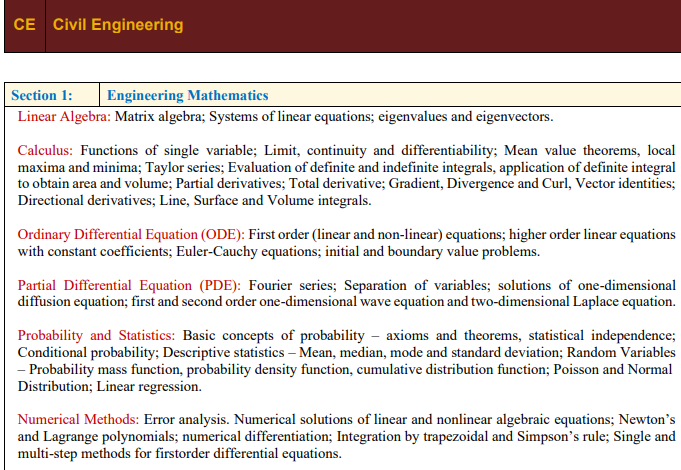
Source: The image has been sourced from the official GATE CE Syllabus.
2. Structural Engineering
Structural Engineering focuses on the analysis, behaviour and design of structures. It covers Engineering Mechanics, Solid Mechanics, Structural Analysis, Concrete Structures and Steel Structures.
3. Geotechnical Engineering
Geotechnical Engineering covers soil mechanics, subsurface investigations, earth pressure, slope stability and foundation design. Candidates should understand soil properties and the principles used in analysing different types of foundations.
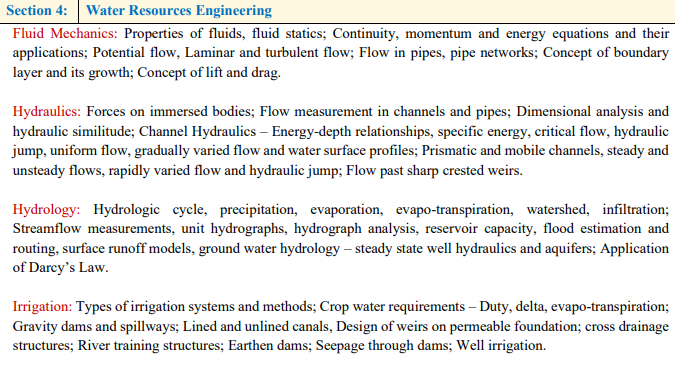
4. Water Resources Engineering
Water Resources Engineering includes Fluid Mechanics, Hydraulics, Hydrology and Irrigation. These subjects cover fluid behaviour, water flow, groundwater systems, irrigation methods and hydraulic structures.
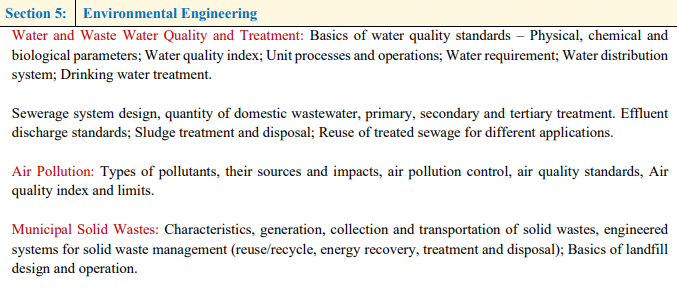
5. Environmental Engineering
Environmental Engineering focuses on water and wastewater treatment, air pollution control and municipal solid waste management.
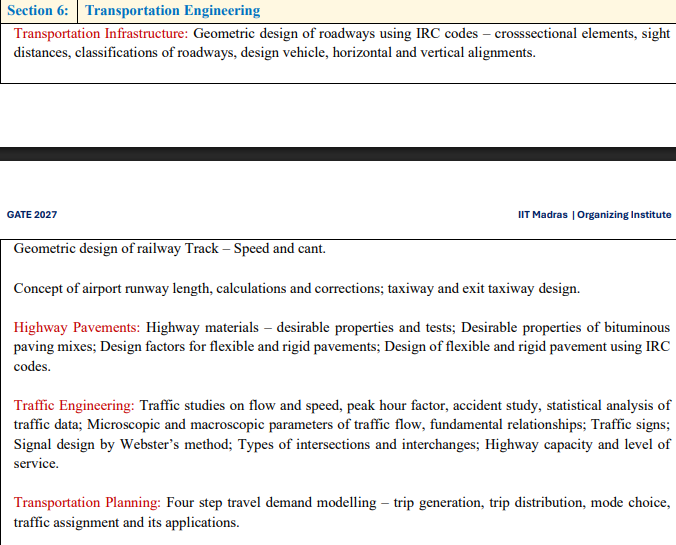
6. Transportation Engineering
Transportation Engineering covers the planning, design and management of roadways, railway tracks, airports and traffic systems.
7. Geomatics Engineering
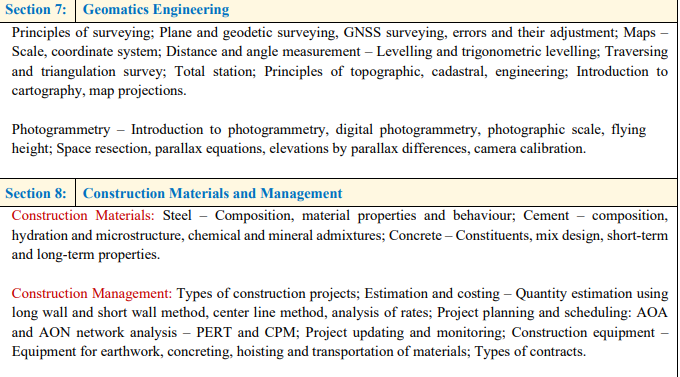
Geomatics Engineering covers surveying, mapping, measurement techniques and photogrammetry. Candidates should prepare the following topics:
8. Construction Materials and Management
Construction Materials and Management covers the properties of construction materials, estimation, costing, project planning and construction equipment.
GATE Civil Engineering Exam Pattern
Candidates should understand the GATE exam pattern along with the CE syllabus. The examination is conducted in Computer-Based Test (CBT) mode for three hours. The paper includes 65 questions carrying a total of 100 marks.
GATE Civil Engineering Marks Distribution
The GATE Civil Engineering paper carries 100 marks. General Aptitude accounts for 15 marks, while the remaining 85 marks are allocated to Engineering Mathematics and core Civil Engineering subjects.
Note: Engineering Mathematics and core subject weightage figures are indicative estimates based on available preparation references. They are not fixed official allocations, and the actual distribution may vary across question papers.
Is GATE Civil Engineering Syllabus Tough?
The GATE Civil Engineering syllabus is extensive because it covers eight major technical sections along with General Aptitude. Subjects such as Structural Engineering, Geotechnical Engineering, Water Resources Engineering and Transportation Engineering require a clear understanding of concepts, numerical methods and engineering applications.
However, the difficulty of the GATE Civil Engineering exam depends on a candidate's conceptual understanding and preparation strategy. Candidates who follow the revised syllabus, practise numerical questions and revise regularly can manage the syllabus systematically.
Preparation Tips for GATE Civil Engineering
- Understand the complete syllabus: Divide all eight sections into smaller topics and prepare a subject-wise study schedule.
- Build conceptual clarity: Focus on fundamental concepts in Structural Engineering, Soil Mechanics, Fluid Mechanics and Engineering Mathematics.
- Practise numerical questions: Solve problems regularly to improve calculation speed and accuracy.
- Use previous-year papers: Practise previous-year Civil Engineering GATE papers to understand question patterns and identify recurring concepts.
- Prepare revision notes: Maintain short notes and formula sheets for quick revision.
- Take mock tests: Attempt full-length tests to evaluate preparation, identify weak areas and improve time management.
Candidates can also refer to standard GATE Civil Engineering books, subject-wise study material and reliable Civil Engineering GATE notes to support their preparation.
GATE Civil Engineering Syllabus 2027 FAQs
How many sections are there in the GATE Civil Engineering syllabus 2027?
The GATE Civil Engineering syllabus has 8 sections, covering Engineering Mathematics and 7 core Civil Engineering areas.
What is the paper code for GATE Civil Engineering?
The GATE Civil Engineering paper code is CE.
Who is conducting the GATE Civil Engineering exam 2027?
IIT Madras is the organising institute for the GATE Civil Engineering exam 2027.
Is the GATE Civil Engineering syllabus tough?
The GATE Civil Engineering syllabus is extensive, but regular practice, revision and conceptual clarity can make preparation manageable.
What is the weightage of General Aptitude in GATE CE?
General Aptitude carries 15 marks, accounting for 15% of the GATE Civil Engineering paper.
What is the expected weightage of Engineering Mathematics?
Engineering Mathematics has an estimated weightage of 10%–15% in the GATE Civil Engineering paper.
How many questions are asked in the GATE Civil Engineering exam?
The GATE Civil Engineering exam has 65 questions carrying a total of 100 marks.
What is the duration of the GATE Civil Engineering exam?
The GATE Civil Engineering exam is conducted for 3 hours in CBT mode.
Which subjects are included in the GATE Civil Engineering syllabus?
The syllabus includes Structural, Geotechnical, Water Resources, Environmental, Transportation and Geomatics Engineering, Mathematics, and Construction Management.
How can I prepare for the GATE Civil Engineering exam?
Follow the GATE Civil Engineering syllabus, practise numerical questions, solve previous-year papers and attempt mock tests regularly.
Where can I find GATE Civil Engineering books and notes?
Candidates can refer to standard GATE Civil Engineering books, subject-wise notes and previous-year papers for preparation.
Where can I download the GATE Civil Engineering syllabus PDF?
Candidates can download the official GATE Civil Engineering syllabus PDF from gate2027.iitm.ac.in.
Exam Calendar
Explore exam calendars tailored to your interest
Question Papers
Browse previous year papers by subject