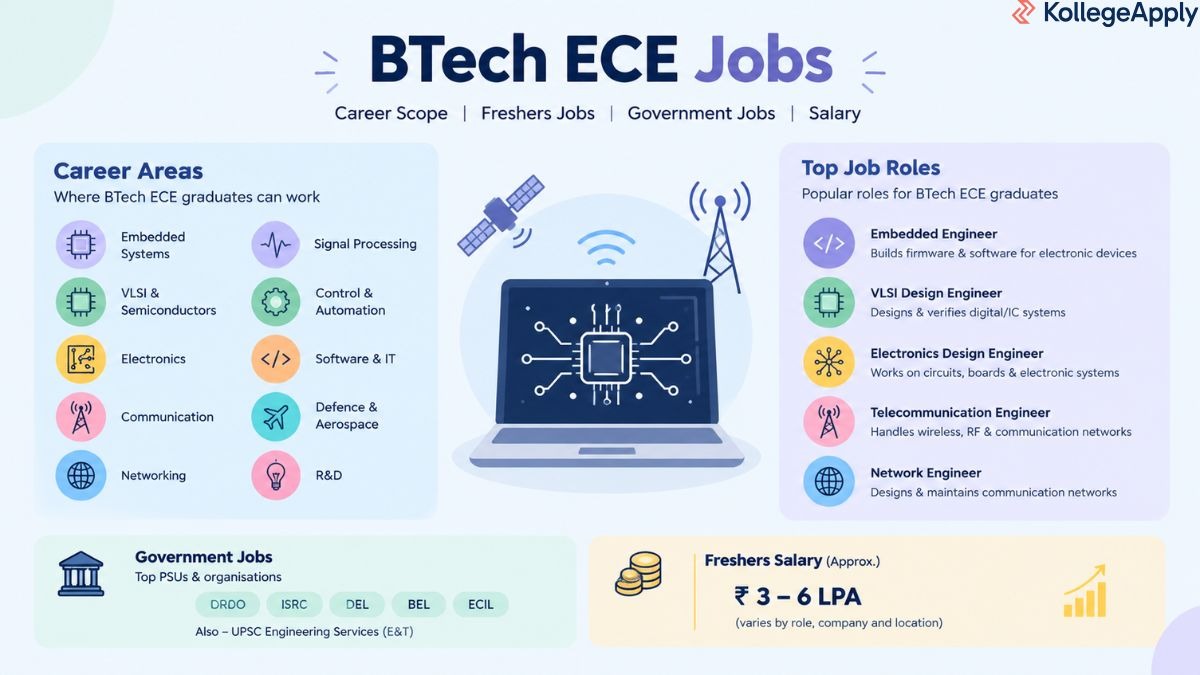
BTech ECE Jobs cover a wide range of technical careers because Electronics and Communication Engineering combines electronic circuits, communication systems, embedded systems, microprocessors, signal processing, networking and related computing skills. Graduates can work in semiconductor design, embedded development, telecommunications, electronics manufacturing, testing, automation, networking, defence, aerospace and software-related roles. The career options therefore extend beyond a single job profile or industry.
The career scope of BTech ECE also includes government and public-sector opportunities. Organisations such as ISRO, DRDO, BEL and ECIL have recruited engineers in electronics or Electronics and Communication-related disciplines, while the UPSC Engineering Services Examination includes Electronics and Telecommunication Engineering. In the private sector, semiconductor and technology companies recruit for areas such as VLSI, RTL design, verification, embedded systems, firmware and hardware engineering.
- BTech ECE Jobs: Career Scope After Electronics and Communication Engineering
- Top Job Roles After BTech ECE
- BTech ECE Jobs for Freshers
- Skills Required for BTech ECE Jobs
- Electronics and Communication Engineering Jobs Companies
- BTech ECE Jobs Near Gurugram, Haryana
- Jobs for BTech ECE Freshers in Delhi NCR
- List of Government Jobs for ECE Engineers
- Jobs for Electronics and Communication Engineers in Government Sector
- BTech ECE Government Job Salary
- BTech ECE Jobs Salary in India
- Career Growth After BTech ECE
- What is the Scope of B.Tech in Electronics and Communication?
- FAQs on BTech ECE Jobs
BTech ECE Jobs: Career Scope After Electronics and Communication Engineering
The BTech ECE curriculum provides a foundation in electronics, communication systems, microprocessors and microcontrollers, digital signal processing, VLSI, wireless communication and embedded systems. These areas correspond directly with several technical job families. The existing BTech ECE course structure also identifies roles such as Embedded Developer, Network Planning Engineer, Telecommunication Engineer, Control Systems Engineer, Signal Processing Engineer and VLSI Design Engineer.
Top Job Roles After BTech ECE
ECE graduates can choose a role according to their preferred technical specialisation. Students interested in hardware and circuits can move towards electronics design and testing, while those interested in programming can build careers in embedded software, firmware or software engineering. Students interested in communication can pursue telecom, RF and networking roles. Semiconductor-focused students can specialise in VLSI design, verification, physical design or related areas.
- Embedded Engineer: Embedded engineers develop software and firmware that operate electronic devices and hardware systems. Knowledge of C/C++, microcontrollers, RTOS, embedded Linux, communication protocols and debugging is useful for this career. Current industry postings demonstrate the connection between embedded engineering and communication technologies such as Cellular, BLE and Wi-Fi.
- VLSI Design Engineer: VLSI is one of the most specialised career paths for ECE graduates. The work can include RTL design, verification, synthesis, timing analysis, physical design and semiconductor development. Electronics graduates with strong digital electronics, Verilog/SystemVerilog, computer architecture and semiconductor fundamentals can build careers in this area.
- Electronics Design Engineer: Electronics design engineers work on circuits, components, boards and electronic systems. Their responsibilities can include circuit design, simulation, prototyping, testing and troubleshooting. Strong knowledge of analog and digital electronics, PCB design, instrumentation and laboratory equipment is useful.
- Telecommunication Engineer: Telecommunication engineers work with communication infrastructure and technologies used for voice, data and wireless connectivity. Career areas can include network planning, RF engineering, transmission, wireless communication and network optimisation.
- Network Engineer: ECE graduates can also enter networking and infrastructure roles, particularly after developing knowledge of computer networks, routing, switching, wireless communication and network security. Current job descriptions show that Electronics & Communication graduates can be eligible for network-related engineering roles.
- Signal Processing Engineer: Signal processing engineers work on the analysis, transformation and interpretation of digital signals. This career can be relevant to communication systems, radar, audio, image processing, wireless systems and defence technologies.
- Control Systems and Automation Engineer: ECE graduates with knowledge of control systems, sensors, instrumentation and programming can work in automation and industrial control. These roles involve monitoring systems, controllers, sensors and automated processes.
BTech ECE Jobs for Freshers
Freshers can apply for entry-level roles such as Graduate Engineer Trainee, Junior Electronics Engineer, Embedded Engineer, Test Engineer, Associate Engineer, VLSI/Verification Trainee, Network Engineer and Technical Support Engineer. The exact eligibility varies by employer, and core electronics companies may expect stronger knowledge of circuits, digital electronics, programming or VLSI than general IT-service roles.
For btech ece fresher jobs, candidates should not limit their search to the exact title “ECE Engineer”. Employers may list openings under Electronics Engineer, Embedded Engineer, Hardware Engineer, Graduate Engineer Trainee, Design Engineer, Verification Engineer, Application Engineer or Software Engineer. Government organisations also use specific designations such as Scientist/Engineer or Graduate Engineer Trainee.
Skills Required for BTech ECE Jobs
Employers generally evaluate both core engineering knowledge and practical skills. A student targeting electronics or semiconductor jobs should strengthen subjects such as digital electronics, analog circuits, microprocessors, communication systems, signals and systems, control systems and VLSI. Programming is also valuable because embedded and hardware-oriented roles increasingly involve software, scripting and automation.
Electronics and Communication Engineering Jobs Companies
ECE graduates can find opportunities across semiconductor, electronics, telecom, IT, automation, aerospace and defence companies. The company list should not be treated as a fixed placement list because hiring changes by location, project requirements and recruitment cycle.
Current official career information provides examples of the types of opportunities available. STMicroelectronics has listed semiconductor engineering positions in Greater Noida, including RTL design and analog-related roles. Renesas has engineering positions in Noida involving SoC design, verification and semiconductor technologies. Capgemini has also advertised embedded firmware engineering work in Gurgaon involving microcontrollers, RTOS, embedded Linux and wireless protocols.
BTech ECE Jobs Near Gurugram, Haryana
Students searching for BTech ECE Jobs near Gurugram, Haryana can consider the wider Delhi-NCR technology and engineering market rather than restricting the search to Gurugram city. Gurugram has engineering and technology employers where ECE skills can be relevant to embedded systems, product engineering, automation, networking, technical support and software-oriented positions.
For example, Capgemini has advertised an Embedded Firmware Development position in Gurgaon requiring knowledge of microcontrollers, RTOS, embedded Linux, C/Python and communication protocols. Such roles demonstrate how ECE graduates with programming and embedded skills can access engineering-service opportunities in Gurugram.
Jobs for BTech ECE Freshers in Delhi NCR
Delhi NCR provides opportunities across electronics, semiconductor, IT services, networking, telecom, defence-related organisations and engineering services. For freshers, Noida and Greater Noida are particularly relevant for semiconductor and electronics-related searches, while Gurugram has opportunities across technology, engineering services and embedded applications.
STMicroelectronics currently lists multiple engineering positions in Greater Noida, including RTL design, digital verification and other semiconductor-related roles. Renesas also has engineering roles in Noida covering SoC and semiconductor development. These examples show that Delhi NCR can offer specialised electronics careers, although individual vacancies and experience requirements change frequently.
ECE Jobs for Freshers in Noida
For ece jobs for freshers in Noida, students can target semiconductor, VLSI, verification, electronics testing, networking, embedded and software-engineering openings. Candidates seeking core roles should prioritise companies whose job descriptions specifically accept Electronics, Electrical, ECE or related engineering degrees.
A useful strategy is to search company career pages for terms such as Electronics, VLSI, RTL, Verification, Embedded, Firmware, Hardware, SoC and Graduate Engineer Trainee.
List of Government Jobs for ECE Engineers
Government employment is an important career pathway for ECE graduates. However, eligibility depends on the individual recruitment notification, so candidates should always verify the accepted branch, degree, percentage, age and examination requirements before applying.
ISRO's career information specifically identifies Scientist/Engineer opportunities for graduates in Electronics, Mechanical, Computer Science and other engineering disciplines. Its 2026 recruitment pages also show Scientist/Engineer recruitment involving Electronics.
DRDO's Recruitment and Assessment Centre lists Electronics and Communication Engineering among the disciplines relevant to its scientific positions. DRDO's Scientist 'B' recruitment has also accepted graduate engineers, with the post placed at Level 10 of the 7th CPC pay matrix.
Jobs for Electronics and Communication Engineers in Government Sector
Among the jobs for electronics and communication engineers in govt sector, scientific and engineering positions in space, defence, strategic electronics and public-sector organisations are particularly relevant. ISRO has recruited Scientist/Engineer 'SC' in Electronics, while DRDO recognises Electronics and Communication Engineering as a relevant scientific discipline.
UPSC's Engineering Services Examination is another major route. The 2026 Engineering Services examination included a dedicated Electronics and Telecommunication Engineering paper at both the preliminary and main stages.
BEL and ECIL are also relevant organisations for ECE graduates. BEL's official recruitment portal publishes engineering vacancies and results, while ECIL's Graduate Engineer Trainee recruitment has specifically included Electronics & Tele-Communication as a discipline.
BTech ECE Government Job Salary
Government engineering positions can offer structured pay scales and career progression. ISRO's recruitment documentation lists Scientist/Engineer-SC at Level 10 with a pay matrix of INR 56,100–1,77,500. DRDO lists Scientist-B at Level 10 with an initial pay of INR 56,100, along with allowances and a merit-based promotion structure.
ECIL's 2025 Graduate Engineer Trainee recruitment included 34 Electronics & Tele-Communication vacancies and specified the INR 40,000–1,40,000 pay scale.
For a detailed breakdown of BTech ECE salary by experience, job role, sector and career path, check the BTech ECE Salary article.
BTech ECE Jobs Salary in India
There is no single salary for BTech ECE graduates because compensation varies substantially by role, company, location, technical specialisation and experience. Core semiconductor, VLSI and specialised embedded roles may follow a different compensation structure from general engineering, telecom operations or IT-service roles.
For freshers, the more useful approach is to compare job functions rather than relying on one average salary figure. Candidates should evaluate fixed pay, variable pay, location, role responsibilities, training, technology exposure and career progression before accepting an offer.
Career Growth After BTech ECE
Career progression in ECE depends strongly on technical specialisation. An entry-level engineer may progress to senior engineer, technical lead, architect, engineering manager or specialist R&D positions after gaining experience. In semiconductor companies, engineers can progress through design, verification, physical design, architecture and technical leadership tracks.
Government organisations offer structured career progression as well. DRDO states that its scientists follow a merit-based Flexible Complementing Scheme, while ISRO provides a defined career-progression framework for Department of Space employees.
Higher education can also improve specialisation. Graduates can pursue MTech/MS programmes in VLSI, embedded systems, communication engineering, signal processing, microelectronics, RF and related areas. GATE can be relevant for postgraduate admission and is also used in some government recruitment processes when specified in the notification.
What is the Scope of B.Tech in Electronics and Communication?
The scope of B.Tech in Electronics and Communication remains broad because ECE skills apply across electronics, semiconductor manufacturing, embedded systems, wireless communication, networking, defence, aerospace, automation and software. The course's combination of electronics and communication fundamentals also allows graduates to specialise after graduation rather than being restricted to one job category.
The strongest career opportunities generally favour graduates who combine core ECE knowledge with practical skills. For example, an ECE graduate with digital electronics plus Verilog can target VLSI; ECE plus C/C++ and microcontrollers can support embedded careers; and ECE plus networking can support telecom and network roles.
FAQs on BTech ECE Jobs
What are the job opportunities after BTech ECE?
ECE graduates can work in embedded systems, VLSI, electronics, telecom, networking, signal processing, software, automation, defence and R&D.
Is ECE a high paying job?
ECE can be high paying in specialised areas such as VLSI, semiconductors, embedded systems, software and advanced R&D, especially with experience.
Is ECE or CSE better?
CSE suits software-focused careers, while ECE offers electronics, communication, embedded, semiconductor and software career options.
Is ECE has good placement?
Yes, ECE has placement opportunities in core and non-core sectors, but outcomes depend on the college, employer, role and student's skills.
Which government job is best for Electronics and Communication Engineering?
ISRO, DRDO, UPSC Engineering Services, BEL and ECIL are important government-sector pathways for eligible ECE graduates.
Which ECE job has the highest salary?
Specialised VLSI, semiconductor, embedded, software and senior R&D roles can offer high salaries depending on skills and experience.
What is the scope of B.Tech in electronics and communication?
ECE offers careers in semiconductors, electronics, telecom, embedded systems, VLSI, networking, defence, aerospace, automation and software.
Can ECE freshers get jobs in Noida?
Yes, Noida and Greater Noida have opportunities in semiconductors, VLSI, networking, electronics and technology services.
Can ECE graduates get government jobs?
Yes, ECE graduates can apply for eligible engineering and scientific posts in organisations such as ISRO, DRDO, BEL and ECIL.
What skills should ECE freshers learn?
Learn C/C++, digital electronics and one specialisation such as embedded systems, VLSI, networking, telecom or electronics design.