BTech ECE colleges in India include centrally funded institutes, state government engineering colleges and private universities offering undergraduate programmes in Electronics and Communication Engineering. Students can compare institutes such as IIT Roorkee, NIT Tiruchirappalli, DTU, VIT and Manipal Institute of Technology based on academic facilities, admission criteria, specialisations and course fees. The availability of ECE programmes and their admission requirements varies by institution.
For students shortlisting BTech in ECE colleges, factors such as entrance exam cutoffs, tuition fees, laboratory infrastructure, research opportunities and placement prospects can help identify suitable options. Admission is generally based on JEE Main, JEE Advanced, state-level entrance examinations or university-specific selection processes. Comparing government and private colleges alongside regional options in Chennai, Kerala, Kolkata, Coimbatore, Bengaluru, Delhi and Dehradun can help students make an informed college choice.
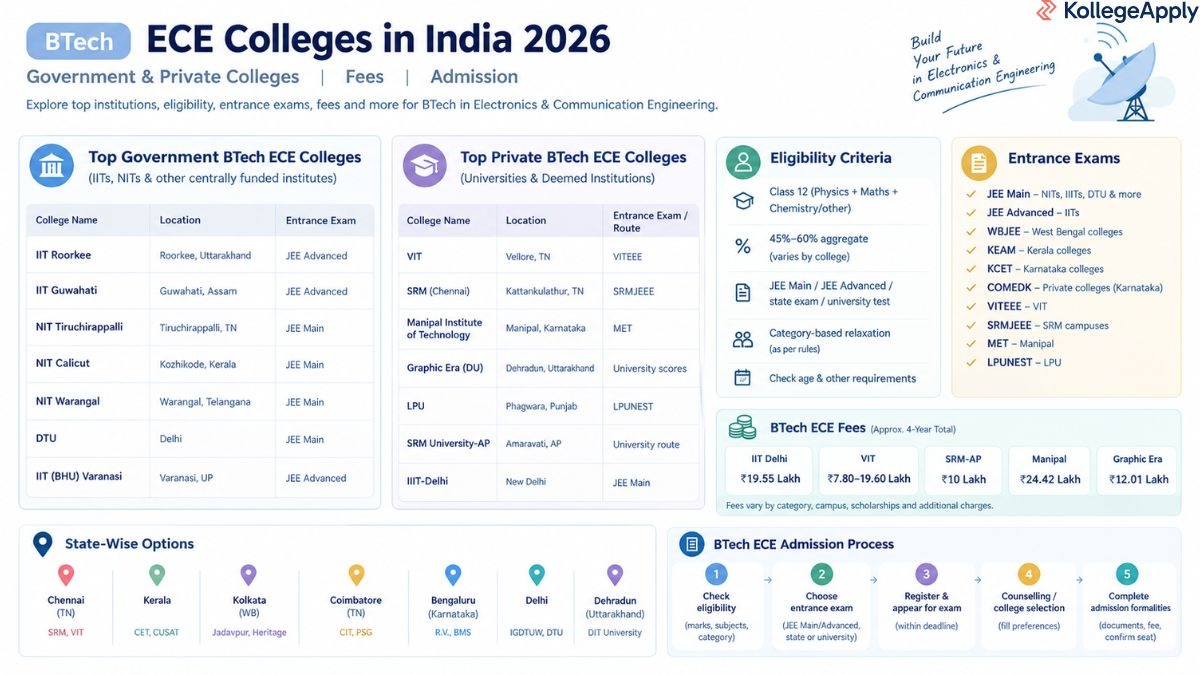
Table of Contents
Top Government and Private BTech ECE Colleges in India
The best BTech ECE colleges should be compared on the basis of their curriculum, laboratory facilities, entrance requirements, research opportunities, industry exposure and total course fees. Government institutes such as IITs and NITs generally admit students through national-level entrance examinations, while private universities may use university-specific tests or other accepted scores. The tables below distinguish government institutions from private colleges and include regional options for students comparing Electronics and Communication Engineering colleges in Delhi, Chennai, Kerala, Kolkata and other cities.
Government BTech ECE Colleges in India
Government engineering colleges are popular among students seeking established engineering departments, research facilities and competitive admission routes. IITs primarily use JEE Advanced scores, while NITs and several other centrally funded institutions accept JEE Main scores through their applicable counselling systems. Students should check the exact branch name, seat availability and category-wise cutoffs before filling in their preferences.
Note: IIT and NIT programmes may have different official branch names, including Electronics and Communication Engineering, Electronics and Communication, or Electronics and Electrical Communication Engineering. Confirm the specific programme in the current admission brochure before applying.
Private BTech ECE Colleges in India
Private institutions offer BTech ECE programmes with different specialisations, including VLSI design, embedded systems, communication networks and the Internet of Things. Their admission processes may involve university-level entrance tests, JEE Main scores or qualifying examination marks, depending on the institution. Students should compare specialisation availability and the complete four-year fee, rather than selecting a college on annual tuition alone.
State-Wise BTech ECE Colleges
Students searching for BTech ECE colleges in Chennai, Kerala, Kolkata, Coimbatore, Bangalore, Delhi and Dehradun can shortlist institutions by location before comparing fees and entrance requirements. The following regional options add to the national lists above without repeating the same colleges. Check the current programme title carefully before applying:
BTech ECE Eligibility Criteria
Students applying to BTech ECE colleges in India must meet the academic and admission requirements prescribed by the institute. Most colleges require Class 12 or an equivalent qualification with Physics and Mathematics, along with Chemistry or another accepted third subject. The minimum marks requirement, subject combinations and entrance examination rules differ across institutions. Reserved-category candidates may receive relaxation where applicable under the relevant admission policy. The following criteria provide a general overview; the individual college's 2026 admission brochure takes precedence.
- Educational qualification: Class 12 or equivalent from a recognised board.
- Required subjects: Physics and Mathematics, with the additional subjects specified by the institution.
- Minimum marks: Commonly 45%–60% aggregate, depending on the college and admission route.
- Entrance examination: Candidates may need to qualify through JEE Main, JEE Advanced, a state entrance test or a university-level examination.
- Reservation and relaxation: Category-based relaxation may apply according to government regulations and the institution's admission rules.
- Age requirements: Any applicable age or other eligibility conditions must be checked in the relevant examination or counselling brochure.
BTech ECE Admission Process
The admission process for BTech ECE colleges in India varies depending on the institution, entrance examination and applicable counselling rules. While IITs admit students through JEE Advanced, NITs and several other government engineering colleges consider JEE Main scores. State engineering colleges may use examinations such as WBJEE, KEAM or KCET, whereas private universities may accept national-level scores or conduct their own entrance tests. Some institutions also offer admission based on Class 12 merit, subject to their eligibility requirements. Students can follow these steps to complete the admission process:
- Check eligibility: Review the college's Class 12 subject requirements, minimum aggregate marks and any applicable category-based relaxation.
- Choose the entrance examination: Identify the examination accepted by the preferred colleges, such as JEE Main, JEE Advanced, a state-level test or a university entrance examination.
- Complete registration and appear for the exam: Submit the application within the prescribed deadline, pay the examination fee and appear for the test, where applicable.
- Participate in counselling or college selection: Register for the relevant counselling process, fill in college and branch preferences, or follow the university's direct admission procedure.
- Complete admission formalities: After seat allotment or selection, submit the required academic and identity documents, pay the prescribed admission fee and confirm the allotted seat.
Entrance Exams Accepted by BTech ECE Colleges
There are multiple entrance exams to get admission in BTech courses. Not every college accepts every examination listed above. For example, qualifying JEE Main alone does not provide admission to an IIT; candidates must also qualify for JEE Advanced and participate in the applicable counselling process.
BTech ECE Colleges Fees in India
The fees for BTech ECE colleges depend on the institution, campus, admission category, scholarships and additional charges. Government engineering colleges often have lower tuition costs than private universities, although the final amount also depends on the student's category and applicable fee waivers. The following table uses published institutional fee information and distinguishes four-year tuition totals from other charges wherever possible.
Important: These figures are based on published fee schedules available for the 2026 admission cycle. They should not be interpreted as a complete comparison of every government and private college: the applicable admission category, fee revisions, scholarships, hostel costs and other compulsory charges can affect the amount payable.
FAQs on BTech ECE Colleges
Which college is best for BTech ECE?
IIT Roorkee, NIT Tiruchirappalli, DTU, VIT and Manipal Institute of Technology are worth comparing for ECE curriculum, fees, facilities and admission requirements.
Is BTech ECE good?
Yes, BTech ECE offers career opportunities in semiconductor design, embedded systems, telecommunications, electronics manufacturing, VLSI and automation.
Is ECE better than CSE?
ECE suits students interested in electronics, chips and communication systems, while CSE focuses on software and computing. The better choice depends on career goals.
Does ECE come under BTech?
Yes, Electronics and Communication Engineering is offered as a BTech specialisation or branch, typically completed over four years and eight semesters.
What is the duration of BTech ECE?
BTech ECE colleges generally offer a four-year undergraduate programme divided into eight semesters, including theoretical subjects, laboratory work and projects.
What are the eligibility criteria for BTech ECE?
Most BTech ECE colleges require Class 12 with Physics and Mathematics, the prescribed aggregate marks and any additional subjects specified by the institution.
Which entrance exams are accepted by BTech ECE colleges?
BTech ECE colleges may accept JEE Main, JEE Advanced, WBJEE, KEAM, KCET, COMEDK UGET, VITEEE, SRMJEEE or MET, depending on the institution.
What are the fees for BTech ECE colleges in India?
BTech ECE course fees vary by college. Published examples include INR 10 lakh at SRM University-AP and INR 19.55 lakh at IIIT-Delhi for four-year tuition.
Which are the best BTech ECE colleges in Chennai?
VIT Chennai and SRM Institute of Science and Technology are options for students comparing BTech ECE colleges in Chennai based on fees and admission criteria.
What jobs can students get after BTech ECE?
Graduates from BTech ECE colleges can pursue roles such as electronics engineer, VLSI design engineer, embedded systems engineer, hardware engineer and communication engineer.