Exam logo

JEE Main Seat Matrix 2026: NITs, IIITs, GFTIs, Branch-Wise & Category-Wise Seats

Updated on 19 Jan, 2026 by Ankita Banerjee

What's new?

JEE Main Latest news and articles

JEE Main 2027: Check Exam Date, Syllabus, Pattern, Eligibility, Application Process Here

7 Sept, 2026
Read more..

NEET, JEE Admissions May Include 50% Board Exam Weightage Proposal

2 Jul, 2026
Read more..

DU BTech First Round Seat Allotment 2026 Released, Check Eligibility, Fees

25 Jun, 2026
Read more..

LIVEJEE Main 2026 Day 2 LIVE Updates: Jan 22 Coverage, Shift-wise Analysis

12 Jun, 2026
Read more..

IIT Kanpur Launches Bachelor of Cybersecurity Degree Admission Open For 2026 Session

12 Jun, 2026
Read more..

JEE Advanced 2026 Female Topper List Out, Arohi Deshpande Tops Girls

1 Jun, 2026
Read more..

LIVEJEE Main 2026 Admit Card for Session 1 Release Soon, Check Info

26 May, 2026
Read more..

LIVEJEE Main 2026 Admit Card for Session 1 Release Soon, Check Details

26 May, 2026
Read more..

JEE Main-NEET Common Entrance Exam Plan Sparks Nationwide Debate

25 May, 2026
Read more..

WBJEE 2026 Paper Analysis: Maths Tougher Than JEE Main, Paper 2 Moderate

25 May, 2026
Read more..

JEE Main Seat Matrix 2026 is an important reference for students planning admission to undergraduate engineering programmes through the JoSAA counselling process. Based on trends from previous years, JoSAA has been offering more than 60,000 engineering seats annually, with around 24,000–25,000 seats in NITs, nearly 9,500–10,000 seats in IIITs, and approximately 10,000–11,000 seats in GFTIs. The JoSAA seat matrix strictly follows the Government of India reservation policy. As per existing norms, 27% seats are reserved for OBC-NCL candidates, 15% for SC, 7.5% for ST, and 10% for EWS, while 5% horizontal reservation is applicable for PwD across all categories. For NITs, a Home State Quota is also applied, where roughly 50% of the seats are reserved for candidates belonging to the state or Union Territory in which the NIT is located, while the remaining seats are filled on an All India basis.


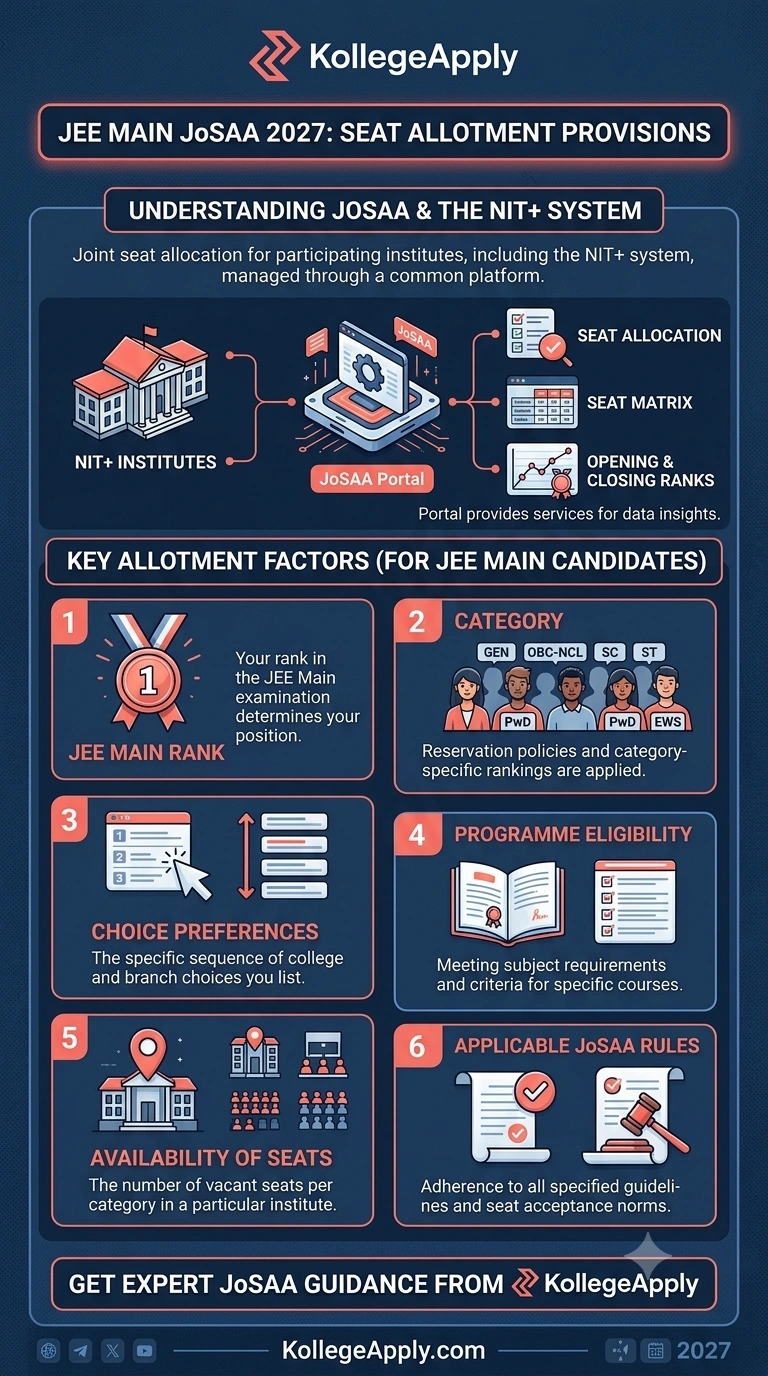
Seat allocation through JoSAA is done on the basis of the candidate’s All India Rank (AIR) in JEE Main or JEE Advanced, category rank, the preferences filled for institutes and branches, and availability of seats. The allocation is conducted over a total of 6 rounds of counselling. Candidates are advised to read the article to get complete information about JEE Main 2026 Seat Matrix.


Table of Contents
  1. JEE Main Expected Seat Matrix 2026
  2. JEE Main Category-Wise Seat Matrix (Expected)
  3. JEE Main Seat Matrix 2026: NITs, IIITs & GFTIs
  4. JEE Main Seat Matrix 2026: Reservation Policy
  5. JEE Main Seat Matrix 2026: Top Engineering Branches with Maximum Seats
  6. JEE Main Seat Matrix 2026 FAQs


JEE Main Expected Seat Matrix 2026

The JEE Main Seat Intake 2026 is likely to increase compared to previous years due to continuous expansion in engineering institutes under the JoSAA counselling system. In 2025, nearly 45,000 seats were offered through NITs, IIITs, and GFTIs together. The expected increase in seats will mainly come from high-demand branches such as Computer Science Engineering (CSE), Artificial Intelligence (AI), Data Science, and related interdisciplinary programs. However, the final and official seat matrix for JEE Main 2026 will be released by JoSAA on its official website, josaa.nic.in, before the counselling process begins. Given below is a table for the expected JEE Main seat matrix for 2026 to give students a fair idea of the likely availability of seats, helping them plan their JoSAA counselling choices in advance.

Institute Type

Seats in 2025 (Official)

Expected Seats in 2026

Reason for Expected Increase

NITs (32)

23,914

24,000

NITs added around 296 seats in 2025; an additional 150–200 seats may be introduced in 2026, mainly in high-demand branches.

IIITs (26)

9,087

10,000

IIITs saw the largest increase in 2025 due to new programs; further expansion in CSE, AI, and Data Science is expected in 2026.

GFTIs (40)

9,981

11,000

GFTIs expanded significantly in 2025; moderate seat increases may continue due to regional development and institute upgrades.

Total (NITs + IIITs + GFTIs)

42,981

45,000

Overall seat growth is expected due to continued infrastructure expansion and the introduction of new academic programs.


JEE Main Category-Wise Seat Matrix (Expected)

Under the JoSAA counselling process, all participating engineering institutes follow a fixed category-wise seat distribution as per the Government of India reservation policy. The number of seats varies depending on the institute, branch, and category, such as General, OBC-NCL, SC, ST, and EWS. While the exact figures differ across colleges, the overall distribution pattern remains similar every year. Based on previous trends, the JEE Main 2026 category-wise seat matrix is expected to be slightly higher than 2025.


JEE Main Seat Intake for NITs (Expected)

In 2025, the National Institutes of Technology (NITs) offered around 23,914 seats as per the JoSAA official data. For 2026, the total seat intake is expected to be 24,000 or more, mainly due to the introduction of new B.Tech programs and expansion in popular branches. Over the past few years, CSE seats in NITs have increased by nearly 15–20% compared to traditional branches. Around 300 new seats may be added in 2026 across various NITs.

Branch

Total Seats (Avg.)

GEN

OBC-NCL

SC

ST

EWS

CSE

150

60

40

22

11

15

ECE

120

48

32

18

9

12

Electrical

110

44

30

17

8

11

Mechanical

110

44

30

17

8

11

Civil

90

36

24

14

7

9


JEE Main Seat Intake for IIITs (Expected)

The total number of seats at IIITs increased from 8,546 in 2024 to around 9,087 in 2025. In 2026, IIIT seats are expected to cross 10,000, mainly due to rising demand for technology-focused courses. CSE and allied programs such as AI, Data Science, and IT account for nearly 40–50% of the total seats in IIITs.

Branch

Total Seats

GEN

OBC-NCL

SC

ST

EWS

CSE

180

80

49

27

13

18

AI / DS / IT

120

53

32

18

9

12

ECE

90

40

24

14

7

9


JEE Main Seat Intake for GFTIs (Expected)

In 2025, GFTIs offered nearly 9,980 seats. Since GFTIs include both centrally funded and state-supported institutes, the seat matrix can vary from one institute to another. For 2026, a moderate increase in seats is expected, especially in core engineering branches and CSE-related programs.

Branch

Total Seats (Avg.)

GEN

OBC-NCL

SC

ST

EWS

CSE

120

52

32

18

9

12

ECE

90

40

24

14

7

9

Mechanical

100

44

27

15

8

10


JEE Main Seat Matrix 2026: NITs, IIITs & GFTIs

The JEE Main Seat Matrix 2026 is expected to show a gradual increase across major engineering institutes, especially in high-demand branches such as Computer Science Engineering (CSE), Electronics and Communication Engineering (ECE), and Mechanical Engineering. Based on the trends observed in the JoSAA 2025 seat matrix, institutes are expanding their intake by adding new programs and increasing seats in popular branches to meet rising student demand.


JEE Main Seat Matrix for NITs 2026 (Expected)

In JoSAA 2025, the NITs offered a total of 23,914 seats. For 2026, the seat intake in NITs is expected to increase further due to academic expansion and higher demand in core engineering branches. Top NITs such as NIT Trichy, NIT Warangal, and NIT Surathkal may add around 20 to 40 seats each, mainly in CSE and ECE. This increase will slightly raise the overall seat count across the NIT system. Given below is the table comparing the seats offered by the top 10 NITs in India in 2025, and the expected seats in 2026:

NIT (Top 10)

Seats in 2025

Expected Seats in 2026

NIT Trichy

1,070 – 1,085

1,090 – 1,120

NIT Warangal

1,135 – 1,150

1,150 – 1,180

NIT Surathkal

1,075 – 1,090

1,090 – 1,120

NIT Calicut

1,145 – 1,160

1,160 – 1,200

NIT Rourkela

1,105 – 1,120

1,120 – 1,150

MNIT Jaipur

1,090 – 1,105

1,100 – 1,130

VNIT Nagpur

995 – 1,010

1,010 – 1,050

NIT Delhi

370 – 380

380 – 420

NIT Durgapur

965 – 980

980 – 1,020

NIT Silchar

855 – 870

870 – 910


JEE Main Seat Matrix for IIITs 2026 (Expected)

According to the JoSAA 2025 seat matrix, IIITs offered around 9,087 seats across 26 institutes. For 2026, the total number of seats is expected to increase, mainly due to the growing demand for CSE, Artificial Intelligence, and Data Science programs. Many IIITs are planning to expand their campuses and introduce new technology-focused courses.

IIIT Institute

Seats in 2025

Expected Seats in 2026

IIIT Hyderabad

480

490 – 520

IIIT Delhi

480

500 – 540

IIITDM Kancheepuram

593

610 – 650

IIITDM Jabalpur

550

570 – 620

IIIT Allahabad

439

450 – 490

IIIT Guwahati

254

270 – 300

IIIT Dharwad

486

500 – 550

IIIT Nagpur

648

670 – 720

IIIT Vadodara

415

430 – 470

IIIT Bhagalpur

344

360 – 400


JEE Main Seat Matrix for GFTIs 2026 (Expected)

In 2025, GFTIs offered a total of 9,980 seats. These institutes play an important role for students who may not secure seats in top NITs or IIITs. For 2026, a moderate increase in seats is expected in several GFTIs due to infrastructure development and regional expansion. Institutes like BIT Mesra and SLIET Longowal are likely to see higher seat additions.

GFTI Institute

Seats in 2025

Expected Seats in 2026

Birla Institute of Technology, Mesra

1,312

1,350 – 1,450

SLIET Longowal

625

640 – 700

GGU Bilaspur (SoSE)

690

720 – 780

Gurukula Kangri Vishwavidyalaya, Haridwar

545

560 – 620

NIAMT Ranchi

291

300 – 350

Assam University, Silchar

180

190 – 220

IITRAM Ahmedabad

192

200 – 240

JK Institute of Applied Physics & Technology, Allahabad

86

90 – 120

NIELIT Aurangabad

120

130 – 160

Mizoram University (School of Engineering)

96

100 – 130


JEE Main Seat Matrix 2026: Reservation Policy

The JEE Main admission process follows a centralised reservation policy that is applied uniformly across all NITs, IIITs, and GFTIs through JoSAA counselling. The category-wise seat reservation directly affects seat availability and closing ranks, especially in popular branches like CSE and ECE.


Under this system, the reservation for OBC-NCL and EWS candidates is 37% of the total seats. Similarly, for SC and ST candidates, the reservation accounts 22.5% of seats. For more details, refer to the table provided below:

Category

Reservation Percentage

GEN–EWS

10%

OBC–NCL

27%

SC

15%

ST

7.5%

PwD (All Categories)

5% (Horizontal Reservation)

Female Supernumerary Seats

Institute-specific (usually 5%–20%)


JEE Main Seat Matrix 2026: Top Engineering Branches with Maximum Seats

In JEE Main counselling, most seats are available in popular engineering branches because these courses are offered by almost all NITs, IIITs, and GFTIs. Understanding which branches have the highest number of seats helps students judge the level of competition, estimate cut-off trends, and plan a better JoSAA choice-filling strategy. Branches with more seats usually offer better chances of admission compared to niche or newly introduced programs.


Based on the 2025 seat matrix and current expansion trends, the branches listed below are expected to continue having the maximum seat availability in 2026:

Rank

Branch

Total Seats (Approx. 2025)

Expected Seats (2026)

Reason for High Seat Availability

1

CSE – Computer Science Engineering

9,000+

9,200 – 9,300

Offered in almost every institute; very high industry demand.

2

ECE – Electronics & Communication Engineering

7,800+

8,000+

Strong mix of core electronics and digital technologies.

3

Mechanical Engineering

6,800+

6,900+

Traditional core branch offered by most NITs and GFTIs.

4

Electrical Engineering

6,200+

6,300+

Important for power systems and electronics-related fields.

5

Civil Engineering

5,500+

5,600+

Infrastructure-focused branch with wide availability.

6

IT – Information Technology

3,800+

4,000+

Rapid growth due to the expansion of the IT and software sector.

7

Chemical Engineering

3,000+

3,050+

Well-established branch with steady intake across institutes.

8

Metallurgical & Materials Engineering

2,100+

2,150+

Offered in many NITs with a stable seat pattern.

9

Production / Industrial Engineering

1,500+

1,550+

Limited to select institutes with a manufacturing focus.

10

Biotechnology / Biochemical Engineering

1,400+

1,450+

Growing demand due to the healthcare and research fields.


JEE Main Seat Matrix 2026 FAQs

What is the JEE Main Seat Matrix 2026?

The JEE Main Seat Matrix 2026 shows the total number of seats available in NITs, IIITs, and GFTIs, including branch-wise and category-wise seat distribution through JoSAA counselling.

How many seats are expected through JEE Main 2026?

As per previous trends, the JEE Main 2026 seat intake is expected to be around 45,000 seats across NITs, IIITs, and GFTIs, with a possible increase in high-demand branches.

Which institutes participate in the JEE Main seat matrix?

The JEE Main seat matrix includes seats from National Institutes of Technology (NITs), Indian Institutes of Information Technology (IIITs), and Government Funded Technical Institutes (GFTIs).

Which engineering branch has the maximum seats in JEE Main?

Computer Science Engineering (CSE) has the highest number of seats in the JEE Main branch-wise seat matrix, followed by ECE, Mechanical, and Electrical Engineering.

How does category-wise reservation affect the JEE Main seat matrix?

The JEE Main category-wise seat matrix follows the central reservation policy, where OBC-NCL and EWS get 37% seats and SC/ST get 22.5% seats, affecting cut-offs and closing ranks.

What is the reservation policy followed in JoSAA counselling?

JoSAA counselling follows the Government of India reservation policy, including 27% OBC-NCL, 15% SC, 7.5% ST, 10% EWS, along with PwD horizontal reservation and female supernumerary seats.

Are seats expected to increase in NITs for JEE Main 2026?

Yes, NIT seat intake in JEE Main 2026 is expected to increase slightly due to academic expansion, new B.Tech programs and higher demand in CSE and ECE branches.

Why are IIIT seats increasing rapidly in JEE Main?

IIIT seats in JEE Main are increasing due to the growing demand for CSE, Artificial Intelligence, Data Science, and IT programs, leading to campus and program expansion.

How can candidates use the JEE Main seat matrix for JoSAA choice filling?

Candidates can use the JEE Main seat matrix to understand seat availability, competition level, and branch trends to make a smart JoSAA choice-filling strategy.

When will the official JEE Main Seat Matrix 2026 be released?

The official JEE Main Seat Matrix 2026 will be released by JoSAA on its official website before the start of counselling, and students should rely on the final published data.

Exam Calendar

Explore exam calendars tailored to your interest

Question Papers

Browse previous year papers by subject