MBA in Family Business is a postgraduate program offered to interested students for a duration of two years. The course is divided into four equal semesters, consisting of both theoretical and practical learning. The program focuses on imparting knowledge on enhancing and expanding existing family businesses while also helping transform them into modern, digitally driven enterprises. An MBA in Entrepreneurship and Family Business Management also creates an understanding of fundamental business principles such as marketing, finance, accounting, operations, and strategic management.
Students aspiring to pursue an MBA in Family Business must ensure they meet the eligibility criteria prescribed by their preferred colleges. The basic eligibility requirement is a bachelor's degree with a minimum aggregate of 50% marks from a recognised university. Candidates belonging to reserved categories (SC/ST/OBC) are generally provided a relaxation of 5–10%, depending on the institute's admission policy. Applicants who successfully meet the eligibility criteria are also required to submit valid entrance exam scores, such as CAT, MAT, XAT, CMAT, or other accepted management entrance examinations.
Once the two-year postgraduate programme is concluded, candidates get the opportunity to sit for placements in many reputed companies. Graduates can pursue a wide range of career opportunities in the dynamic and ever-evolving landscape of family business and entrepreneurship. They can take up leadership roles such as CEO, CFO, or COO in family businesses, work as Family Business Consultants, Business Development Managers, Wealth Managers, Innovation and Strategy Analysts, Incubation Managers, or explore entrepreneurial opportunities by starting or expanding their own ventures.
MBA in Family Business Highlights
It is crucial for the candidates to accumulate information related to the MBA in Family Business which will help in making an informed decision. Various components are included in the course details, such as duration, fees, syllabus covered, career scope, and more. There is a table given below that can be referred to for better clarity on the key highlights of an MBA in Family Business:
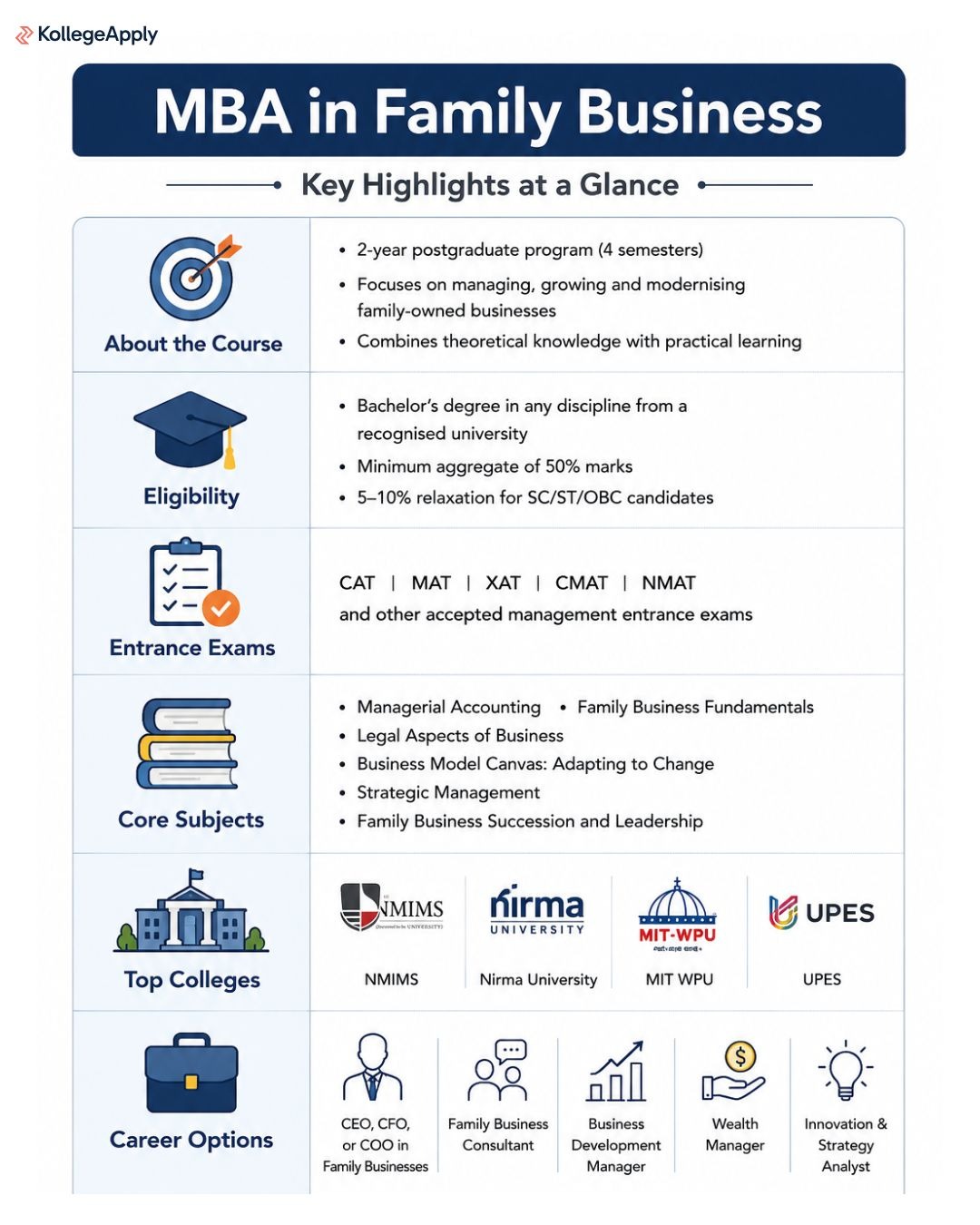
Table of Contents
- What is MBA in Family Business?
- Why Pursue MBA in Family Business?
- Is an MBA in Family Business Worth It?
- What is the Eligibility for MBA in Family Business?
- MBA in Family Business Entrance Exams
- What are the top MBA in Family Business Colleges in India?
- How Does the MBA in Family Business Admission Process Work?
- What is the Syllabus of MBA in Family Business?
- What are the Career Opportunities After MBA in Family Business?
What is MBA in Family Business?
An MBA in Family Business is a two-year postgraduate program designed to equip students with the managerial and entrepreneurial skills required to successfully manage, expand, and transform family-owned businesses. The program is divided into four equal semesters and combines theoretical knowledge with practical learning to develop a strong understanding of business operations, leadership, finance, marketing, and strategic decision-making.
The course focuses on developing entrepreneurial competencies such as problem-solving, goal setting, planning, innovation, and calculated risk-taking while preparing students to tackle real-world business challenges. Through classroom learning, industry exposure, internships, live projects, and case studies, students gain the expertise to sustain business growth, diversify operations, and build successful family enterprises or entrepreneurial ventures in today's competitive business environment.
Why Pursue MBA in Family Business?
Pursuing an MBA entrepreneurship and family business management program is an ideal choice for students who wish to strengthen their entrepreneurial capabilities while gaining the expertise to manage and grow family-owned enterprises. The program blends management principles with practical business knowledge, enabling students to address real-world challenges, adopt innovative strategies, and ensure the long-term sustainability of family businesses. Here are some of the key reasons to pursue family business MBA programs:
- Develop the leadership, decision-making, and entrepreneurial skills required to successfully manage and expand a family-owned business.
- Gain in-depth knowledge of succession planning, family governance, conflict resolution, and business continuity to ensure sustainable growth.
- Learn to identify new business opportunities, diversify existing ventures, and implement digital transformation strategies in traditional family enterprises.
- Acquire practical exposure through case studies, live projects, internships, and interactions with industry experts, helping bridge the gap between theory and practice.
- Explore diverse career opportunities after completing a family MBA, including leadership roles in family businesses, entrepreneurship, business consulting, wealth management, advisory services, and strategic management.
Is an MBA in Family Business Worth It?
Students must adhere to the fact that family-owned businesses contribute nearly 79% of India's GDP, and their role in driving economic growth, employment, and innovation continues to expand. As businesses become increasingly competitive and technology-driven, there is a growing demand for professionals who can successfully manage, modernize, and expand family enterprises. This makes MBA entrepreneurship and family business management an excellent choice for students who wish to build leadership skills while preserving and strengthening their family business for future generations.
Apart from preparing students to lead family-owned enterprises, family business MBA programs also open up career opportunities in business consulting, wealth management, advisory services, strategic planning, entrepreneurship, and family offices. A family MBA equips graduates with practical knowledge of governance, succession planning, digital transformation, and business strategy, enabling them to tackle real-world challenges while ensuring sustainable business growth. With the increasing contribution of family businesses to the Indian economy, the degree offers strong long-term career prospects and significant professional value.
What is the Eligibility for MBA in Family Business?
It is important for students to meet the eligibility criteria for the MBA in Family Business program to secure admission to their desired colleges. Every college has its own set of eligibility requirements that candidates must fulfil. These criteria act as an assessment tool to determine a student's suitability for admission into the program. Students interested in learning more about the MBA in Family Business eligibility criteria can refer to the pointers given below:
MBA in Family Business Entrance Exams
Candidates are offered several entrance exam options for admission to colleges offering an MBA in Family Business. These entrance examinations are generally competitive in nature, as the best MBA in Family Business colleges have limited seats and receive a large number of applications each year. Entrance exams such as CAT, XAT, MAT, CMAT, and other accepted management entrance tests play an important role in the admission and selection process. Interested candidates can refer to the table below to learn more about the entrance exams accepted for MBA in Family Business:
What are the top MBA in Family Business Colleges in India?
Students have the option to choose from a wide range of public and private colleges in India offering an MBA in Family Business. These colleges focus on imparting industry-specific knowledge and management skills required to excel in the power and energy sector. The curriculum combines theoretical learning with practical exposure through internships, live projects, case studies, and industry interactions, preparing students for leadership roles in government organizations, PSUs, consulting firms, and private energy companies. Check out the table given below to learn more about some of the colleges offering the power management course:
How Does the MBA in Family Business Admission Process Work?
Students seeking admission to MBA in Family Business colleges should understand the complete admission process before applying. Generally, candidates are required to complete the online application, submit the necessary documents, pay the application fee, and participate in the institute's selection process. Applicants can refer to the admission process followed by Nirma University to better understand the MBA in Family Business admission process.
Step 1: Visit the official website of Nirma University (https://management.nirmauni.ac.in) and complete the online registration by filling in the MBA in Family Business application form with the required personal details. Candidates must also pay the prescribed application fee before the last date of submission.
Step 2: Fill in the academic details, upload the required documents, and submit the completed application form. Applicants should ensure that all information provided is accurate and fulfils the prescribed eligibility criteria.
Step 3: After the application process is completed, eligible candidates are shortlisted based on their performance in the accepted entrance examination, such as CAT or other applicable management entrance tests. The shortlisted candidates are then invited to participate in the Theme Development and Presentation (TDP) round and the Personal Interview.
Step 4: The final selection is based on a composite score that includes the entrance examination, TDP, personal interview, and past academic performance. Nirma University also provides additional weightage to candidates belonging to business families, as per its admission policy.
Step 5: Candidates who are selected receive the admission offer through their registered email ID. To confirm their admission, applicants must complete the admission formalities and pay the prescribed acceptance fee within the specified deadline to secure their seat in the MBA in Family Business program.
Documents Required
What is the Syllabus of MBA in Family Business?
The MBA in Family Business syllabus is divided into four equal semesters and focuses on providing students with both managerial and practical knowledge. Students begin the curriculum with foundational subjects such as managerial accounting, organizational behaviour, etc and then move towards advanced topics like Intellectual property right, family business succession and leadership, etc. Check out the table given below to learn more about the Jain University MBA in Family Business syllabus for a better understanding of the course:
What are the Career Opportunities After MBA in Family Business?
The main objective after completing the MBA in Family Business program is to secure placement opportunities offered by the university or explore suitable career opportunities independently. Graduates can pursue a wide range of job roles across family-owned enterprises, consulting firms, and corporate organizations, such as Business Development Manager, Family Office Manager, Succession Planning Consultant, Wealth Manager, and more. Check out the table given below to learn more about the career opportunities available after an MBA in Family Business:
MBA in Family Business vs MBA in Finance
There are various specialisations available under postgraduate management programs. Students should choose the specialisation that best aligns with their future goals and career aspirations. Interested candidates can opt for courses such as MBA in Marketing, MBA in Human Resource Management, MBA in Finance, and many others. To make an informed decision, students are advised to compare different MBA specialisations based on their interests, curriculum, and career opportunities:
MBA in Family Business FAQs
What are the benefits of pursuing an MBA in Family Business?
An MBA in Family Business helps students develop leadership, entrepreneurial, and strategic management skills to successfully manage family-owned enterprises.
What skills are developed through MBA entrepreneurship and family business management?
MBA entrepreneurship and family business management develops skills in leadership, succession planning, governance, innovation, and business strategy.
Which entrance exams are accepted for family business MBA programs?
Family business MBA programs generally accept CAT, XAT, MAT, CMAT, NMAT, and other recognised management entrance examinations.
What are the top MBA in Family Business colleges in India?
Top MBA in Family Business colleges include NMIMS, Nirma University, UPES, MIT WPU, and Bennett University.
What is the admission process for an MBA in Family Business?
The MBA in Family Business admission process includes registration, application submission, entrance exam, interview, and document verification.
What is the MBA in Family Business syllabus?
The MBA in Family Business syllabus includes entrepreneurship, governance, succession planning, finance, marketing, and business strategy.
Which industries recruit graduates from family business MBA programs?
Family business MBA programs prepare graduates for roles in family enterprises, consulting firms, startups, family offices, and corporate organisations.
Is a family MBA better than an MBA in Finance?
A family MBA is ideal for managing family-owned businesses, while an MBA in Finance focuses on banking, investments, and financial management.
What are the career opportunities after MBA entrepreneurship and family business management?
MBA entrepreneurship and family business management graduates can become entrepreneurs, consultants, wealth managers, or business development managers.
What is the average salary after an MBA in Family Business?
MBA in Family Business graduates can earn between ₹5 LPA and ₹25 LPA, depending on their role, skills, and experience.